
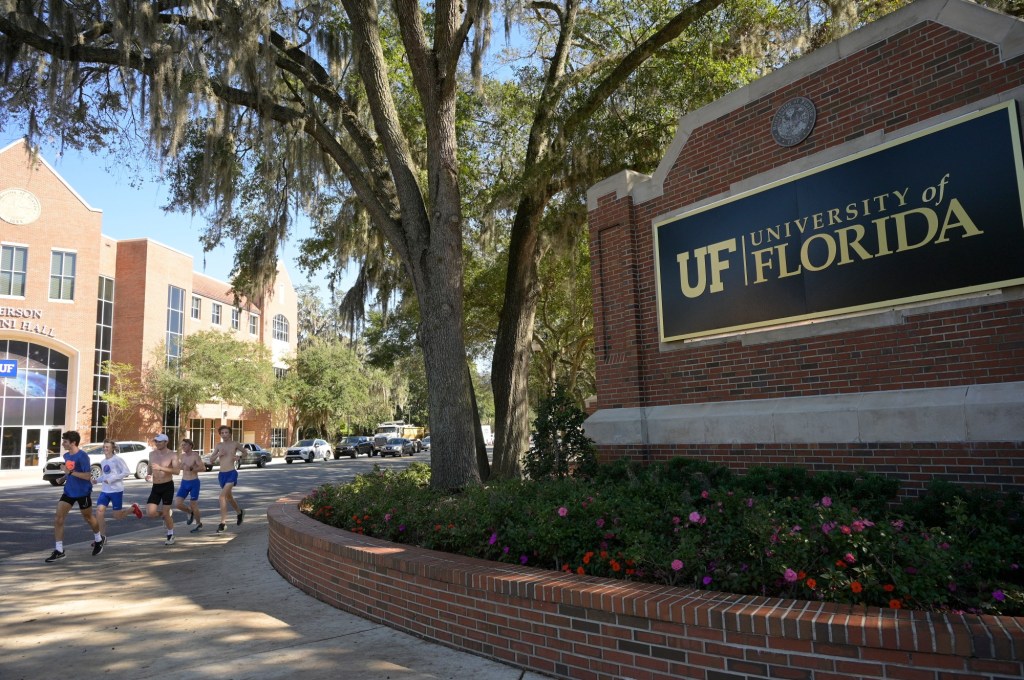
Florida could bar its public universities from hiring foreign faculty on H-1B visas for the next year, a move called potentially “devastating” to science departments at state schools.
Just months after Gov. Ron DeSantis said he wanted to “pull the plug” on the use of those visas at state colleges and universities, the Florida Board of Governors is slated to take steps Thursday to abide by his request.
The board, at its meeting in Tallahassee, is to vote on a proposed one-year ban on hiring faculty who would use the H-1B visa to work in the United States. If approved, the proposed new rule would be put out for two weeks of public comment and then the board could finalize at a later meeting.
The H-1B program allows companies and institutions to bring in educated foreign professionals with at least bachelor’s degrees for “specialty” occupations that are deemed hard to fill with U.S. workers. Almost 400 such employees work at Florida universities.
But DeSantis in October said foreign professors, including those from China, Argentina and Canada, were “cheap labor” and taking opportunities from qualified Floridians.
Kathryn Jones, a biological science professor at Florida State, disagreed, saying professors on H-1B visas often are needed for hard-to fill positions. Banning H-1B visa hires would be “devastating” for Florida university science departments and their students, she said.
“If you’re searching for someone who does cryo-electron microscopy, or if you’re searching for someone who looks at particular patterns and evolution, or someone who works on a specific kind of genomics — there’s often not someone from a domestic background who comes up in in that year as ready to go up for a job,” Jones said.
University staff on H-1B visas are largely in computer science, engineering, physics and chemistry departments, professors say, fields relatively few Americans pursue. In 2023, for example, about 60% of those who earned Ph.Ds in computer science from U.S. universities were temporary visa holders, not citizens or permanent residents, according to the National Center for Science and Engineering Statistics.
Florida’s universities are among the largest users of the H-1B visa program in the state, with University of Florida employing 150 staff on those visas, according to federal immigration data. Other universities aren’t far behind, with 72 at USF, 69 at Florida State University, 28 at the University of Central Florida and 13 at Florida Atlantic University.
Foreign faculty, who Jones called her “highly valued colleagues,” often were already in the U.S. on student visas and use the H-1B visa as a pathway to citizenship.
She said she doesn’t understand why Florida would want to turn away highly qualified faculty, no matter where they’re from.
“They’re citizens now, and they are absolute contributors. I would just hate to think that we wouldn’t have access to those sort of colleagues anymore,” she said.
The H-1B program involves more than 7,200 employees in Florida, mostly at private companies. It has recently divided supporters of President Donald Trump, with some like Elon Musk strongly favoring the program and others on the side of DeSantis.
In September, Trump announced an increase in fees for individual H-1B visas from $215 to $100,000. That fee is typically paid by employers. Trump also signed a proclamation saying there had been “systematic abuse” of the program.
Trump’s decision, expected to face a legal challenge, means employers have to pay the new $100,000 fee for H-1B petitions filed after Sept. 21, so it could sharply limit the program, but it does not impact visa holders already working in the United States.
The board of governor’s agenda item for Thursday did not explain why Florida was seeking a one-year ban.
This is a developing story. Check back for updates.