
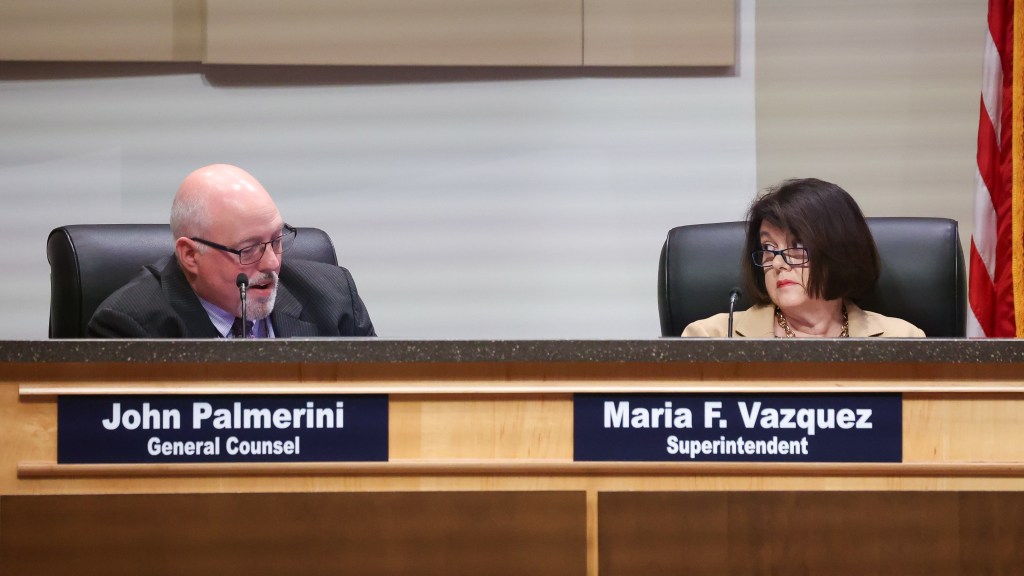
Orange County Public Schools. set to close seven schools this year, could lose another 5,000 students and then shutter even more campuses next year, Superintendent Maria Vazquez said Tuesday.
As the Orange County School Board considered new attendance plans for students at the seven under-enrolled schools closing this year, Vazquez said the same problems likely will bleed into the next school year.
“While I wish I could sit up here and say, ‘This is the last of our consolidations.’ I’m afraid that would be an untrue statement,” Vazquez said.
Orange County Public Schools lost about 5,600 students this year and has lost almost 9,000 students in the last three.
The district plans to close six elementary schools and a middle school at the end of this academic year because they now enroll only about half as many students as they were built to accommodate. The closures will impact about 3,200 students, who will be assigned to new schools, which because of declining enrollment also have empty classrooms.
Schools are funded on a per-student basis, so enrollment declines mean a loss of money. OCPS lost about $41 million in state funds this year, Vazquez said, and could lose $45 million next year.
Schools that are half-empty are particularly costly to run, officials said, as they are not self-supporting.
Vazquez did not provide any information on what schools might face closure in 2027. The district’s enrollment declines, however, have hit elementary schools the hardest.
The district largely blames enrollment losses on the increased use of state-funded vouchers for private and homeschool education, as well as declining birth rates and the nation’s immigration crackdown. The district estimates its count of Venezuelan students fell about 1,200 this year, for example.
Across Florida, other districts face similar enrollment declines. A new state report said enrollment is down statewide by more than 46,000 students. “The most likely explanation is related to the chilling effects from recently implemented immigration policies,” said the Office of Economic & Demographic Research.
After Vazquez’s comments, school board member Angie Gallo, who is also president of the Florida School Boards Association, said she was “angry” about the position the state Legislature has put the district in.
The state has prioritized alternative education options, such as private, charter and home schooling, over appropriately funding traditional public school districts — driving the enrollment losses, Gallo said.
Florida expanded its voucher program in 2023, wiping out family income requirements, and more than 500,000 students now use state scholarships to attend private school or pay for homeschooling resources.
“I’m getting very fed up with the legislators that have to put down public schools to bring every other entity up. We are not failing public schools. We are not failing children,” she said.
Board member Stephanie Vanos said she wanted to see the district “do a more proactive job in speaking with our community” about declining enrollment. Parents who emailed her and those who spoke at meetings about the seven planned closures said they felt blindsided by the news.
The district, she added, needs to be “educating earlier” so parents know sooner if their child’s school faces closure.
OCPS is the eighth-largest school district in the United States and now enrolls about about 180,000 students in traditional public schools.