
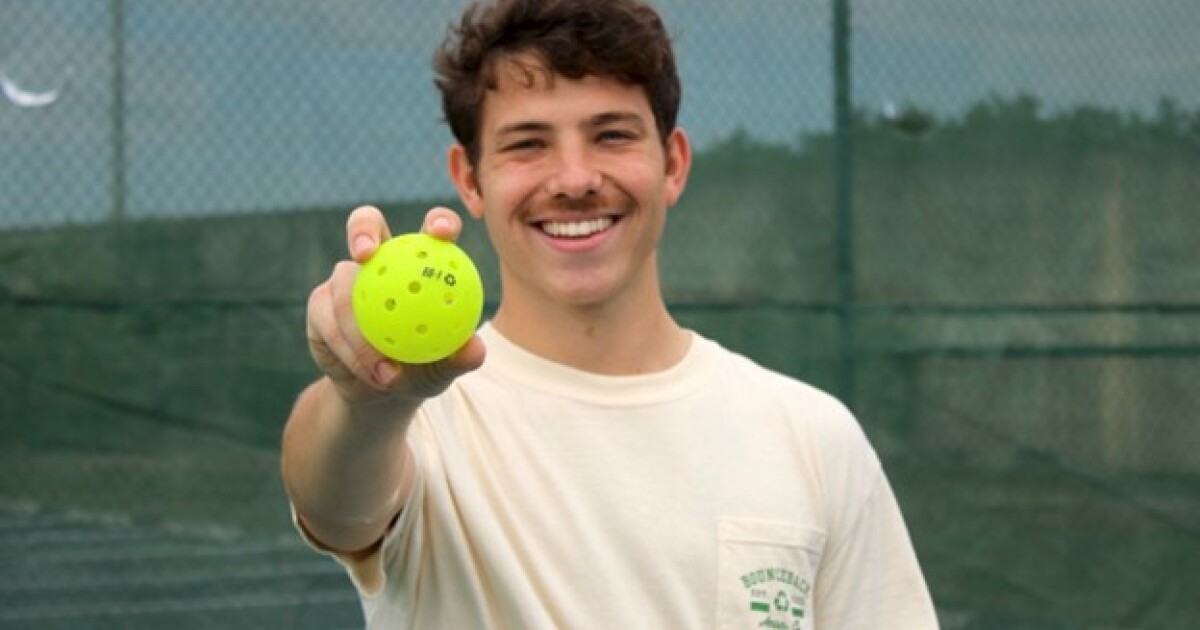
As the bright yellow plastic pickleball is hit back and forth, cracks begin to grow and tear the ball apart rendering the ball’s full potential to only a few games. The broken pickleball eventually finds its way into the trash.
A look into Pickleball courts’ trash cans around the U.S. finds them filling with broken balls at a rapid pace.
One young entrepreneur, Dillon Rosenthal, 22, has come to a solution for the ignored plastic waste issue. Rosenthal’s newly started business, BounceBack Pickle, is a recyclable pickleball company that is designing the first fully recycled pickleball.
BounceBack Pickle has a mission to utilize the cast-off balls that have been increasing with the sport’s popularity and make a dent in the world’s plastic waste that goes into landfills.
“Not everyone saw the problem, but there was a problem,” said Rosenthal. “It’s not like anyone was doing anything other than throwing them [pickleballs] away, so why not throw them away in our recycling bin?”
Rosenthal’s idea formed last January when he and his roommate started playing pickleball every morning. Due to the cooler weather, Rosenthal and his roommate were cracking pickleballs at a frequent rate. Tossing every cracked ball in the trash, Rosenthal knew that there was a potential solution to the number of balls that were thrown in the trash.
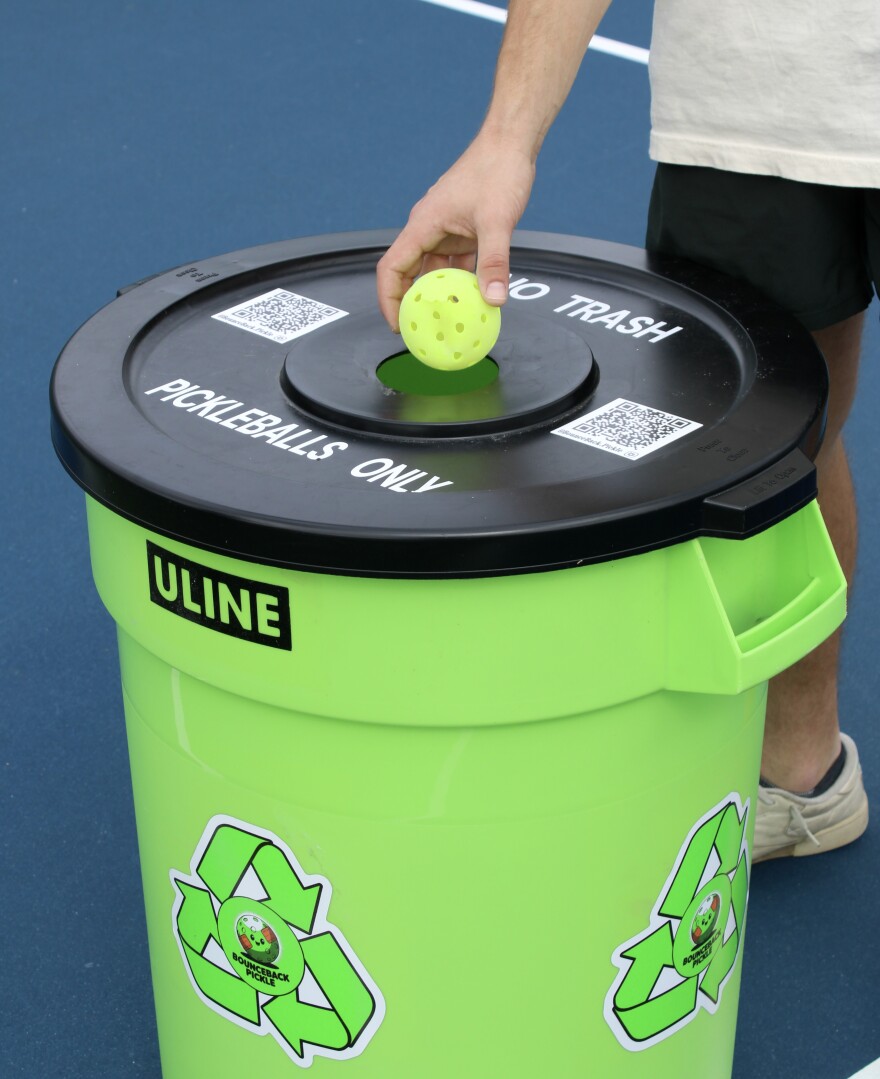
The bright green BounceBack Pickle recycling containers have started appearing at numerous facilities in Florida and in several other states.
Rosenthal went home that day and started to do research into recycling pickleballs.
Pickleballs only last 30-40 games regularly and 2-4 games at a professional level. A ball’s life expectancy depends on the intensity of a game, the weather and the quality of the ball.
Rosenthal said he discovered that 770,000 pounds of plastic from pickleballs end up in landfills every year. Rosenthal said he estimates now that the plastic waste has increased to over 800,000 pounds a year.
The solution was to launch a recycling business, gather broken pickleballs from courts and transform the cracked balls into new 100% fully recycled pickleballs.
The first step to the solution was to make recycling bins for pickleballs only and place them at courts around the Fort Myers area.
The first bin Rosenthal made was a black cardboard box with a small circular hole on the lid. The side of the bin had a sticker of the BounceBack Pickle logo.
Rosenthal launched his first bin in Three Oaks Park in Fort Myers in March 2025. The bin only lasted three days due to sunlight exposure that wore out the cardboard.
“So, it’s a startup, right? So, we try things. We learn. We fail. We learn. We try again,” said Rosenthal.
The bins were the biggest investment Rosenthal made for his business. To raise money, Rosenthal did a variety of pitch competitions and fundraising to gain funding and support for BounceBack Pickle.
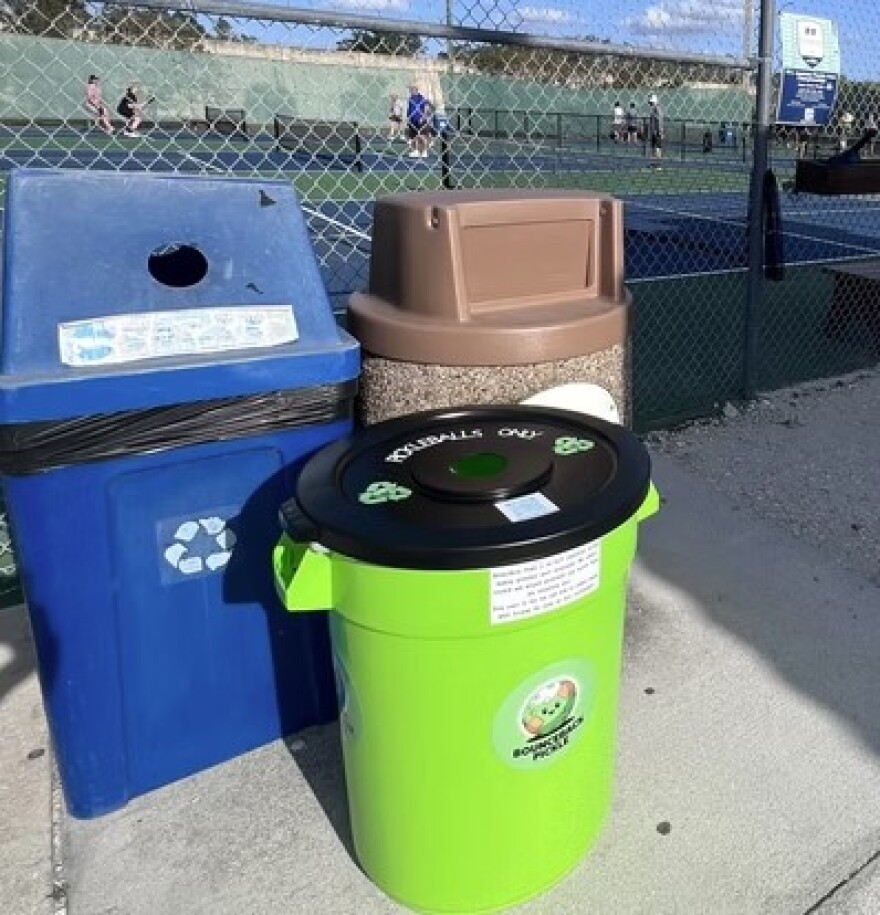
The bright green BounceBack Pickle recycling containers have started appearing at numerous facilities in Florida and in several other states.
With funding, Rosenthal invested in bright green plastic trash cans to place at pickleball courts. The bins have the BounceBack Pickle logo displayed on the can. The black lid of the can has a circular pickleball-sized hole cut in the center with signage around the hole that said, “Pickleballs only. No trash.”
Once the first bin was placed, Rosenthal contacted other local pickleball facilities to install bins for free. The number of bins began growing in the Fort Myers area as facilities started reaching out to Rosenthal to receive them.
Thomas de Faria, a professional pickleball player and instructor at Marco Island YMCA, heard about BounceBack Pickle at a tournament. De Faria was one of the first to call Rosenthal to get a bin placed at the YMCA.
“I think it’s actually pretty necessary just because it’s a lot of plastic that we’re using,” De Faria said. “So, being able to, you know, reuse as much of that [plastic] as we can is pretty important.”
BounceBack Pickle has bins located in 35 facilities in Fort Myers and 10 facilities in Tampa, with additional locations across Florida. The company has also expanded to 10 facilities in Los Angeles, four in San Francisco and one in Long Island, N.Y.
Rosenthal has connected with at least one facility in every state due to his social media marketing on Instagram and TikTok. Showing off the process of operations and mission, BounceBack Pickle has gained a following in the pickleball community.
Making connections with every state, Rosenthal decided that before moving nationwide, BounceBack Pickle had to formulate a plan of operations. Rosenthal said he will figure out a plan by the end of the month.
With the bins appearing at different facilities, more balls are being recycled. Volunteers are sent out to different facilities to collect the broken balls.
BounceBack Pickle is partnered with the RePickle Project, a nonprofit dedicated to keep pickleballs out of landfills, who send their own volunteers to collect balls. Students at Florida Gulf Coast University also offer helping hands to the nonprofit’s mission in return for service learning hours.
The pickleballs that are collected are sent to a local plastic manufacturer in Fort Myers, which grinds up the plastic into a colorful mix of powder. This powder is then sent to a manufacturer in China that molds the dust into a new pickleball.
The estimated total manufacturing cost for the first prototype test run is $3,000.
The first batch of pulverized balls was sent to China in November 2025. Rosenthal received the prototype of the world’s first recycled pickleballs earlier this month.
Rosenthal said he has sent prototypes of the product to facilities in seven states. He said the recycled pickleballs are being tested now on some courts in those states.
The balls are currently being tested around courts in Fort Myers and will be tested this weekend in the Tampa Bay area. The balls will be up for sale before summer.
Rachel McEneaney, a pickleball player at Three Oaks Park, recently learned about BounceBack Pickle’s goal to recycle pickleballs.
“I think that’s a good idea,” said McEneaney. “I’m just curious how the pickleball works.”
Rosenthal said the prototype balls that came back are incredible and are comparable to Franklin’s pickleballs, which are known as the most popular pickleball brand for professional pickleball players.
Each ball is visionally unique with a variety of different color speckles. The balls have a recycling logo stamped on with the words, “BB-1,” referencing BounceBack prototype one.
The recycled balls are able to be purchased through BounceBack Pickle’s website, bouncebackpickle.com. The company is currently generating a waitlist through social media platforms and its website to purchase the balls.
Part of the first batch of prototypes is being distributed to facilities that contain a BounceBack Pickle bin in hopes of attracting customers who will try out the balls at the facilities where they play.
Rosenthal said he estimates around $300,000 in revenue in year one if he can collect, recycle and sell all the pickleballs saved from landfills.
BounceBack Pickle plans to give part of the profit back to its partner, RePickle Project. Rosenthal said he also hopes to donate a portion of the profit to inner city schools and youth programs to fund a pickleball program for children. Through donations of balls, paddles and nets the idea is to give youths a good time playing a sport they may not be able to afford.
BounceBack Pickle continues to focus on environmental sustainability and making an impact on the growing pickleball community.
“Probably hundreds of millions, if not billions, of plastic waste that goes into landfills,” said Rosenthal. “But if we can just, like, make a dent in it.”
WGCU is your trusted source for news and information in Southwest Florida. We are a nonprofit public service, and your support is more critical than ever. Keep public media strong and donate now. Thank you.