
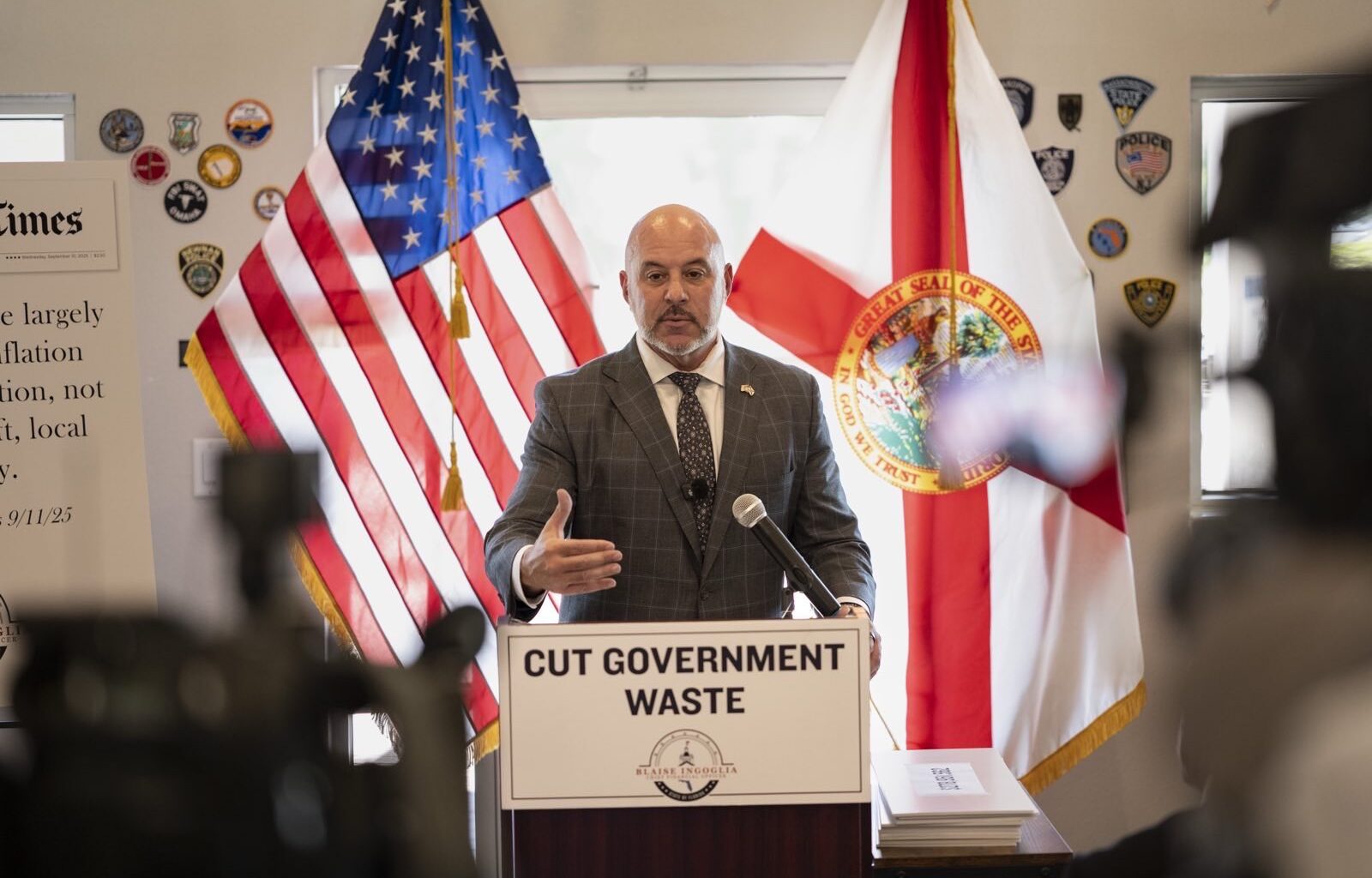
Chief Financial Officer Blaise Ingoglia criticized St. Petersburg for overtaxing residents by $49.4 million, making the city the latest among 13 local governments spotlighted by his Florida Agency for Fiscal Oversight initiative as part of a statewide push to cut property taxes.
Ingoglia’s press conference cast St. Petersburg as a prime example of what he described as runaway local government spending, a narrative he and other lawmakers are using to build support for placing a property tax reduction measure on the 2026 ballot.
“It is my hope that the Legislature comes up with something big, bold and aggressive that we can put on the ballot and fix the property tax system here in the State of Florida for decades to come,” Ingoglia said.
Mayor Ken Welch, speaking at a State of the Bay forum the night before Ingoglia’s appearance, preemptively rejected that framing. Welch said the state’s analysis was not a true audit, but an exercise designed to justify a predetermined political outcome — arguing Tallahassee is scapegoating cities in ways that threaten public safety and infrastructure.
“Every few years, the Legislature decides to scapegoat local governments as being bloated when we know there’s a lot of waste and fraud in Tallahassee,” Welch told members of the Suncoast Tiger Bay Club on Tuesday.

Ingoglia forcefully defended his office’s methodology Wednesday, stressing that the review is not partisan and that he is holding governments led by either party accountable for what he identified as excessive spending. He said the figure is not cumulative, but reflects one year of spending that exceeded inflation- and population-adjusted benchmarks.
“The amount of excessive and wasteful spending that we have found across those 13 governments is $1.97 billion,” he said. “This is money that government should have never had in the first place, and should have never spent in the second place.”
Ingoglia said St. Petersburg’s general fund budget grew by nearly $133 million over six years — an increase of roughly 48% — despite population growth of about 11,500 residents during that period. Using that comparison, his Office concluded the city overspent by $49.4 million.
“That means that for every person that moved into the City of St. Pete over the last six years, the budget went up by $11,557,” Ingoglia said. “For every family of four that moved into the city of St. Pete, the budget went up $46,228. Think about that.”
Ingoglia also focused heavily on staffing, saying St. Petersburg added 371 employees over the period examined, but that only 65 were first responders.

“For every 38 people that moved into the city, they hired one bureaucrat,” Ingoglia said.
Ingoglia argued the city could have reduced its millage rate by 1.34 mills without cutting services during that time frame. For a home assessed at $400,000, he said that would have amounted to roughly $535 in annual savings on the city’s general fund portion of the tax bill. For homes assessed at $500,000 and $600,000, the estimated savings would have been about $669 and $802, respectively.
“We believe the city of St. Pete overtaxed you guys by the tune of 1.34 mills. This is money that they could have easily cut, in our estimation, your millage rate by and offered property tax relief last year” Ingoglia said. “They just chose not to.”
Ingoglia directly addressed arguments raised by Welch and other local officials statewide that property taxes overwhelmingly fund police and fire services. He called that claim misleading, arguing that local governments can also rely on sales taxes and other revenue streams to support law enforcement.
“It’s a trick that local governments say,” Ingoglia said. “What they do is take the amount of ad valorem and they take the law enforcement budget and they go, ‘Oh, 97% of our ad valorem taxes go to law enforcement,’ like there’s no other part of the budget funding. It’s just that?”
Ingoglia also pushed back on concerns that cutting property taxes would undermine infrastructure investment, including stormwater and wastewater projects. He said St. Petersburg “absolutely needs” new infrastructure, but argued the city already had sufficient resources to make those investments.
He suggested that redirecting even a portion of the $49.4 million that his Office identified as wasteful spending could have funded infrastructure improvements without additional taxes or fees.
“I would also say they had more than enough money to do it and they should have been doing it over the last 10 years because they had the money,” Ingoglia said.
Ingoglia said local governments expanded budgets rapidly after COVID, fueled by federal aid and rising property values, and then locked in higher spending levels by adding permanent positions and programs. He framed property tax relief as a form of housing affordability, saying lower tax bills would help residents remain in their homes as assessments rise.
“This is my point, they had more than enough money,” Ingoglia said.
“They’re just choosing to spend it unwisely. Spend it wisely. You saw a pot of money come into the city of St. Petersburg, and what did they do? They hired more personnel. No, what they should have done was take the money and fix the infrastructure so they didn’t have to go back to the taxpayers and tax them again. Sorry, I get passionate about this because it’s so frustrating.”
Welch, along with Tampa Mayor Jane Castor and Clearwater Mayor Bruce Rector, disputed that logic during the State of the Bay. They argued the primary affordability pressure facing homeowners is insurance, not property taxes.
With St. Petersburg now squarely in Ingoglia’s spotlight, the city has been put on notice about the potential impact if Florida overhauls its property tax system during the 2026 election.