
ST. PETERSBURG, Fla. — Pole Star Defense, based out of the Maritime Defense and Technology Hub in St. Petersburg, uses innovative technology to track large cargo ships and oil tankers around the globe, including vessels trying to avoid detection, according to managing director Alex Field.
“Primarily we track large commercial vessels across the world,” he said. “We currently support the U.S. Coast Guard.”
What You Need To Know
Pole Star Defense is based out of the Maritime Defense and Technology Hub in St. Petersburg
The company uses innovative technology to track large cargo ships and oil tankers around the globe, including vessels trying to avoid detection
Pole Star Defense has been monitoring a new problem called bridge carriers, which are ship-to-ship transfers in the middle of the ocean
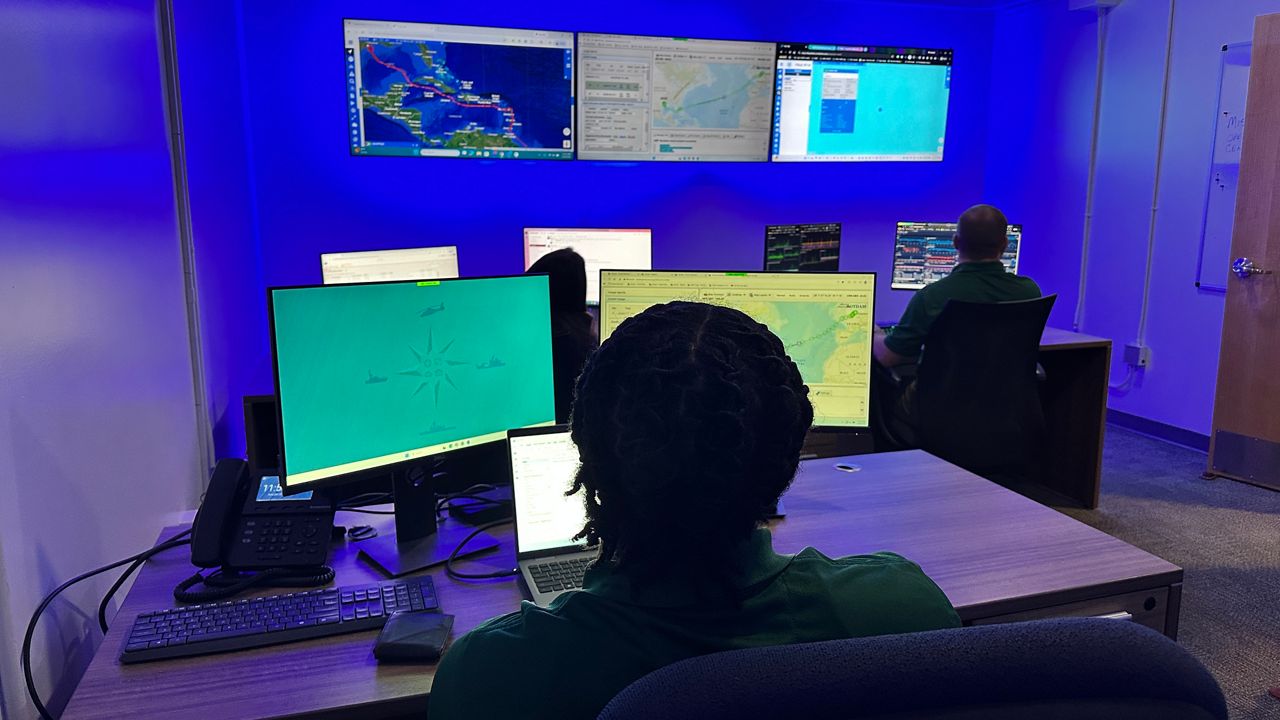
Spectrum News was the first media organization allowed to bring cameras into Pole Star Defense’s mission operation center, which is manned 24-7
The International Maritime Organization passed regulation after 9/11 mandating commercial vessels share their location with their flag states and other countries as the ships enter those waters. Pole Star Defense is part of that large global data sharing operation.
“The vessels will send their vessel position and other vessel data up to the satellite,” said Field. “That satellite will then send it to us as an ASP (Application Service Provider) and then ultimately we send it to what’s called a national data center for that flag registry.”
Some vessels, which include sanctioned oil tankers, take great lengths to spoof or hide their location. Field said a new problem the defense maritime company has been monitoring are what’s called bridge carriers.
“What you ultimately see is one vessel coming from a sanctioned port, doing a ship-to-ship transfer in the middle of the ocean to another one,” he said. “Then that vessel will also take it to another vessel that then can go off to another port and they’ve blended product to that point. All these are bulk carriers and so now what’s Iranian oil versus what’s Venezuelan oil?”
Senior Solutions Engineer Richard Aguilar said he has been investigating an oil tanker which caught his attention on Jan. 9, when it stopped off the coast of Guyana, near Venezuela, and conducted a ship-to-ship transfer with two other ships. Aguilar said an STS is common with two vessels but three raises suspicion.
“When you start seeing more than two, then it becomes why?” he said. “Especially in different areas where it’s known to have sanctioned or illicit activity occurring.”
Field said Pole Star Defense played an adjacent role to the U.S. blockade of sanctioned Venezuelan oil tankers, referred to as the dark fleet, which began last December.
“We’re helping gather information around what’s going on. Much of those vessels go dark,” he said. ”Tracking all the vessels that we could coming out of Venezuela, coming into Venezuela and where they were going. As each of those vessels, I think it’s up to seven now, have been seized by U.S. Coast Guard.”
Field said the U.S. Coast Guard is their primary customer and the reason the company chose to locate its U.S. headquarters in St. Petersburg. The company also supports 65 other countries. Pole Star Defense is a subsidiary of Pole Star Global, a company based in the U.K., with about 20 years of experience in the maritime business.
Pole Star Defense is one of the first companies which moved into the Hub when it opened nearly 5 years ago. Field said the company began with three employees and currently has nearly 50 and expects to be in St. Petersburg for the long haul.
“The area is great. The ecosystem in St. Pete, lots of other small businesses focused on maritime space,” he said. “We’ve got the Coast Guard right next door here, which is our primary customer.”
Spectrum News was the first media organization allowed to bring cameras into Pole Star Defense’s mission operation center, which is manned 24-7.