
Story and photos by Joey Garcia, University Communications and Marketing
What if the answer to combating red tide isn’t a complex mechanical system, but a
fine, crystalline powder? That’s the goal behind a new material developed by USF researchers
Ioannis Spanopoulos and George Philippidis and their doctoral students.
Representing expertise in chemistry, biology and global sustainability, this interdisciplinary
team has developed a fine, crystalline material designed to remain solid in seawater.
When activated by sunlight, the material diminishes the growth of Karenia brevis,
the scientific term for red tide, offering a potential new approach to combat the
algae and its impacts on human health and marine life.
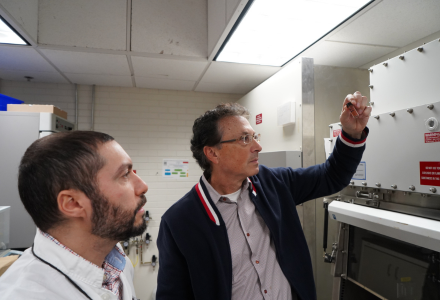
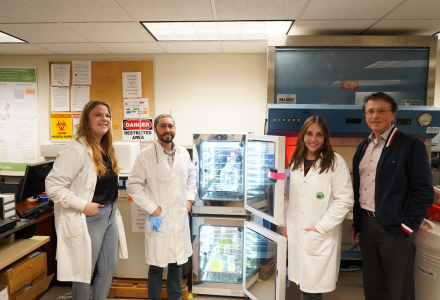
USF researchers Ioannis Spanopoulos and George Philippidis collaborated on the study,
combining their expertise in chemistry and global sustainability.
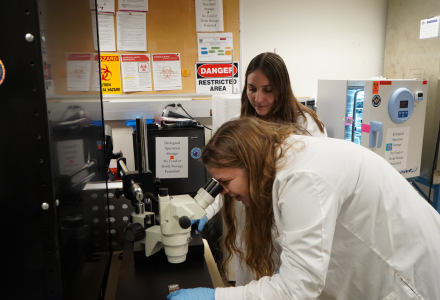
USF doctoral candidates Alissa Anderson and Paulina Slick teamed up in the lab, pushing
the research forward under their mentors’ guidance.
“We’re addressing pressing environmental issues by developing next-generation materials
for energy, medical and environmental applications. What makes this technology so
compelling is that we developed a family of materials that are biocompatible and can
work continuously, something that hasn’t been done before.”
USF Assistant Professor Ioannis Spanopoulos
GULF COAST MAKES PERFECT TARGET FOR RED TIDE
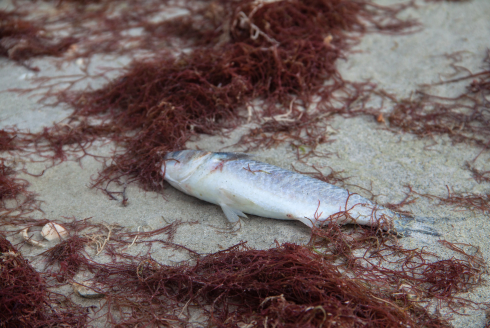
Red tide can have wide-ranging consequences, from killing marine life to releasing
airborne toxins that cause respiratory and eye irritation in humans. Hurricanes can
intensify these impacts by stirring nutrients from deeper waters, allowing blooms
to persist or worsen.
“I grew up in Florida watching these red tide blooms and noticed the impact they have
through fish kills, beach closures and major losses to tourism,” said Alissa Anderson,
a doctoral chemistry student and a member of the Spanopoulos Lab. “It really hurts
the Florida economy when blooms are as bad as what we’ve seen after recent storms.”
CREATING AN ENVIRONMENTALLY SAFE MATERIAL
Current strategies for managing red tide rely on a mix of chemical treatments, the
use of living organisms to limit blooms and physical removal. However, these approaches
can be difficult to control once introduced into large-scale environments and are
costly.
“Our goal was to create a material that could work effectively in seawater without
breaking down or causing unintended environmental impacts,” Spanopoulos said.
To do so, the researchers developed a material made from microscopic, sponge-like
crystalline structures with a porous framework, building on their previously published
findings. The material contains bismuth, a naturally occurring metal known for its
biocompatibility and antibacterial properties. Iodide incorporated into the material’s
crystal particles enables it to become light-activated when exposed to sunlight.
The result is a product activated by natural light that can generate a chemical compound
capable of attacking and breaking down red tide cells.
“We are very excited about this technology because of its sustainable nature,” Philippidis
said. “The material functions using ambient sunlight, meaning it doesn’t require added
energy or ongoing chemical inputs once it’s in place. In addition, the material is
not consumed and does not dissolve in water, so it can be recovered and reused”
“It’s important to tackle current issues within our ecosystems while providing solutions
that don’t harm surrounding organisms,” added Paulina Slick, an integrative biology
doctoral student and member of the Philippidis Lab. “Being able to address Karenia
brevis without disrupting marine life that shares the same environment is very important.”
The research is supported by the National Oceanic and Atmospheric Administration through
the U.S. Harmful Algal Bloom Control Technologies Incubator program, which advances
scalable, environmentally responsible solutions to harmful algal blooms.
FROM LAB TO REAL-WORLD IMPACT
Based on their findings, both labs are now focused on testing the material under controlled
laboratory conditions at USF, with larger experimental water systems, such as tanks,
representing a possible next step. Further research will examine how the material
can be deployed cost-effectively and potentially managed and recovered as part of
future efforts.
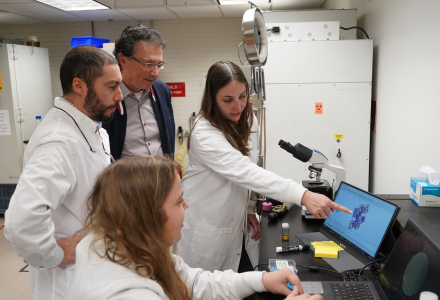
The teams examine the molecular makeup of the new material.
With their new findings, both labs are set to begin larger-scale testing.
“Not only did we develop something new, but the team is proud to have found a tangible
solution to a very important ecological problem,” Spanopoulos said. “Now, through
careful optimization, we are scaling the technology responsibly while maintaining
selectivity and environmental safety.”
For the team, success would mean demonstrating the material is consistently effective.
That data would support larger-scale testing and inform potential future deployment
by environmental agencies and partners responsible for managing harmful algal blooms
in the Gulf.