
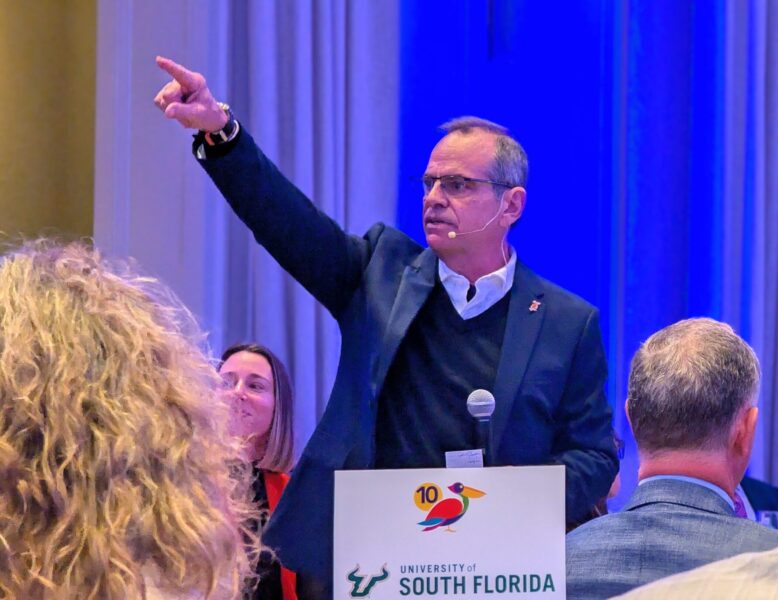
A sold-out crowd of approximately 400 people heard how St. Petersburg can turn its momentum into a sustainable movement Tuesday afternoon.
That was the keynote topic at the St. Petersburg Area Chamber of Commerce’s 127th Annual Meeting, held at the Vinoy Resort & Golf Club. The organization’s cornerstone event provided an opportunity for stakeholders to reflect on the strength, optimism and trajectory of the city’s business community.
Brian Glazer, owner of the Vinoy and co-chairman of the Tampa Bay Buccaneers, said St. Petersburg continues attracting “entrepreneurs, families, creators and builders” because it is “growing thoughtfully, not randomly.” The challenge is maintaining and building upon that success.
“We believe the future of St. Pete is incredibly bright, not because of any single project, but because of the collective vision, leadership and pride that define the city,” Glazer said. “The Vinoy is just one piece of a bigger story – a story of growth, culture, business and community coming together, in a powerful way.”
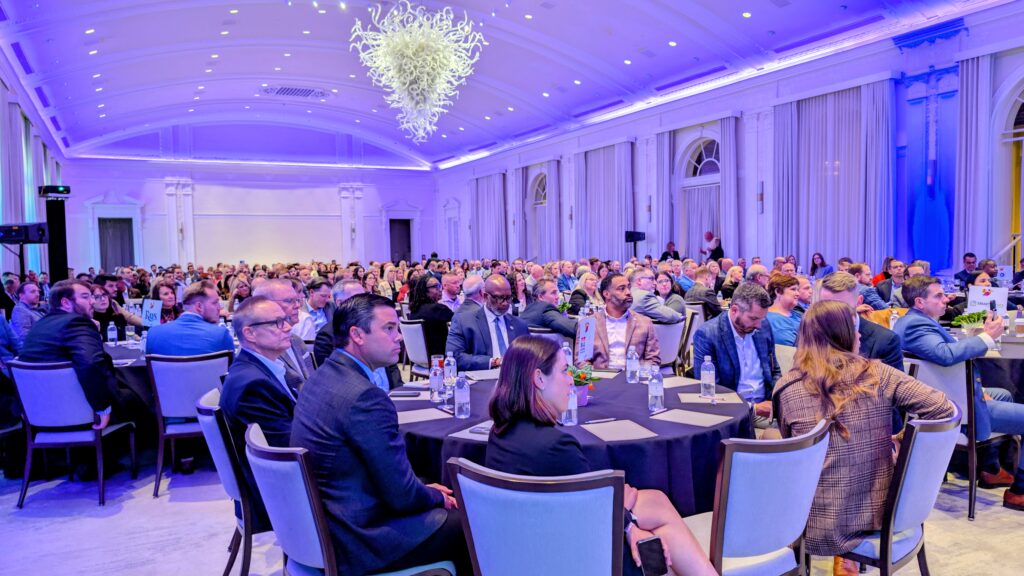
A sold-out crowd filled the Grand Ballroom at the Vinoy Resort & Golf Club.
Mayor Ken Welch continued the theme. He said there are “few other rooms where you can feel the energy and momentum of our city as clearly as you can in this one.”
Welch noted that Christ Steionocher, CEO of the chamber, exudes that energy and passion for St. Petersburg’s community, regardless of recent challenges. The city has a rich history of collaboration between the public and private sectors, he said.
Dr. Robin Roark, senior partner at McKinsey & Company and the event’s keynote speaker, then drove the point home. He provided a data-driven look at the momentum building across St. Petersburg and highlighted hurdles that could prevent it from becoming a movement.
McKinsey & Company, the world’s largest and oldest of the “Big Three” management consulting firms, embodies the city’s trajectory. Roark said the St. Petersburg office opened 15 years ago with 20 people; it now has over 1,400.
He used Nashville and Phoenix as case studies. The former city grew exponentially over the past 20 years due to anchor institutions and a favorable business environment, Roark said.
Job creation rates surpass population gains, helping Nashville sustain its upward trajectory. Roark credited Phoenix’s growth spurt over the same period to real estate speculation rather than anchor institutions.
He said population increases outpaced the number of new jobs in the latter city, and momentum stalled. “More importantly … you saw that Phoenix was less resilient, in terms of its growth, during periods of stress.”
Roark added that “the question then becomes, what is a strong economy, and what defines a city?” After analyzing roughly 600 metropolitan areas, he found that “seven things matter.”
Those include a “dynamic industry mix,” innovation engines, a “broad, deep and self-sustaining talent base,” significant density, well-delivered public services, a top-ranked quality of life and a global impact, Roark said.
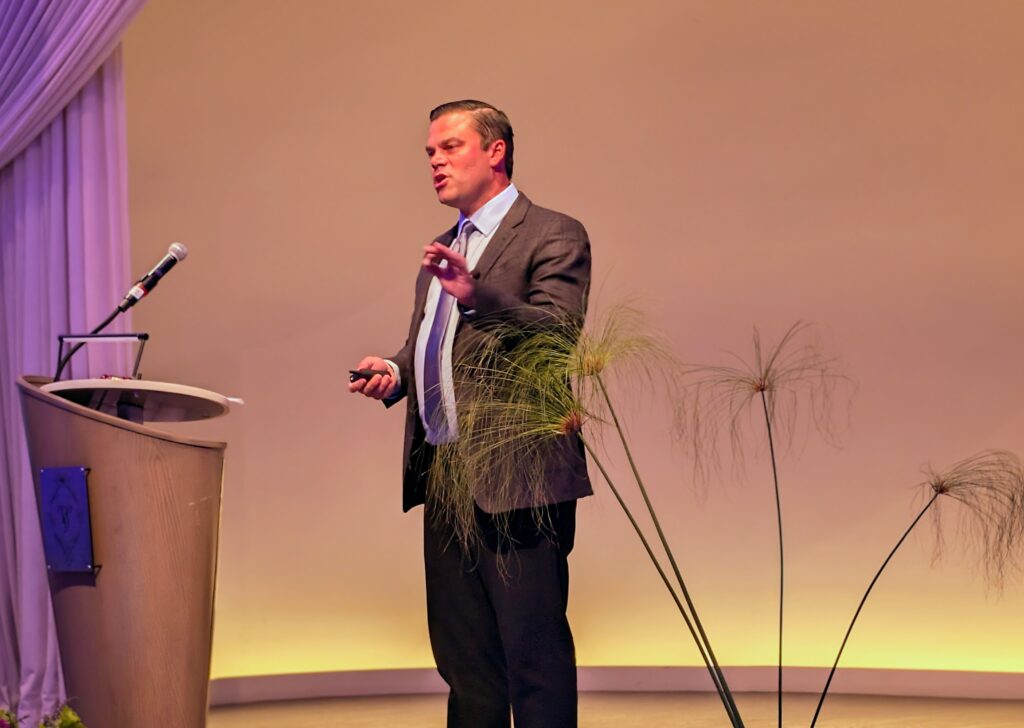
Dr. Robin Roark, senior partner at McKinsey & Company, was the event’s keynote speaker.
He believes St. Petersburg checks most of those boxes. Roark credited the area’s economic and population growth, density, an “opportunity” for job and talent growth, a “rapidly maturing” academic system and a focus on innovation.
“So, the point here is St. Petersburg, today, is starting from an immense place of strength,” he said. “That plays out in the numbers.”
However, hurdles to sustaining a movement remain. Many local incomes do not align with soaring housing costs.
Roark provided three ideas for creating “an even stronger future.” The first was to foster a homegrown talent pipeline that aligns with target industries rather than relying on transplants.
“The second is we have a very dynamic sector mix, but I would argue that we have a lot of fragmentation,” Roark continued. “We don’t have the scale of industry and businesses that you see in other cities.”
He advocated for “disruptive collaboration,” where organizations partner “in a way that is non-competitive, but that builds strength.” That includes sharing capabilities, insight and talent pools.
Roark concluded by stressing the importance of leveraging artificial intelligence (AI). He said St. Petersburg is well-positioned to capitalize on “roughly $1 trillion of value that is on the table for AI innovation across the U.S. economy.”
“The question for history then becomes, do you want to be a taker of technology and change, or do you want to be either a maker or a shaper of technology and change?”
Roark also advocated for a local version of North Carolina’s Research Triangle, additional startup support and a business ecosystem that fosters sustainability, innovation and talent. “St. Petersburg is prime,” he said.
“At the end of the day, it’s the leaders in this room that will define what the growth looks like and what the economy is in the future,” Roark concluded. “I’m incredibly excited by this moment. I think we will turn this moment into a movement.”
Other chamber news:
Patrick Causey, an attorney with Trenam Law, was named the 2025 Member of the Year for his leadership, advocacy, engagement and commitment to the community.
Matt Lettelleir, local government and public policy manager, will oversee the annual Thinking Outside the ‘Burg benchmarking trip to New Orleans.
Outgoing board chair Owen LaFave, Pinellas County market president for The Bank of Tampa, passed the gavel to Roy Binger, founder of Binger Financial Services.