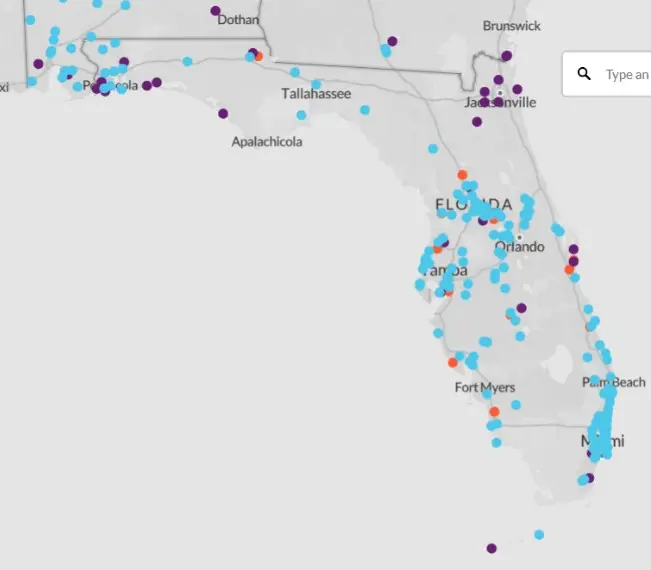
PFAS in Florida. Via EWG.
TALLAHASSEE, FL – State lawmakers are weighing a ban on a highly effective but toxic foam widely used to suppress flammable-liquid fires that is leaking into water supplies and sickening people, with firefighters at the forefront of the worldwide battle with “forever chemicals.”
Due to public health and environmental concerns, the foam was banned in the United Kingdom last year and in Australia in 2018. Several U.S. states, including New York and Michigan, ban most uses of it. The U.S. Department of Defense is phasing it out this year.
The effort this year by lawmakers to ban the substance comes years after state and federal findings that numerous military installations, airports and firefighter training centers in Florida are riddled with forever chemicals, called PFAS (which stands for per- and polyfluoroalkyl substances), in water and soil. That is because the toxic firefighting foam, which is very good at its job, has for decades been routinely sprayed at those places in tests, in training, and when big machines such as jets catch fire.
State Sen. Gayle Harrell, a Republican representing all of Martin County and parts of neighboring St. Lucie and Palm Beach counties, wants Florida to ban the use of Aqueous Film-Forming Foam – or AFFF, which is loaded with PFAS – starting July 1 and to ban its sale, purchase or distribution in Florida by July 1 of next year.
Her bill, SB 1230, sets a July 1, 2028, deadline to ban the possession and use of the toxic foam. There are major exemptions for aviation facilities, military installations and emergency firefighting situations in which no alternative to AFFF is suitable.
“This is a really significant step forward to protect our firefighters,” Harrell said at the bill’s first legislative hearing in Tallahassee on Jan. 20, where it passed unanimously and advanced for further hearings. “Our firefighters are the ones directly exposed to it. … This is a forever chemical, and it does cause serious risk for cancer.”
PFAS are a group of synthetic chemicals that include PFOS, PFOA and many related compounds used for decades in household items because they are resistant to water, grease and stains. Everyday products that may contain PFAS include non-stick cookware, pizza boxes, cosmetics, and water-resistant, stain-resistant raincoats, carpets and upholstery.
PFAS chemicals bioaccumulate and never degrade, leading them to be called forever chemicals. Firefighting foam containing PFAS is linked to kidney cancer, testicular cancer and other diseases, according to multiple federal health and environmental agencies.
Being heavy with PFAS, AFFF foam is excellent at smothering flammable-liquid fires — which is a big deal at airports and military installations where big machines laden with fuel can ignite. Safe alternatives are being sought, but until the right thing comes along, federal aviation and military authorities are keeping AFFF at the ready. Even where bans are in place, exemptions usually are made for those facilities.
The U.S. Centers for Disease Control and Prevention, in its occupational safety and health branch, and the National Cancer Institute cite research about PFAS and disease, and they report firefighters among workers most at risk of developing cancer and other diseases in the line of duty. PFAS also are prevalent around dry-cleaning establishments, chemical plants and certain other industrial sites. Some states and regions are investigating the effect of PFAS on wildlife. For example, Michigan health authorities in September issued a “do not eat” advisory for deer and fish in a hunting and fishing area contaminated with PFAS.
“We’ve known for some time”
Meanwhile, federal authorities including the U.S. Environmental Protection Agency (EPA), the National Institutes of Health, and the U.S. Department of Defense cite the use of AFFF as a leading source of PFAS contamination in water and soil and a menace to public health. Ten years ago, the EPA issued drinking water advisories for certain PFAS at 70 parts per trillion. In 2024, the agency slashed that tolerance and issued a National Primary Drinking Water Regulation setting enforceable thresholds ranging from 1 to 10 parts per trillion.
Firefighters are aware, and they are concerned.
“We’ve known for some time the ingredients in this foam are carcinogenic, and bad for the environment,” said Treasure Island Fire Chief Trip Barrs, 37 years a firefighter, and president of the Florida Fire Chiefs Association. He told the Florida Trident his 18-person fire department has disposed of its AFFF and uses less powerful products, but he worries about his crews’ past exposures to the foam, mostly during training exercises. His team has annual physicals to screen for cancer markers.
“We trained a lot” with AFFF, Barrs said, adding that firefighters also have learned that materials containing PFAS are sewn into most protective suits, called turnout gear. He noted that a 2019 Florida law recognized the hazards of his profession when it established a “cancer presumption” for firefighters diagnosed with any of 21 types of cancers. That law presumes a firefighter’s line of work caused his or her cancer and guarantees medical coverage and a one-time cash payout.
As federal reports emerged detailing widespread pollution of water with PFAS, water suppliers in Stuart, FL, and hundreds of other water suppliers brought a tidal wave of lawsuits against manufacturers 3M, DuPont, Tyco and BASF. The actions, combined into a mega lawsuit titled “Aqueous Film-Forming Foam (AFFF) Products Liability Litigation,” accused the manufacturers of failing to warn users about the dangers of their products. Admitting no guilt, 3M and the lesser manufacturers agreed in 2024 to pay up to $14.7 billion across the country to remediate contaminated public water systems. The lion’s share comes from 3M alone — $10.3 billion paid out over 13 years.
Water suppliers in Florida eligible in coming years for millions from the water settlements include suppliers in Stuart, Tampa, Tallahassee and Miami. Tampa Bay Water, for example, announced in July it will receive more than $21 million. The actions they take should result in safer water but cannot undo damage done. Across the nation, more than 73 million people use water containing excessive levels of PFAS, according to the EPA.
Another flood of AFFF lawsuits, these for personal injury, is on the way.
Suspicious cancers in the vicinity
Sick firefighters and other people with cancers they believe are caused by PFAS leaked from Aqueous Film-Forming Foam have filed thousands of federal lawsuits claiming personal injury. The number of open cases in the AFFF mega lawsuit has risen to more than 15,000, according to the U.S. Judicial Panel on Multidistrict Litigation. Like the water contamination cases, the personal injury cases are being handled by the same judge, U.S. District Judge Richard M. Gergel, in Charleston, S.C.
One of the new lawsuits was filed by Jerelyn Zeche and nine other people employed now or previously at the College of Central Florida’s Ocala campus. They are suing the college, the Florida State Fire College, and a host of PFAS manufacturers, alleging that those parties avoidably exposed them to PFAS left behind by the use of Aqueous Film-Forming Foam, used when the site operated as the State Fire College training center.
A lead attorney on the case, John B. Agnetti of Miami, told the Trident his clients were not told that test wells on the campus where they worked were known to be contaminated with PFAS.
“The state of Florida, particularly the college, knew of this condition for some time and failed to disclose it,” Agnetti contends. “These carcinogens were used to put out fires … These are chemicals that never go away.”
Zeche, identified in the lawsuit as a professor/manager in a dental hygiene program at the college’s Hampton Center in Ocala, alleges she was sickened by high levels of PFAS in wells and on the ground at the campus. She says she developed breast cancer, which spread to her lymphatic system, and other diseases, including heart problems related to her cancer treatments.
Another plaintiff employed in the dental program, Chiquita Brewton, believes both she and her daughter developed diseases from being poisoned by the chemicals. All the plaintiffs assert they have been sickened or are at elevated risk for developing cancer and other diseases linked to PFAS exposure at the Ocala college campus.
Besides the health claims, Agnetti also foresees a wave of lawsuits claiming losses in value of neighboring properties due to their proximity to the contamination.
In 2019-21 testing, the state DEP tested 29 current and former fire-training centers believed to have used AFFF over the years. As at the Ocala site, all but two were found to contain excessive levels of PFAS in on-site water and/or soil. They include sites in Pensacola, Tallahassee, Jacksonville, Tampa, Orlando, Englewood, Daytona Beach, Hialeah, Miami-Dade, Grassy Key in the Florida Keys, and 17 others.
Legislative steps
Sen. Harrell’s proposed ban on AFFF also calls on the Florida Department of Environmental Protection to catalog inventories of the toxic foam, design plans for safely disposing of it — which isn’t easy or cheap — and issue guidance and money to help fire departments and airports with the transition to safer products. The amount of money was not specified in her bill, leaving room to speculate whether firefighting units will be able to afford safe disposal of their AFFF stockpiles and to reconfigure their gear to handle the safer alternative products.
Fire Chief Barrs, who traveled to the state Capitol last week to share his views with lawmakers, hopes there will be significant funding to help firefighters and their communities do battle with PFAS, which are essentially everywhere and last forever.
With the stoic demeanor of a leadership firefighter, Barrs said, “This is a good start.”
Harrell’s bill is cosponsored in the House by Rep. Omar Blanco, a Miami Republican and Florida’s 2020 Professional Firefighter of the Year, and Rep. Bill Conerly, a Republican and civil engineer who represents part of Manatee County. Their bill is HB 1019, which has not yet had a hearing.
A more comprehensive pair of bills, which also address liability for contaminated property, has not been scheduled for hearings. They are SB 1058, sponsored by Sen. Lori Berman, of Palm Beach County and Senate Democratic caucus leader, and HB 855, sponsored by Democratic Reps. Daryl Campbell of Broward County and Rob Long of Palm Beach County.
The 2026 regular legislative session started Jan. 13 and is set to end March 13.
This article first appeared on Florida Trident and is republished here under a Creative Commons Attribution-NoDerivatives 4.0 International License.