
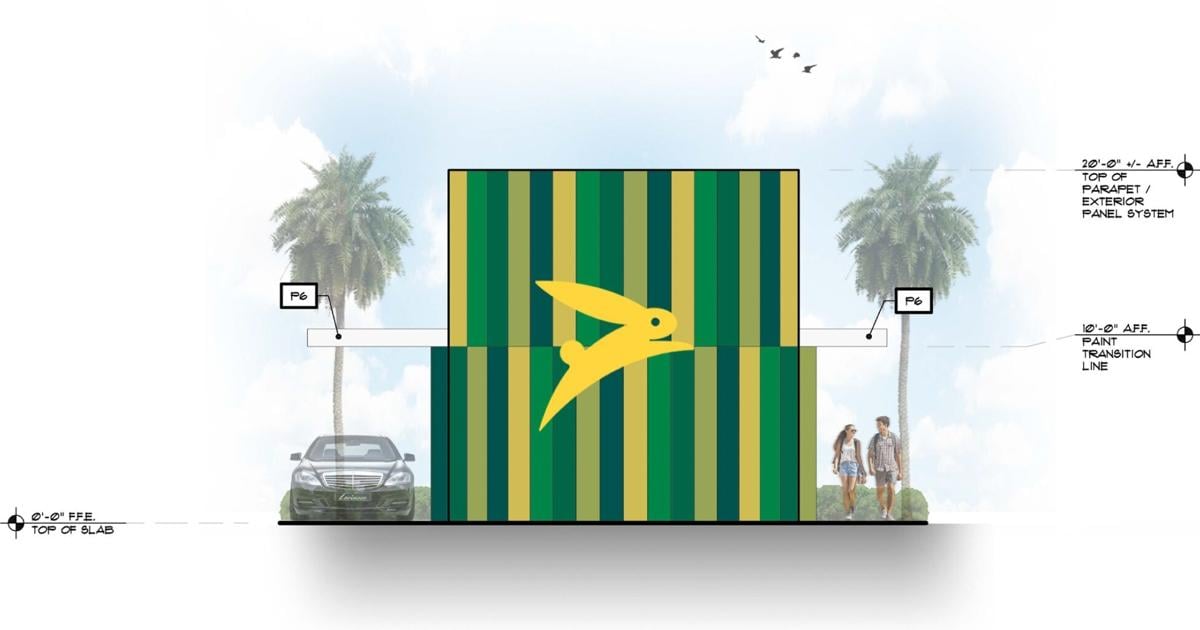
SEMINOLE — The City Council declined to authorize negotiations for a redevelopment agreement for a former SunTrust Bank site during a Jan. 20 workshop meeting because of concerns over building design, traffic access and stormwater management.
Paradise Ventures Lake Seminole LLC owns the 1.2-acre property near Park Boulevard at 7405 Seminole Blvd., on which sits a vacant two-story, 10,000-square-foot SunTrust bank building. The structure, built in 1962, contains asbestos.
The developer proposed demolishing the building and splitting the property into two lots: a 3,000-square-foot PNC Bank on the southern lot and a 1,000-square-foot Greenlane Healthy fast-food restaurant on the northern lot. The restaurant would have drive-thru service only, with no dine-in option.
Community Development Director Wesley Wright said the site is zoned for general commercial use, and the proposed plans are permitted by right under current zoning.
“This is one of the oldest parcels that we have in the city,” Wright said.
While the zoning allows the uses, Wright said the developer is seeking relief from certain city code requirements, including parking and stormwater detention, which requires approval through a development agreement.
“They still have to have Swiftmud, FDOT approval should the council wish to move forward,” Wright said, referring to the Southwest Florida Water Management District and Florida Department of Transportation. “Our ordinance requires the site to be looked at as a grass field, not the total impervious area that’s out there currently. So they have to start from square one and design it like it’s complete grass. That is a high bar to achieve.”
The property currently lacks modern stormwater treatment and shares access and parking with a nearby Walgreens.
The redevelopment plan includes new landscaping, driveway modifications, improved site circulation, utility connections and construction of a right-turn lane from Seminole Boulevard onto Lake Drive.
Cody Akres, project manager for Paradise Ventures, said FDOT requires eliminating the driveway access from Seminole Boulevard, which would route traffic through Lake Drive and the existing cross-access with Walgreens. The plan includes closing existing curb cuts, improving Lake Drive and adding off-site turn-lane improvements.
Akres said Greenlane’s dual drive-thru stacking lanes would accommodate 13 to 14 vehicles, while PNC Bank’s ATM drive-thru would stack three to four vehicles. City documents show the plan includes five parking spaces for Greenlane and 18 for PNC Bank.
“We have gone through several iterations of this plan,” Akres said. “We think what’s shown here is our best intent to meet the city’s code.”
Attorney Brian Aungst Jr., who was representing the developer, said the project would improve safety by reducing driveway conflict points along Seminole Boulevard in accordance with FDOT standards.
Greenlane’s building would be set back from Seminole Boulevard and have enhanced landscaping. It would be visible from within the site rather than from the roadway.
“The idea isn’t to catch your attention and turn in,” Aungst said. “The idea is to allow them to keep their identity.”
He said the company isn’t willing to give up its brand look of bright green, which is one of the big things that sets it apart.
Council concerns
City Manager Ann Toney-Deal said the revised proposal did not reflect the guidance she provided during meetings with the development team and did not align with the city’s strategic plan for the corridor.
“The concern I have as your negotiator is that we’ve just been told there’s very little wiggle room,” Toney-Deal said. “It would be inconsistent with the corridor appearance that you’ve been striving to achieve.”
She also criticized the proposed PNC Bank building, describing it as “downscale” compared with other PNC locations in the area.
“I would not recommend negotiations,” Toney-Deal said. “Not the way it’s presented. Any site that goes there is going to be heavily landscaped. But just from the look and feel for our corridor, I just in good conscience would not.”
Mayor Leslie Waters criticized Greenlane’s bright colors and branding.
“We’re not South Beach,” Waters said. “Seminole is not a lime-green city. You’ve muted it a little bit, but not enough. … The lime green is something that I’m not really supportive of.”
Waters questioned the use of a rabbit graphic in the building design. Aungst explained that the branding was intended to reference healthy food and greenery.
Council members said redevelopment must align with the city’s character.
“It would be nice to have something there,” council member Jim Quinn said. “But we just don’t want anything. We want to match the things we want to see in the city. If you can get them to jazz it up … come up with something a little prettier.”
Dillon Goodell, a civil engineer with Dynamic Engineering, said larger national brands often have more flexibility when entering cities, while smaller companies may be more reliant on brand identity.
Toney-Deal said she was not opposed to the Greenlane business concept but objected to the proposed design.
Council members had concerns about how the revised access plan would affect Lake Drive, Walgreens and nearby residential streets.
Akres said shared access with Walgreens would remain and that no parking spaces would be lost, though Walgreens drive-thru customers cannot exit eastbound. He said delivery truck movements had been modeled to ensure access could still be accommodated.
Council member Trish Springer said flooding along Lake Drive is a persistent issue and highlighted the importance of stormwater management.
The developer said the plan would reduce the site’s total impervious area and reroute stormwater to an existing basin, meeting Southwest Florida Water Management District requirements.
Goodell said the request for relief stems from the city’s requirement to treat the site as if it were undeveloped.
Next steps
The council reached consensus not to authorize the city manager to negotiate a development agreement, saying the proposal lacked flexibility and did not align with the city’s vision.
“There’s no backup plan in terms of who the other tenants are going to be at this point,” Aungst said.
He said more negotiations would have allowed further refinement but acknowledged the council’s concerns.