
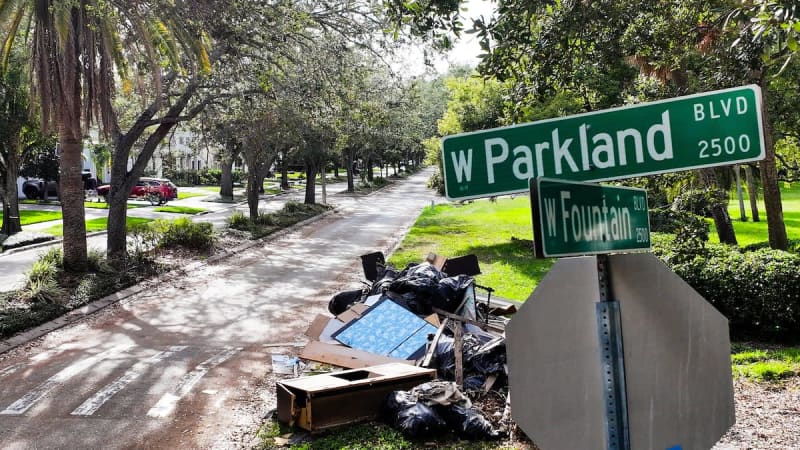
After a critical City Council vote on Thursday, Tampa will move forward with its South Howard Avenue flood relief project.
Intended to alleviate persistent flooding in low-lying parts of South Tampa, the projecthas quietly ballooned from $65 million to nearly $100 million and divided neighbors, business owners and city leaders.
Ahead of Thursday’s vote, Tampa Mayor Jane Castor had drawn a line. Had it failed, the city’s chief financial officer said that morning, the project may have been cancelled altogether.
“There’s been a great deal of energy and resources put toward this project,” said Dennis Rogero, the financial officer. “At some point, I think the decision needs to be made to either proceed with this $98 million project, or not proceed. That point has come tonight, per the mayor.”
After hours of debate and public comment, the Council voted to transfer more than $21 million to the project from another fund, with council members Bill Carlson, Guido Maniscalco and Naya Young voting no.
The vote concerned only a slice of the total funding, but it carried extra weight.
“This is our lives you hold in our hands,” said Parkland Estates resident Steve Gerrish, who wore a shirt that read, “Stop flooding in Parkland Estates and Palma Ceia Pines.”
“If this project gets stopped, there is no project waiting in the wings,” he said. “We cannot physically, mentally, emotionally withstand more flooding.”
The plan involves adding a large box culvertand pipes along stretches of West Swann and South Howard avenues to address frequent flooding in Parkland Estates, Palma Ceia Pines and surrounding neighborhoods. The Council approved an initial contract with Kimmins Contracting Corp. in a 5-2 vote in 2024.
Proponents say that even short summer storms turn their streets into rivers, flooding their homes and businesses. But a group of business owners on South Howard have fought the project for months, as it will require periodically closing sections of the busy, two-lane street to traffic. Other detractors fear the cost and worry it will drain the city’s stormwater budget.
Questions about funding have swirled around the project for months as the scale and scope have changed. Some council members say they have heard inconsistent information about the cost and funding plan.
“Every briefing and council meeting, I have received different answers,” said council member Naya Young. “We all understand that something has to be done, but as a contributing member of this council, I would appreciate more transparency and consistency.”
On Thursday, Rogero explained the city’s plan to pay for the massive flood relief project.
The City Council has already approved more than $28 million, including $8.4 million from a stormwater fee assessed on taxpayers, a $10 million Florida Department of Environmental Protection grant, $10 million in bonds and the $21 million approved on Thursday.
That leaves a $50 million gap.
Rogero said the city would apply for other state and federal grants to cover the $98 million price tag. The city could also get money from the Tampa Hillsborough Expressway Authority. Or it could pull from the renewal of the county’s Community Investment Tax, a half-percent sales tax that funds major public construction projects, he said.
“But,” Rogero said, “I can’t assure you we’re going to get any of these funds. It’s potential.”
That lack of clarity alarmed some community members.
“It’s amateurish for senior city officials to suggest that not having THIS MUCH money months before being presented with a construction contract is common,” resident Elizabeth May wrote in an email to council members this week.
But for dozens of residents, the fear of flooding outweighed questions about cost.
There was a father who said his wedding photos and children’s toys were destroyed when the first floor of his house was swamped during Hurricane Milton. A homeowner who said she had chosen to live in Palma Ceia Pines because she thought it was unlikely to flood. A teenager who cried as she told council members that she worries every time it rains.
“There is no perfect solution,” said Maegen Peek Luka, who owns homes in Parkland Estates and Palma Ceia Pines. “We would rather have something now, because the other option is nothing.”