
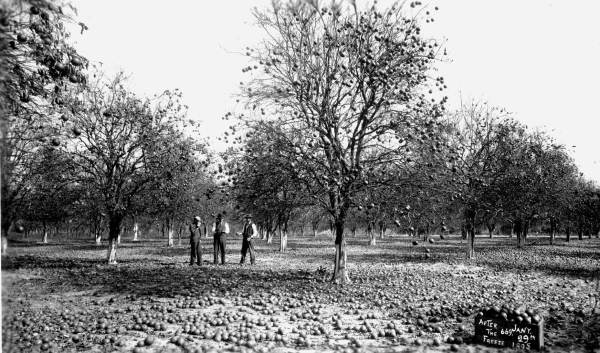
As Orlando and Central Florida prepare for what could be a record-cold weekend, it hopefully won’t be as bad as the calamitous ‘Great Freeze’ of late 1894 and early 1895. A one-two punch of frigid weather killed the area’s main cash crop, forced businesses to close and caused at least one person to kill himself. From our Orland Sentinel archives, here is an account of that history freeze from staff writer Mark Andrews, which was originally published on Feb. 13, 1994. The headline was “Great Freeze of ’94-’95 destroyed groves and fortunes, but not faith”
Orange County’s citrus industry has weathered a long series of ups and downs over the past 150 years. The most recent setbacks were a trio of killer freezes in the 1980s that pruned the acreage devoted to citrus by more than 70 percent and forced all but one of the county’s citrus-processing plants to close.
But probably the greatest calamity of all was the Great Freeze of 1894-95. The Great Freeze actually was two back-to-back killer frosts that occurred within six weeks of each other.
The first – on Dec. 29, 1894 – was an uppercut punch that staggered the industry and wiped out the season’s crop. The second — on Feb. 7, 1895 — was a roundhouse punch that killed most of the trees damaged by the first freeze and sent the industry to the canvas for several years.
The twin freezes were a much more devastating blow to the county’s economy than those of the 1980s because there was little diversification of the county’s economy beyond agriculture back then.
Before the freezes, Orange County’s citrus industry was dominated by individual growers, who had small groves spread from Oakland and Winter Garden east to Christmas and from Sanford south to Pine Castle, Conway and Windermere.
The days leading up to the first of the twin freezes gave no indication of the disaster that was about to befall the county, Eve Bacon wrote in “Orlando: A Centennial History.” Christmas Day 1894 was sunny and beautiful with temperatures in the 80s. Three days later, a cold front from the northwest pushed a terrific rainstorm with high winds through the area. By the next morning, “cold had settled in to a point where pumps were frozen, water pipes began to burst, foliage blackened and of ’94-’95 fortunes died,” Bacon wrote. The temperature dropped to 18 degrees, killing the season’s entire citrus crop while most of it still hung on the trees.
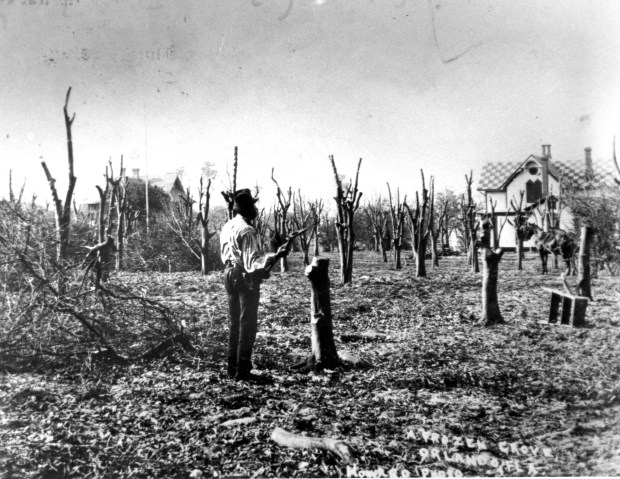 A man surveys freeze damage done to a citrus grove in the winter of 1894-95. (Sentinel file via Orange County Historical Museum)
Karl Abbott, who was a boy at the time of the freeze, in 1950 recorded his recollections of citrus growers and buyers gathering in the lobby of the San Juan Hotel, which his parents ran, as the temperature dropped.
“By 2 p.m., the San Juan was in an uproar. Prices had dropped to ‘no sale.’ Commission merchants were frantically trying to get out of options, and heated debates and fistfights started in the lobby. . … About 9:00 that night, a fine looking grayhaired man in a black frock coat and Stetson hat walked up the street in front of the hotel and looked at the thermometer, groaned, ‘Oh, my God!’ and shot himself through the head.”
Abbott continued, “For three days the icy winds blew over a dead world. The gloom in the San Juan was something you could feel and touch.”
 Orlando Sentinel 150th birthday logo for Friday Flashback feature
It was the worst freeze in Orange County in the generation that oranges and other citrus fruits had been cultivated on a large scale. A large number of mom-and-pop growers, who had come to Florida and invested all their savings in groves, moved back North in discouragement. Most, however, dug in their heels and hoped the next year would be better.
But the worst possible thing happened next: January 1895 brought warm, encouraged trees growth. The trees lose their leaves and the layer of woody tissue just under the bark became engorged with sap as the wounded trees struggled to survive.
The presence of so much liquid in the trees made them far more vulnerable to a second freeze.
When the second freeze hit on Feb. 7, people who were here then said they heard the trees pop light pistol shots as freezing sap split the bark, former county agricultural extension agent Henry Swanson record in his book, “Countdown for Agriculture in Orange County Florida,”
More than 90 percent of Orange County’s namesake trees were killed, although those with large root systems could survive once the deadwood was cut away.
Land values plummeted, and growers with mortgages were forced to sell at a loss. It took several years for new trees to mature and bear fruit. People with money were able to scoop up large tracts at bargain prices from those who could not afford to wait.
The freeze had cascading effects on the rest of Orange County’s economic landscape.
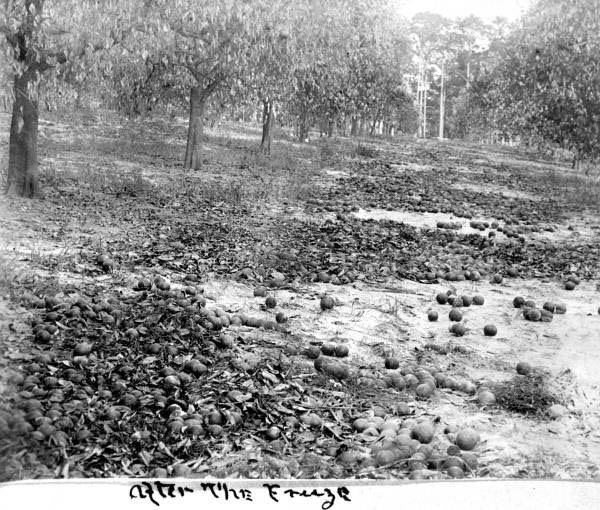 This is a photo after the Great Freeze of 1894-95 with fruit on the ground. The citrus industry suffered a devastating blow during a six-week period between Dec. 29, 1894, and the following Feb. 7. An 18-degree freeze on the first night killed the season’s crop while it was still on the trees. But the worst possible thing happened next: January brought warm, wet weather, which encouraged trees to produce sap and new growth. This made them extremely vulnerable to the second freeze. People said they heard the trees pop like pistol shots as freezing sap split the bark. (Sentinel file via Orange County Regional History Center)
Peter Herdic gave up the Orange water company he owned, leaving it in the hands of attorney John M. Cheney, who represented the stockholders. After some legal maneuvering, Cheney emerged as the major stockholder, according to Bacon’s account. Cheney reorganized the utility company into the Orland Water & Light Co. in 1897 and sold it to the city 25 years later as what became the Orlando Utilities Commission.
Of the eight banks in the county before the freeze, only the First National Bank of Sanford survived. Some stores and packing houses also closed.
Some growers diversified into winter vegetables, while other business people explored news kinds of commerce. Never again would the county be so reliant on one industry for its survival.