
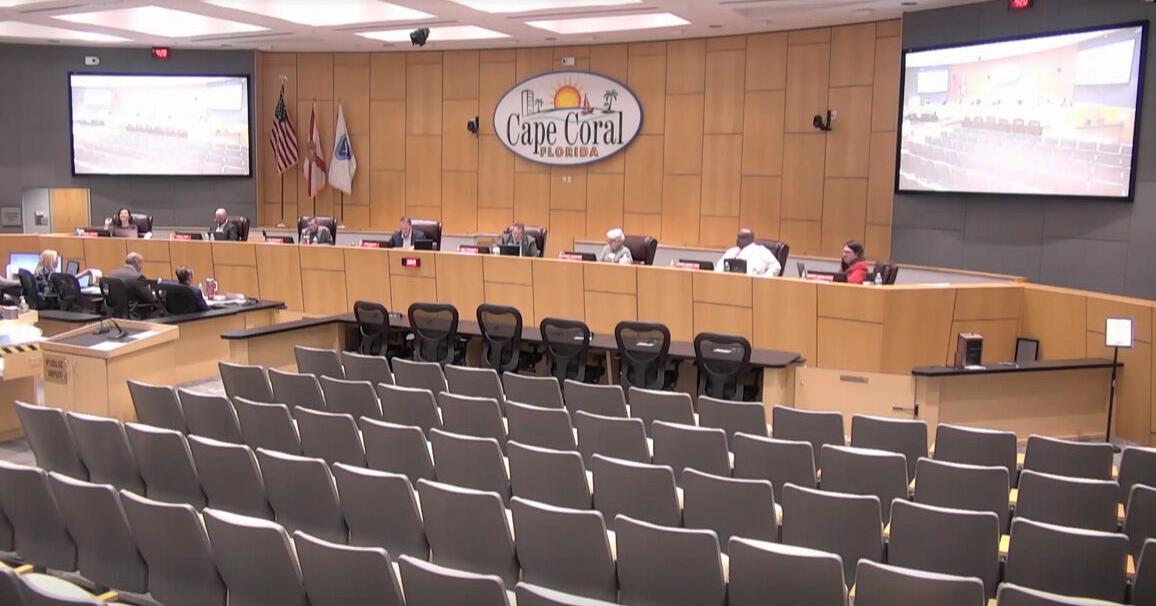
As Cape Coral officials began their annual budget discussions Jan. 29, state lawmakers were weighing property tax relief proposals that could eliminate nearly 40% of the city’s annual ad valorem revenue and force deep cuts to public safety services and other core operations.
Earlier this month, Assistant City Manager Mark Mason warned City Council that House Joint Resolution 201, based on the city’s fiscal 2026 budget, would cut more than $62 million from the nearly $158 million general fund.
“[We] would end up having to eliminate in its entirety Parks and Recreation, Transportation, Code Enforcement, the remainder of Fire if not funded and Administration budgets for the year,” he said. “That’s what $62 million in $158 million in funding means.”
If approved by the Florida House, Senate and Gov. Ron DeSantis, the measure would place a referendum on November’s ballot asking voters whether to eliminate ad valorem taxes on homesteaded properties statewide, excluding school taxes. A similar proposal, House Joint Resolution 203, would phase out those taxes more gradually. Lawmakers also are considering other tax relief measures that could impact local government revenues, though less dramatically.
Under current proposals, cities would not be allowed to reduce police department budgets below recent levels, Mason said, and legislators are considering extending that protection to fire departments and other first responders. School property taxes would not be affected.
Mayor John Gunter said the proposals would still likely have indirect impacts on police and fire services.
“It could hamper future projects, future growth, getting more police officers out on the road, opening up more firehouses,” Gunter said. “So, there could be a ripple effect long-term for that.”
City Manager Michael Ilczyszyn noted at a prior meeting that tax-cut referendums historically fare well with voters. Gunter and council member Joe Kilraine said a ballot measure to eliminate nonschool homesteaded property taxes would likely pass given current political and economic conditions.
“Something that goes out on a referendum for reducing property taxes more than likely will pass,” Gunter predicted.


A city presentation outlines the potential impacts of House Joint Resolution 201, which would eliminate non-school homestead property taxes and reduce Cape Coral’s general fund revenue by more than $62 million.
Cape Coral government
If approved by voters, the measure could take effect in 2027.
There are currently no provisions in the state proposals to replace the lost revenue, Mason said. He suggested local sales tax increases or higher millage rates on nonhomesteaded properties as possible alternatives.
“If there’s no revenue replacement, the level of services will obviously have to be decreased,” Mason said.
The city also could impose higher fees on services ranging from fire protection to streetlighting.
Cape Coral is more reliant on property taxes than many cities. Residential properties account for 91.2% of its taxable property value, with commercial and industrial properties making up the remainder.
Mason said 44.4%, or 61,599 of the city’s 138,659 properties, are homesteaded, representing $12.6 billion of the city’s $31.4 billion in taxable property value. At the city’s current 5.1471 millage rate, those homesteaded properties generate $62.3 million, or 39.44%, of fiscal 2026 ad valorem revenue.
Cape Coral’s total fiscal 2026 budget, including capital projects and debt service, is nearly $1.5 billion.
Ilczyszyn said the proposed changes also could disrupt services the city receives from Lee County, including those provided by the West Coast Inland Navigation District for canals and waterways.
“There are even further downstream effects that I think aren’t being paid attention to, but we’re starting to explore those to make sure we have an understanding of what that may look like depending on where we end up,” he said.
As budget deliberations continue, city officials are closely tracking legislative developments.
“What happens if next year we lose 30% of our ad valorem tax or whatever that case may be?” Gunter said. “Then what do we do? So, that’s something that you have to keep in the back of your mind when we’re going through this process, as well, that we’ve never had to have.”