
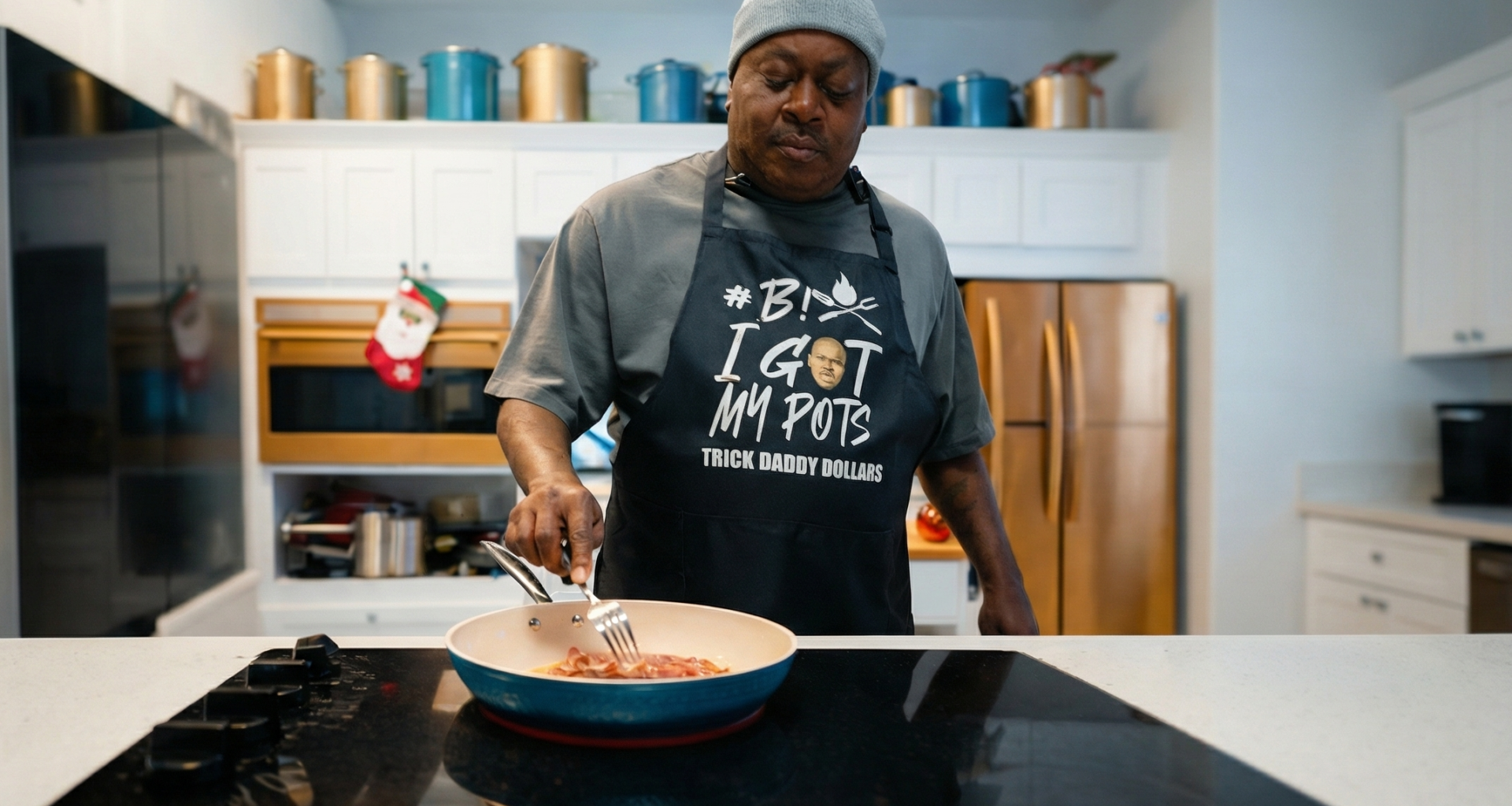
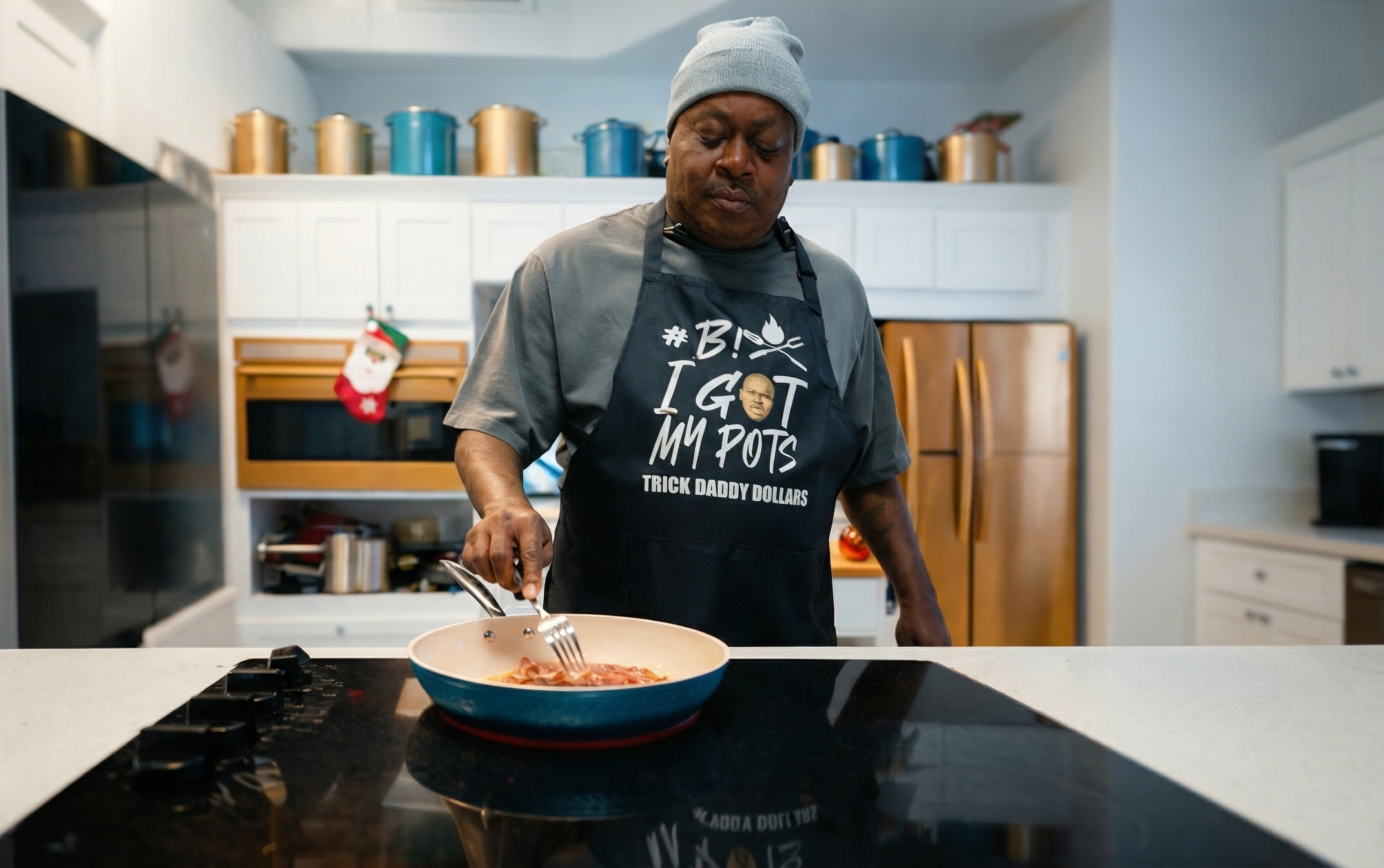
With his new cookware line, Trick Daddy Pots, Miami rap legend Trick Daddy talks food, family, and why the kitchen helps save the community.
Trick Daddy Pots photo
For years, Trick Daddy has cooked on camera the same way he’s always rapped — unapologetic, opinionated, and rooted in Miami. Now, the Liberty City icon is turning that lifelong relationship with food into something tangible: Trick Daddy Pots, a new line of cookware designed not just for cooking, but for culture.
“People walk up to me saying, ‘Bitch, I got my pots,’” Trick says, laughing. “Now I want them to say it and mean it.”
But beneath the humor is something deeper. For Trick Daddy, the pots are a vehicle, a way to talk about family, relationships, and what he sees as a missing ingredient in today’s households: home time. New Times contributor David Suarez sat down with the Miami legend himself to discuss his meaningful new venture and his passion for the community.
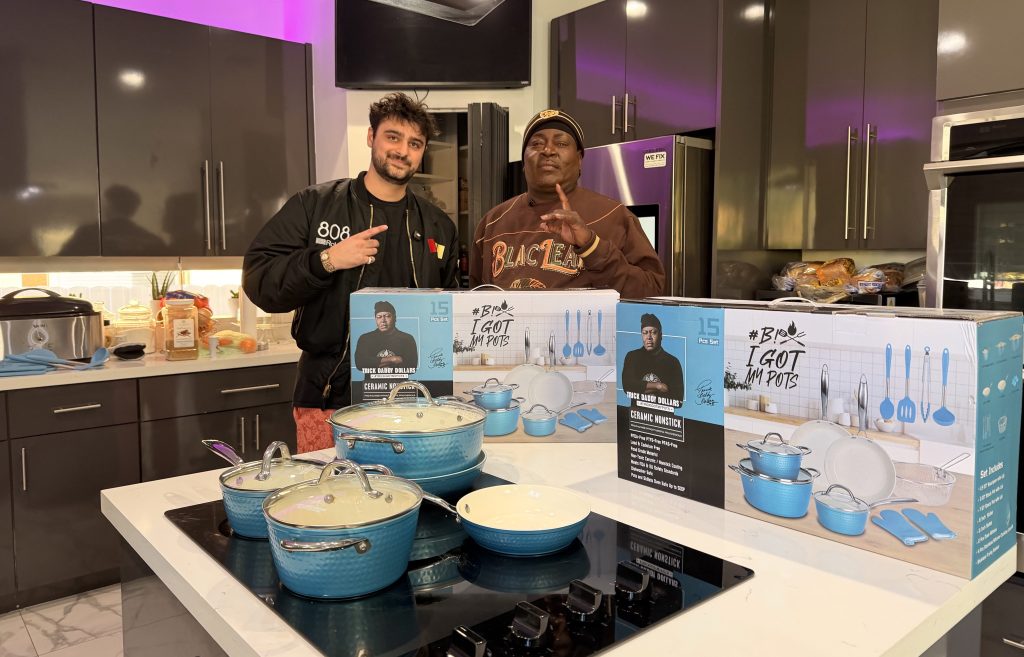 From left: New Times contributor David Suarez and Trick Daddy
Cooking as Culture, Not Content
Trick Daddy doesn’t see cooking as a trend or a side hustle. He sees it as a legacy. Raised in Miami and shaped by Southern and Caribbean influences, food has always been as present in his life as music.
“One of my songs starts with, ‘Collard green, neck bone eatin’ ass,’” he tells New Times. “Even though I don’t put neck bones in my greens. We use turkey.”
That balance, tradition with intention, shows up everywhere in his approach. At his Miami restaurant, Sunday’s Eatery, pork is optional. Fried ribs are legendary, but baked and grilled options are always available. And when it came time to design his own cookware, Trick was adamant about safety and quality.
“We did the research,” he says. “No toxic stuff. No cheap nonstick that sticks. You shouldn’t need a Brillo pad to clean a pot. A rag, a napkin — that’s all you need with mine.”
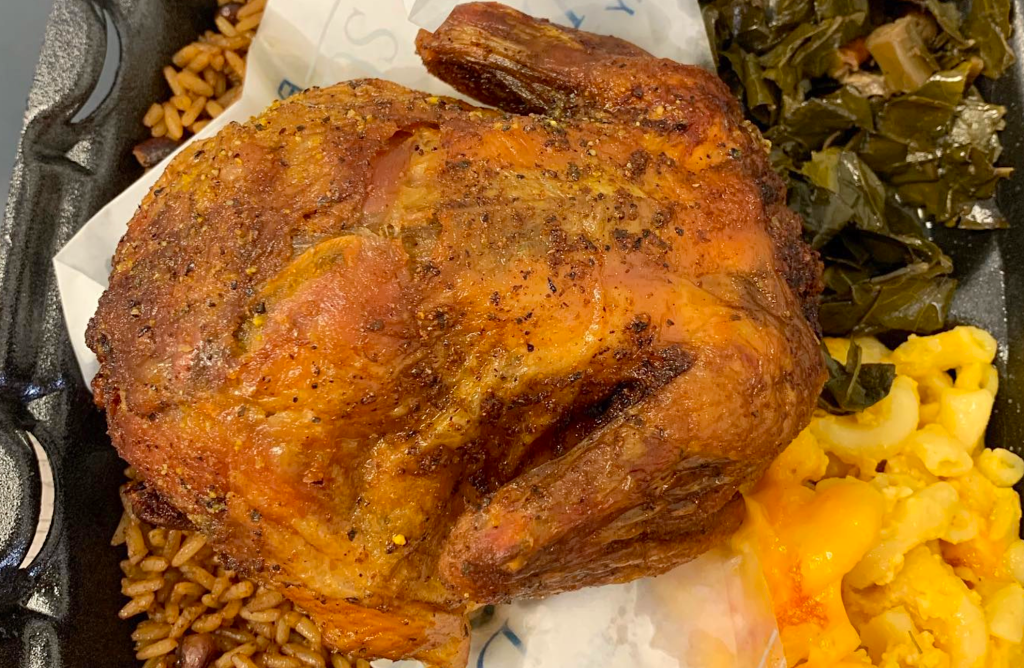 A to-go platter from Trick Daddy’s Sunday’s Eatery in Miami Gardens
A Love Letter to Miami Cuisine
If there’s one thing Trick Daddy is clear about, it’s this: Miami has its own cuisine, even if no one ever bothered to name it.
“Everybody got a thing,” he says. “South Carolina, Georgia, soul food. New Orleans, seafood. Chicago got pizza. Philly got cheesesteaks. But Miami? We got everything.”
Caribbean, Latin, Southern, Bahamian, Haitian, Cuban — Miami’s food scene is a melting pot in the truest sense. Trick rattles it off like a roll call. Conch fritters. Red snapper. Key West shrimp. Flavors from the Atlantic that can’t be replicated anywhere else. “That’s Miami cuisine,” he says. “There’s nowhere like it.”
The pots, dressed in South Florida colors and tied directly to Sunday’s Eatery, are meant to represent that blend: Miami on the stove.
More Than Pots — A Mission to Help the Youth
For Trick Daddy, the cookware isn’t the end goal. It’s the entry point. He wants the pots in homes, schools, and eventually classrooms. He wants cooking classes back in the education system. He wants kids learning how to feed themselves instead of living off fast food and social media fantasies.
“They don’t even have home E.C. [economics] anymore,” he says. “No P.E., no cursive, no fundamentals. We need to get back to what works.” In Trick’s vision, the kitchen becomes a classroom, a place where life gets discussed alongside recipes. Responsibility. Parenthood. Work ethic. Respect.
“There’s no kitchen on the street corner,” he says. “The kitchen brings you back to the home. I’m trying to do something different with my life,” he says. “I ain’t in the streets no more. I need to help clean up the dirt that we created.”
He speaks directly to parents, to kids, to entire generations that grew up on his music. His message is blunt, but intentional: tighten up, take care of your family, stop chasing appearances, and start building something real. “If I can reach five out of 5,000 kids,” he says, “I did my job.”
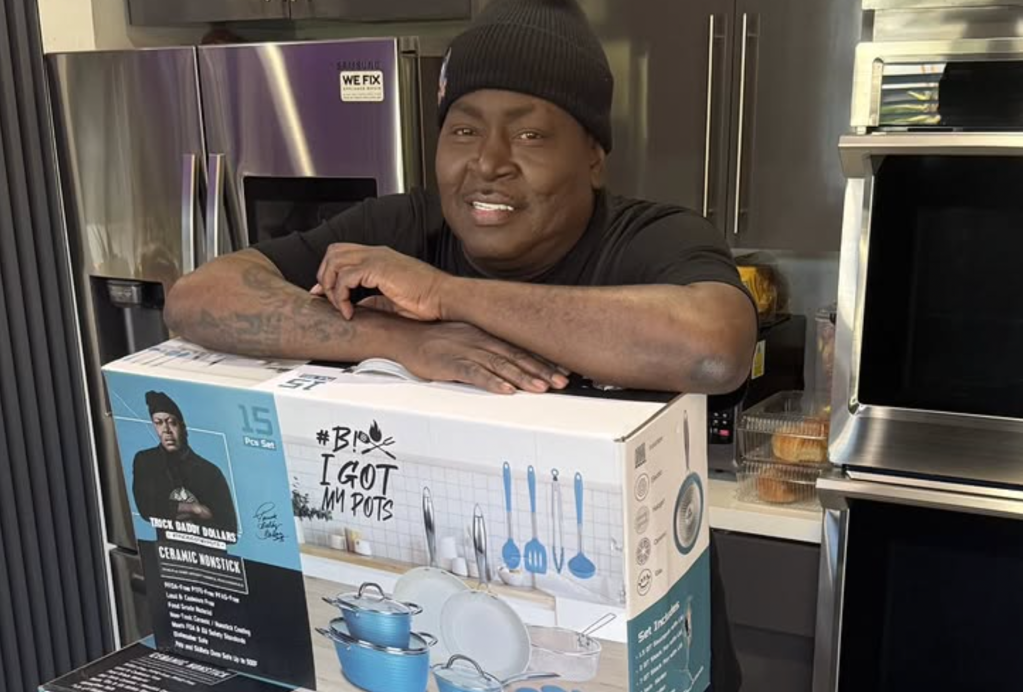 Trick Daddy hopes he can inspire the next generation to love to cook and bring family back to the kitchen
Back Where It All Starts
In the end, Trick Daddy’s pots are about more than nonstick surfaces or dishwasher safety. They’re about bringing people back together — couples, families, communities — around a shared space that once meant everything.
“The kitchen reverts back to the home,” he says. “And that’s my focus.” That, and, of course, making a lot of money.
Because in true Trick Daddy fashion, he plans to do both.