
NFL.com Mock Draft in Rd 1 has Miami Selecting…
Lead NFL Draft Writer for NFL.com, Eric Edholm, released his first Mock Draft on Friday. With the 11th overall pick in Round 1, he has the Dolphins adding an offensive weapon for whoever their quarterback is.
Round 1, Pick #11: Kenyon Sadiq, TE, Oregon
“It will be interesting to see what the new Dolphins regime does with this pick, but I could see Miami wanting to add an offensive chess piece such as Sadiq, even if this is a little higher than I currently envision him going.”
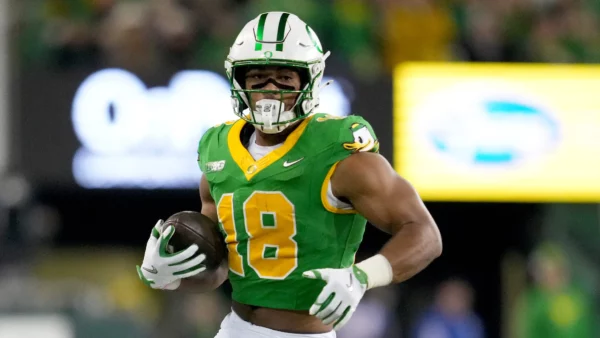
The Draft Network Draft Profile
Kenyon Sadiq Scouting Report
Kenyon Sadiq has a rare combination of explosiveness, versatility, and plus-level run blocking ability, which projects him as a top-tier tight end in the NFL.
Draft Grade: Round 1 – Pro Bowl Caliber
Strengths:
Athleticism: Sadiq is a quick accelerator with top-end speed and fluid hips
RAC: In the open field, Sadiq can pick up extra yardage due to his athleticism, speed, and strength, which makes him a difficult ball carrier to tackle.
Versatility: Sadiq has aligned at every receiver position while also taking snaps lined up in the backfield, making Sadiq a unique matchup piece for offenses.
Run Blocking: Sadiq seeks to be a dominant run blocker. There are multiple reps of him finishing defenders by driving them into the ground.
Concerns:
Route Running: Sadiq rounds off a lot of his routes, and he needs to become more detailed and precise in his route running to help separate against man coverage on in-breakers.
Hands/Catching: Sadiq has periodic concentration drops.
Kenyon Sadiq the 6’3″, 245-pound junior arrived in Eugene as a consensus four-star recruit who dominated Idaho prep football, leading Skyline High School to three consecutive state championships while accumulating eye-popping numbers that earned him MaxPreps Idaho Player of the Year honors as a senior. His final prep campaign featured 62 catches for 1,303 yards and 18 touchdowns, including a memorable 246-yard, six-catch, five-touchdown performance in the state semifinals that showcased the explosive playmaking ability that would later translate to college football.
Sadiq’s college career began modestly as a true freshman in 2023, catching five passes for 24 yards while learning behind veteran tight ends and contributing primarily on special teams across 14 games. His breakthrough moment came in the Vrbo Fiesta Bowl, where he hauled in his first collegiate touchdown against Liberty, providing a glimpse of the athletic ceiling that made him such a coveted recruit. The following season proved transformative as Sadiq expanded his role significantly despite playing behind starter Terrance Ferguson, who would become a second-round NFL Draft pick. His 24 receptions for 308 yards demonstrated remarkable efficiency, with both of his touchdown catches coming in Oregon’s Big Ten Championship Game victory over Penn State – a performance that included a spectacular hurdle over a defender that became an instant highlight reel staple.
Throughout his time at Oregon, Sadiq has compiled impressive academic and athletic credentials while earning recognition from Pro Football Focus as one of the top returning tight ends in Power Four football heading into 2025. His 80.6 PFF grade ranked second nationally among returning tight ends, trailing only Vanderbilt’s Eli Stowers, while his combination of receiving prowess and blocking development has drawn consistent praise from coaching staff and teammates alike. With Ferguson’s departure to the NFL, Sadiq enters his junior campaign positioned to become the featured tight end in an Oregon offense that has historically leaned heavily on the position.
Explosive athlete with elite timed speed that allows him to separate vertically from linebackers and safeties.
Natural hands receiver who consistently secures contested catches and demonstrates excellent ball tracking skills on throws outside his frame.
Versatile route runner capable of lining up in-line, in the slot, or split wide while creating separation through smooth releases.
Outstanding body control and spatial awareness, evidenced by his ability to make difficult catches along the sidelines and in traffic.
Competitive blocker who shows willingness to engage in the run game despite his receiver-heavy skill set and frame limitations.
High football intelligence with excellent field awareness, consistently finding soft spots in coverage and adjusting routes accordingly.
Clutch performer who elevates his game in critical moments, as demonstrated by his Big Ten Championship Game touchdown performance.
Raw physical tools include impressive leaping ability and coordination, allowing him to hurdle defenders and make acrobatic catches consistently.
Made the 2025 Feldman freaks list – he wrote:”The 6-3 Sadiq came to Oregon two years ago at 220 pounds but is now 255. He’s much leaner this season thanks to healthier eating, which he said has enabled him to go from 12-13 percent body fat to about 10. He vertical jumped 41.5 inches this summer, power cleaned 365 pounds and bench pressed 435.”
Undersized frame at 245 pounds limits his effectiveness as an in-line blocker against bigger defensive ends and outside linebackers.
Limited sample size as a featured receiver raises questions about how he’ll handle increased target volume and defensive attention.
Can struggle with physical press coverage from bigger defensive backs who can disrupt his release timing at the line of scrimmage.
Inconsistent run blocking technique, particularly on combo blocks and when asked to reach block defensive ends on outside zone schemes.
Needs to develop more nuanced route running against zone coverage, occasionally sitting in windows instead of finding true open grass.
Sadiq’s deep-ball production and vertical threat capability create matchup problems that translate directly to the professional level, but his blocking inconsistencies and 245-pound frame raise questions about every-down usage. His route precision suggests immediate contributions as a receiving weapon, yet NFL tight ends who struggle in protection often get pigeonholed into specific packages rather than featured roles.
The speed advantage over linebackers becomes more pronounced at the next level, though his frame limitations magnify against NFL pass rushers who will test his anchoring ability. His competitive spirit and football intelligence provide hope for technical improvements in blocking, but the size constraints aren’t developmental issues. The league’s shift toward athletic tight ends helps his cause, though baseline competency across all phases remains essential.
His draft stock depends entirely on how he handles expanded responsibility as Oregon’s primary tight end this season. The big-play ability and clutch performances suggest legitimate upside, but the small sample size means he could plateau once defenses focus on limiting his vertical routes. The talent is evident and encouraging, but questions about his complete game will determine whether he becomes a legitimate weapon or remains a situational contributor.