
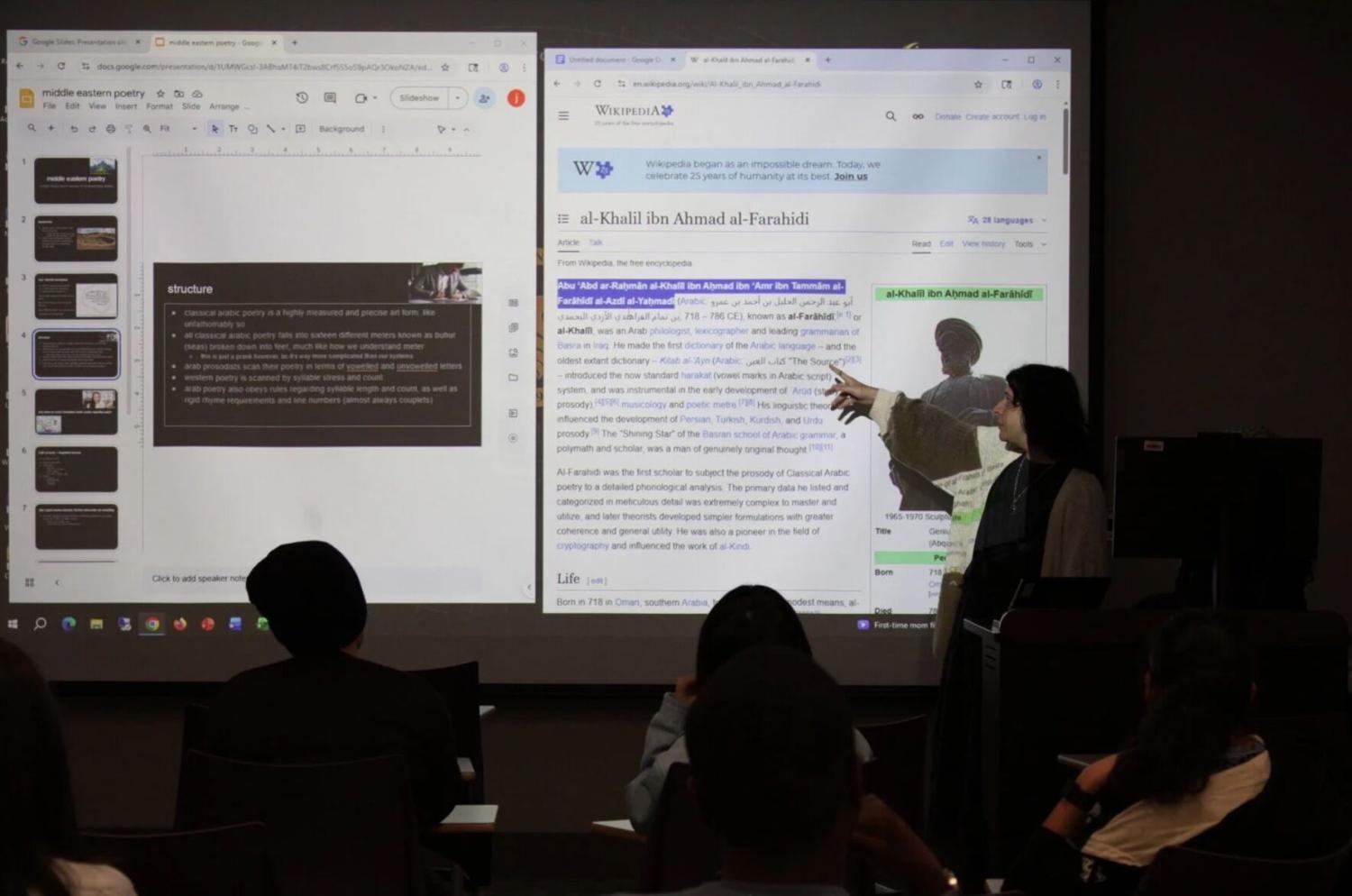

Jamie Sub Laban talks about al-Khalil ibn Ahmad al-Farahidi, who is credited with developing the Arabic poetic meter, during the Middle Eastern poetry night hosted by the Young Poets’ Society at UCF, held in Trevor Colbourn Hall on Wednesday.
Ana Ferreira Verdugo Lizama
In a night marked by curiosity, conversation and shared creativity, students gathered Wednesday in Trevor Colbourn Hall to explore Middle Eastern poetic forms and share their own work at a UCF Young Poets’ Society event.
The meeting began with an icebreaker, inviting both first-time and returning members to share their favorite word. This was followed by an overview of Arabic poetic structure and the work of key figures, such as al-Khalil ibn Ahmad al-Farahidi, an eighth-century scholar credited with developing Arabic poetic meter and compiling one of the earliest dictionaries of the language, according to Muslim Heritage.
Members also had the opportunity to read and discuss contemporary poems, including “Who Am I, Without Exile” by Palestinian author Mahmoud Darwish, and “A Brief Love Letter” by Syrian writer Nizar Qabbani. The selections were chosen by the club’s vice president, Jamie Sub Laban.
Laban, sophomore English major of Palestinian descent, said poetry entered her life unexpectedly after a high school English teacher invited her to host an open mic event.
“I was like, ‘Wait, I can’t host an open mic and not have a poem,’” Laban said.
Laban took the initiative to organize the Middle Eastern poetry night after seeing the club host events highlighting poetry movements from other regions, such as the Caribbean.
“One of my big concerns about this meeting was that all of the poetry was going to be too sad,” Laban said. “But I wanted to pay homage to the very powerful role poetry plays in supporting revolutionary movements and raising awareness of human suffering, and injustice in general.”
Coyec Ramirez Silva, sophomore psychology major, attended the meeting as a returning member. She said poetry is often underappreciated today because society has become so rooted in realism.
“There’s not really a lot of room for daydreaming or romanticism nowadays, especially with the lives most people live, which is, at the very minimum, casual cynicism,” Silva said. “I think poetry works as a very good way to actually confront these issues that you deal with every day.”
For Silva, the club provides an important space to connect people through art without requiring a financial commitment.
“It’s a really loving community, very open to new people and very kind to those who have been there for a long time,” Silva said. “I think it’s important for that to exist for people who are just trying to find new things or new communities to be a part of.”
Toward the end of the meeting, members were encouraged to share poems they wrote during the event, inspired by the themes and structures they learned from Middle Eastern authors.
“The job of people who are really into science and math is to keep the world running,” Laban said. “And then it’s the job of artists to keep the world.”