
Many of us South Floridians are clueless when it comes to the cold.
Even some who have migrated from northern climes have discarded their winter clothes and forgotten how to turn on the heat. And our poor pets: Fido and Luna may have to forego some of their walks because we humans won’t want to venture out of the house.
Below, find expert advice on how to stay warm, keep your pool and car well maintained, and make sure (most of) your plants survive. And here’s a consolation: This trauma will last for only a few days and then we can hopefully return to our sunny South Florida winter.
TURN ON THE HEAT
Anthony Pascucci, general manager of Sansone Air Conditioning, Electric & Plumbing, which has offices in Palm Beach and St. Lucie counties, offers the following tips for navigating that unfamiliar thermostat setting.
Test your heating system now: Set the temperature a few degrees higher than the current indoor temperature. Within a few minutes, you should feel warm air coming from the vents. If you don’t feel warm air, call a professional.
A temporary odor is normal: “You may notice a mild burning smell when the heat is first turned on. There’s no need to panic — this is very common and typically occurs when dust that has settled on the heating elements burns off. The odor should fade within 30 to 60 minutes,” Pascucci said. If it doesn’t, call a professional.
Don’t wait until you’re uncomfortably cold: “Heating a home in South Florida often takes longer than cooling it,” he said. “Many systems in our area are designed primarily for efficient cooling, meaning the heating output is more limited. In some cases, it can take several hours — or longer — for your home to reach the desired temperature.”
Be mindful of energy usage. Start at 68 degrees and adjust upward if needed. Lower to 65 when you leave the house.
THE POOL
Don’t panic about your pool. Robert Frank, owner of Boca Raton-based RF Pools, said it likely won’t be cold long enough to damage the pool or its equipment.
It’s important for homeowners not to drain the water, though: “Keep the water in the pool and keep the pump running as usual so water is flowing through the pipes.”
THE CAR
This may be the one time all year when the car needs to be warmed up. When you take it out for the first time after the freeze, let the motor idle for five to 10 minutes, said Max Torres, manager at Tune Rite Auto in Boca Raton.
“You want to warm up the oil in the engine so it gets through all the passages,” Torres said.
You also might see your tire sensor light up because the cold contracts the air inside the tire and lowers the pressure. Torres recommends driving the car to see if the light goes off as the car thaws. If it stays on for more than 10 minutes, fill the tires to the recommended level or get them checked by a mechanic.
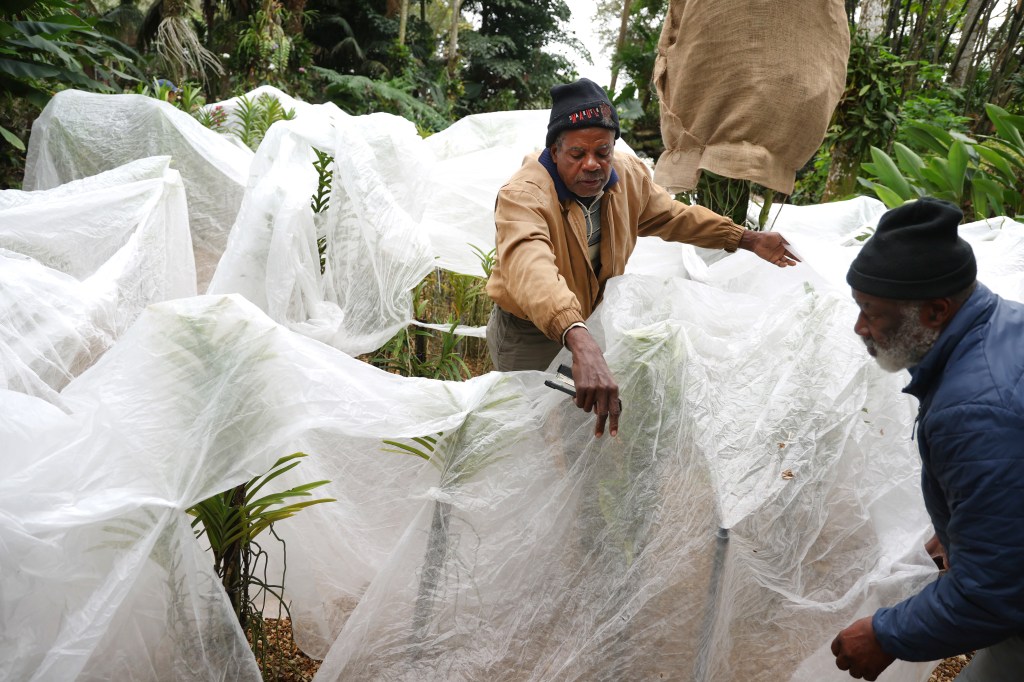
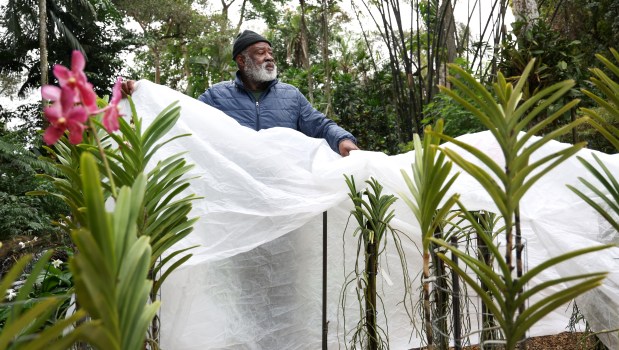 Flamingo Gardens horticulture team member Lenford Reid covers Aranda orchids ahead of the expected cold weather blast. Experts recommend wrapping plants with a blanket, sheet or row-cover cloth. (Carline Jean/South Florida Sun Sentinel)
PLANTS
Chris Maler, senior director of horticulture at Flamingo Gardens in Davie, recommends these steps for saving outdoor plants:
Water tropical or cold-sensitive plants well before the temperature drops. “Water buffers the cold and helps plants resist cellular damage,” Maler said.
Wrap plants with a blanket, sheet or row-cover cloth. “Do not use plastic sheeting as it can damage plants in the sun,” he said.
If you have a plant that can’t be wrapped, like a mango tree, “there isn’t much you can do,” he said. “Cold-tip burn damage can only really be prevented by wrapping or tenting with cloth or burlap.” In future winters, Maler recommends applying silica and calcium spray to strengthen and protect the tree.
Take small, portable plants into the house or garage if possible. If you can’t move them inside, move them into a protected area (such as a porch or carport) where they are not exposed to cold north wind, which dries out plants and leaves.
After the cold has passed, remove the covers as as soon as possible so the plants receive sunlight and air.
WHAT TO WEAR
Many of us longtime Floridians have emptied our closets of cold-weather clothing.
But fear not. Eden Tabor, a Boca Raton-based clothing consultant and personal shopper, said you don’t need to rush out and buy special gear — just layer items you likely already have in your closet. Start with a T-shirt or long-sleeved cotton top, add a sweater over it and a jacket over the sweater.
If you still own winter clothing, search the depths of your closet for a scarf and a hat and “break out the boots,” she said.
Joelie Fetterman, a personal shopper and stylist at Saks Fifth Avenue in Boca Raton, agreed that most South Floridians should be able to make do over the next few days with stuff lodged deep in their drawers.
“Almost everyone has a sweater or a light puffer, even a hoodie or a sweatshirt, that they can wear,” she said.
And don’t forget your legs. If they are cold, Fetterman recommends putting on a pair of leggings or tights under sweatpants. If you don’t have gloves, she said to buy a pair of hand warmers that can be placed in a jacket pocket.
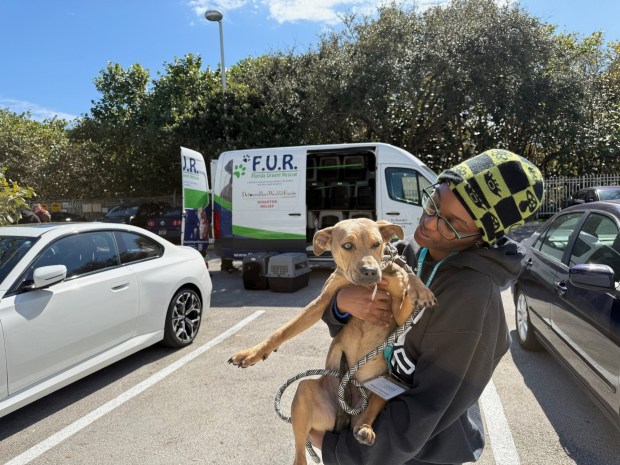 Mehgan Mclymont, an animal care associate at the Humane Society of Broward County, escorts one of 11 dogs transferred from a rural outdoor shelter in Union County ahead of a drastic temperature drop expected to bring freezing conditions to parts of the state. (Humane Society of Broward County/Courtesy)
PETS
We humans can bundle up, but what about our animals?
Animals that live outside should be brought inside if possible, said Dr. Alyssa Dayton, director of veterinary services for the Humane Society of Broward County.
“If your pet is unable to come into the house or you feed a neighborhood cat that you cannot touch, provide a warm, safe place for them to get out of the cold and wind,” she said.
For cats, use a large heavy storage bin, cardboard box or even a Styrofoam cooler. Place straw inside for warmth.
“Any type of doghouse should be elevated off the ground and put lots of straw inside. Straw is a good insulator, and it repels moisture,” she said.
Don’t deny your dogs their walks. Dayton said to be alert for shivering or lifting their paws off the ground.
“Above 45 degrees is generally safe for dogs, but small or elderly dogs or dogs with short fur may need sweaters or coats,” she said. “Best time to walk is later in the morning or early afternoon when hopefully the sun has come out.”
If you bring in plants from outside, Dayton said to make sure they are out of reach of pets. Some plants, such as lilies and poinsettias, can be toxic to dogs and cats. “And some [pets] like to chew on the leaves, which can cause vomiting,” she said.
One more thing: Honk your horn when you enter your car for the first time in the morning: “Toot the horn or bang on the hood in case any cats or critters have climbed in to stay warm,” Dayton said.
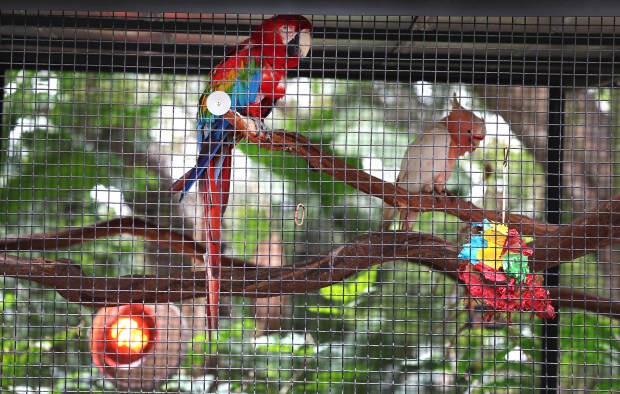 Rescued parrots at Flamingo Gardens in Davie are provided with heat lamps on Friday, Jan. 30, 2026. (Carline Jean/South Florida Sun Sentinel)
WILD ANIMALS
Speaking of critters, animals such as raccoons and rats may find their way out of the cold and into homes through plumbing stacks and other gaps, said Shaun Crawford, owner of The Critter Guys, based in Delray Beach.
He recommends keeping trash cans secure to make sure wild animals don’t smell food and decide to find a warm spot inside the nearest home.
If you see an animal in distress from the cold or for any reason, the Florida Fish and Wildlife Conservation Commission says not to touch it. Instead, call one of the following numbers:
FWC Fish Kill Hotline: 800-636-0511
FWC Wildlife Alert Hotline (for sea turtles and manatees): 888-404-FWCC (3922)