
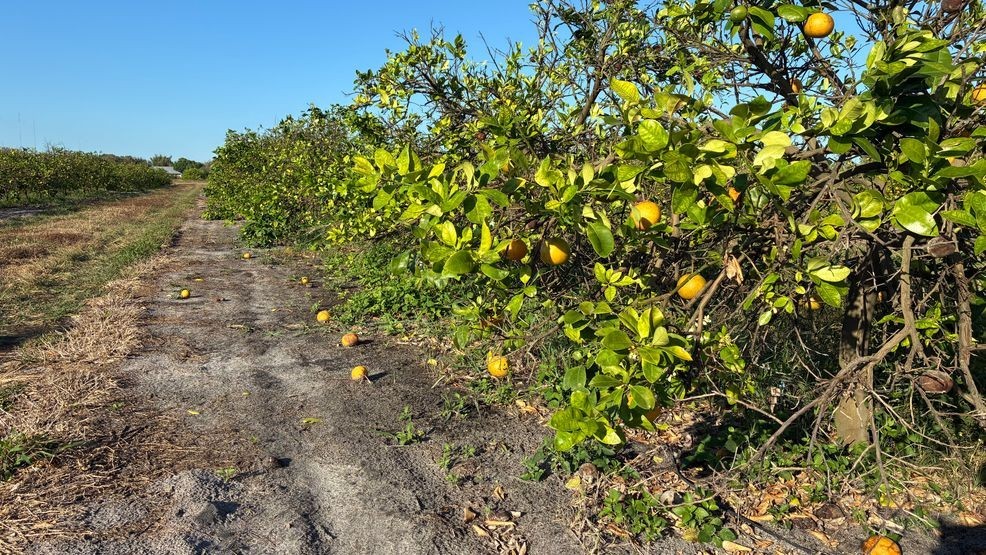
FORT PIERCE, Fla. (CBS12) — The future of Florida’s citrus industry may be growing on a 20-acre grove in Fort Pierce. Researchers at the University of Florida’s Indian River Research and Education Center are closer than ever to solving a problem that has ravaged local growers for two decades: citrus greening. Since the bacterial disease first appeared, it has decimated production across the state, but a new breeding program is showing that some trees can not only survive the infection but continue to produce high-quality fruit.
Flavia Zambon, an assistant professor at the research center, says the industry is currently at a historic low point. “We are seeing decline on the production since 2005, and we have now the lowest production this century since and 1920s,” Zambon told CBS12 News. Because a definitive cure for the disease is not expected in the foreseeable future, the focus has shifted toward creating “tolerant” varieties—trees that can sustain a crop even while carrying the bacteria.
One of the most promising results of this research is a variety known as 914, which was developed specifically through the UF breeding program. “We have some of the varieties that are showing some high tolerance and 914 is one of them. It is a product from the UF breeding program. It is a pomelo hybrid. It’s not a grapefruit itself. It is a pomelo hybrid that tastes like grapefruit,” Zambon explained. This hybrid offers a potential lifeline for growers who have struggled to keep traditional grapefruit trees alive long enough to turn a profit.
See also: Questioning the Count: Legal battles and misinformation plague PBC election
Despite the success of the 914 hybrid, researchers face a major hurdle that no amount of technology can easily fix: time. Breeding a new tree and proving its viability in the field is a process that spans decades. “It really takes time there. There are some varieties here that took 15 years to get to the field. This is a perennial tree that we need to wait three years to start having a crop and then when we need to evaluate for a couple years more,” Zambon said.
In addition to the long-term breeding cycle, local weather is playing a role in current challenges. Recent fluctuations on the Treasure Coast—swinging rapidly from 80-degree rainy days to 40-degree dry spells—have made it difficult for the fruit to last through the harvest. While these resilient trees are currently confined to the “Millennium Block” research area, the hope is that they will eventually be available to commercial growers across Florida.