
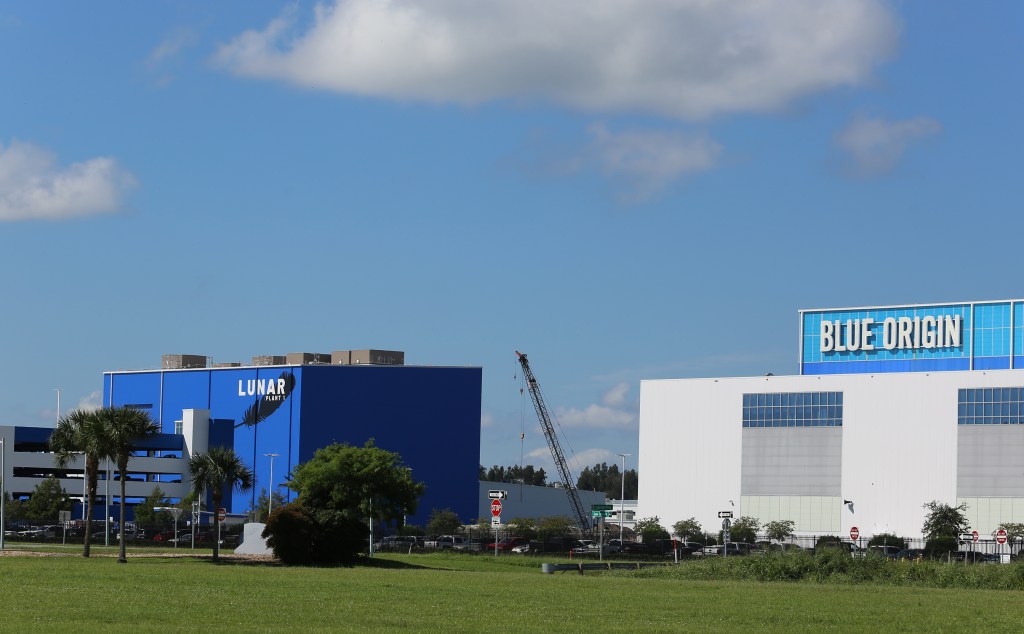
When the Florida Department of Environmental Protection announced a draft proposal to allow Blue Origin to renew its industrial wastewater output that could flow into the Indian River Lagoon, residents and government officials in Brevard County corralled enough support to get the DEP to hold a public hearing.
That support came in force during the three-hour information session at the UF/IFAS Extension Building Cocoa on Friday night.
About 200 people crammed into the small building for the opening of the event, although by 6 p.m., the crowds had dissipated. About 20 personnel from Florida DEP as well as representatives from Blue Origin were on hand with informational placards to talk one-on-one with concerned citizens.
“I think a lot of people have had a lot of questions answered,” said Brevard County Commission Chairman Thad Altman. “There are some that are still not satisfied. That’s to be expected, but at least it’s better than not having a hearing at all. So I think it was positive.”
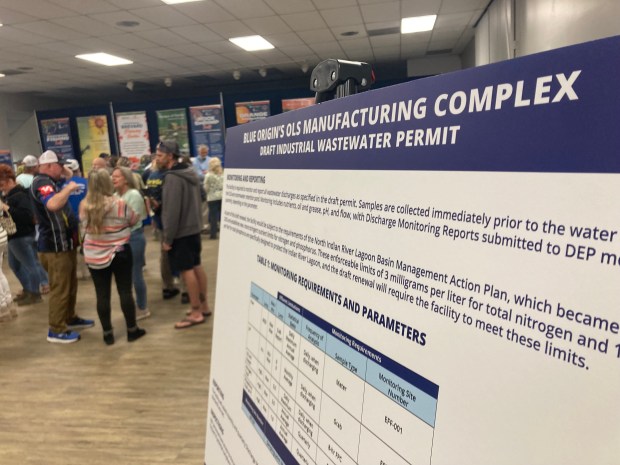 An informational placard details some of the information behind Blue Origin’s wastewater permit request, seen during a public hearing put on by the Florida Department of Environmental Protection in Cocoa on Friday, Jan. 30, 2026. (Richard Tribou/Orlando Sentinel)
At issue was the desire of officials at Jeff Bezos’ company to generate nearly 500,000 gallons of wastewater daily at Blue Origin’s Merritt Island facilities that would affect the Indian River Lagoon. The original draft permit that was published last November sought to allow Blue Origin to operate an industrial wastewater treatment facility that could dispense up to 490,000 gallons. Of that total, up to 15,000 gallons per day could be “non process” wastewater.
Last fall, Blue Origin simply took the stance it was asking to continue a process already in place.
“This is a renewal of an existing agreement that has been in place for more than five years,” the company said in an emailed statement. “We are committed to maintaining responsible and compliant operations.”
Questions about what the proposal meant for the sensitive Indian River Lagoon, and what exactly some of the wording meant, were not readily answered. Brevard County commissioners then voted to seek a public hearing and encouraged residents at a packed meeting late last year to write the DEP and request it as well.
That’s what the Friday meeting was all about, with the DEP stating it intended “to provide an opportunity for the public to ask questions, offer input and obtain information about the industrial wastewater permit renewal application.”
Turns out the “non process” water meant water that was not directly part of manufacturing at the site. In this case it would be cooling water used for commercial air-conditioning cooling towers.
After the public response, Blue Origin amended its application to remove the “non process” aspect of the permit request, and lower the overall total daily maximum to 467,000 gallons per day.
Of note, the Florida DEP has a Basin Management Action Plan that requires any wastewater treatment facility with a flow of more than 500,000 gallons per day to meet more rigorous wastewater treatment standards if they flow directly into the Indian River Lagoon or rapid infiltration basins within the lagoon watershed.
The DEP and Blue Origin also put together handouts to answer some of the biggest questions they had heard in the last few months.
Big among the talking points was their continued contention that this is simply a renewal of a permit that was granted five years ago, and that now it’s actually going to be lower than that initial permit.
Also, the facilities’ daily average is nowhere near the upper limit of the permit, averaging about 40,000 gallons per day. The wastewater would only rarely reach the Indian River Lagoon, they said.
The water comes from manufacturing activities at the OLS Manufacturing Complex site where Blue Origin builds its New Glenn rocket.
The handouts revealed it’s primarily water used for pressure-testing new fuel tanks; those tanks are empty and the water is used to confirm weld integrity. It’s also used for rinsing and flushing water softener, carbon and reverse osmosis filters and associated piping.
“All water used at the facility is monitored and reported regularly to DEP to ensure it meets strict water quality standards,” the DEP stated in its handouts.
The documents also point out the company is using water from the city of Cocoa, the same it supplies to residents as drinking water, but the company then further purifies it before it lets it near its hardware.
The informational documents stated the manufactured parts do not contain rocket fuel or other hazardous substances and that it meets all surface water quality standards including new requirements put in place in 2025 by the North Indian River Lagoon Basin Management Action Plan, although those are primarily focused on nitrogen and phosphorus content, which are an issue with agricultural runoff.
The discharge heads into a large stormwater pond with more than 400,000 square feet of surface area, and only flows into the sensitive Indian River Lagoon in north Brevard County during heavy rain events through a three-mile drainage ditch system, which itself has engineered controls that manage and limit water movement.
The DEP and Blue Origin also argued that while the permitted amounts seem large, they are relatively small in comparison to normal rainfall in the area.
“Even if the pond reaches its holding capacity during heavy rain events, the amount of water reaching the lagoon would be far less than what enters the system during a typical rainstorm,” the handout reads.
Some of the residents were not completely satisfied, including Laurilee Thompson, who is a partner in Titusville restaurant Dixie Crossroads, and is a board member of the Merritt Island Wildlife Association.
Asked if she learned anything, she replied, “I learned that the DEP guys kept saying, ‘I can’t answer that.’ ‘I can’t answer that.’ ‘I can’t answer that.”
She also noted the handouts were “very defensive for Blue Origin” and said she’s still concerned with the threat of a freshwater flow into the brackish estuary that is the lagoon.
“They keep saying, Oh, the water is clean enough to drink. Actually doesn’t matter. It’s still poisonous to the estuary,” she said.
Others on hand found the information useful, though, and noted more communication from businesses and the government around the growing space industry in north Brevard County can only help.
“The amount of growth we’re going to see up here at Kennedy is going to be huge, and the impacts will be equally huge,” said Duanr De Freese, executive director of the Indian River Lagoon National Estuary Program. “So that tension is, how do you do it? Not just faster, but you want to do it better — faster, cheaper, but also better.”
Altman thinks this sort of public hearing and the public outcry has been effective as far as Blue Origin goes.
“I do think they’re going to be a good corporate citizen, and they want to do the right thing. I think good will come out of this, and I think you’ll see further changes made to lessen any potential impact,” he said.
In addition to the meeting, the DEP has opened a public comment period that will run through Feb. 6.
“All comments received will be reviewed and considered before the department takes final action on the permit application,” the DEP stated.
At the meeting, the DEP revealed comments could be made by email to DEP_CD@FloridaDEP.gov.
On the original DEP notice at https://floridapublicnotices.com/notices/11397829, it noted public comment could be made by sending mail to Randall Cunningham, 3319 Maguire Blvd, Suite 232, Orlando, Florida 32803-3767.