
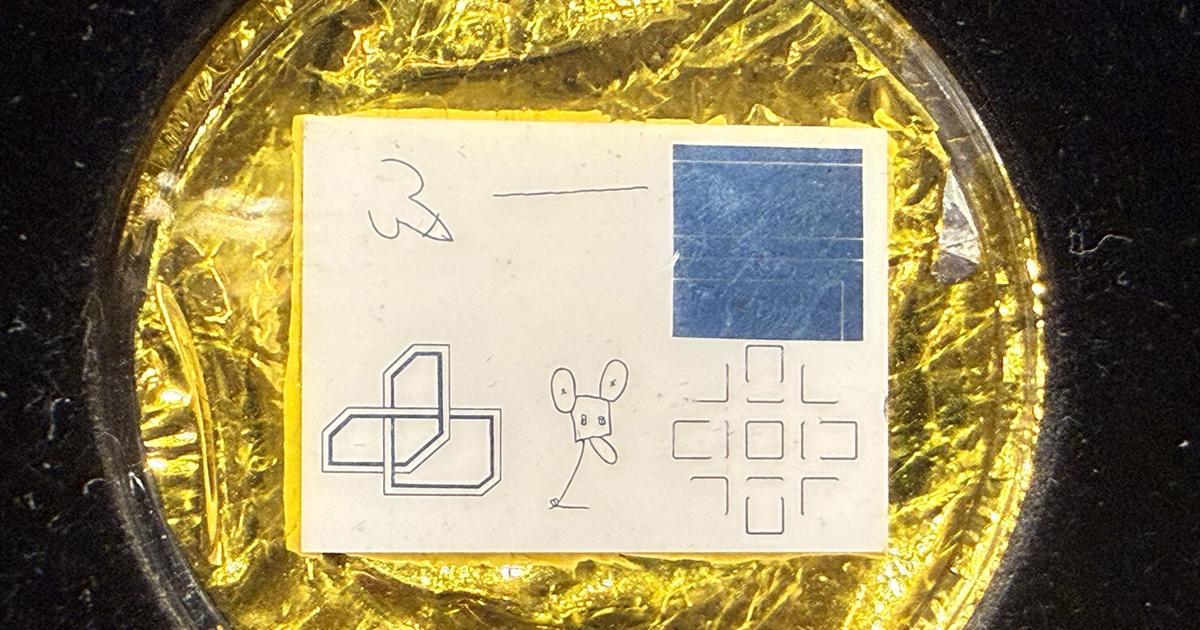
The Marco Island Center for the Arts joined in the celebration of Bob Rauschenberg’s birth centenary and hosted a visit by Jade Dellinger, Director of the Bob Rauschenberg Gallery at Florida SouthWestern State College. Dellinger also brought with him a small ceramic chip that contained artwork by six prominent artists from the late 1960s. Attendees had the rare opportunity to a first-hand viewing of the famed secret Space Art/Moon Museum.
The ceramic wafer is considered to be the first space art object and was “allegedly” snuck and covertly attached to a leg of the Lunar Module Intrepid and subsequently left on the moon during Apollo 12’s landing in 1969. It is impossible to verify if the Moon Museum is on the Moon without sending another moon mission to check on it, but technicians associated with the launch have admitted to placing personal effects onto the Apollo landers, “hidden” in the layers of gold blankets that wrapped parts of the leg of the lunar module Intrepid and left on the Moon after the astronauts departed.
The famous 1960s artists with works included in the “Moon Museum” are Bob Rauschenberg, David Novros, John Chamberlain, Claes Oldenburg, Forrest Myers, and Andy Warhol. The concept for the Moon Museum was brainstormed by sculptor Forrest “Frosty” Myers who had the idea to get six great artists together to make a tiny little museum that would be on the moon. Frosty tried to get this sanctioned by NASA, and though they never said no, they also did not say yes. So, a back route emerged to smuggle the Moon Museum on board the Intrepid.
Myers worked with scientists from Bell Laboratories, and using techniques used to produce telephone circuits, the scientists etched the drawings onto a small ceramic wafer. About 16-20 of these wafers were created with one going on the Apollo 12 lunar lander, and copies of the original were handed out to artists and those involved in the project.

The Space Art Object was “allegedly” snuck and covertly attached to a leg of the Lunar Module Intrepid and subsequently left on the Moon by Apollo 12 in 1969. Original photo by NASA.
Each of the artists had been gifted a chip as a souvenir and some of them maintained them; Rauschenberg’s is in his Foundation; Claes is with his estate; Andy’s chip is with the Warhol Museum in Pittsburgh, and Chamberlain probably gave his to a girl at a bar.
The Moon Museum is the smallest object in the Museum of Modern Art’s permanent collection. It is part of the collection of the Metropolitan Museum and the National Gallery of Art in Washington, D.C. All over the world, many exhibits have been occurring to celebrate what would have been Robert Rauschenberg’s 100th birthday year.
Bob Rauchenberg has a connection to Southwest Florida. According to Dellinger, he bought a property on Captiva Island in 1969, and “the Gulf of Mexico was much like Port Arthur (where Rauschenberg was born and raised) in terms of being on that body of water. Captiva also provided him the isolation that he needed at the time. There wasn’t even a bridge to the island. You had to take the ferry to get there.” Rauschenberg lived there until his death in 2008 – he was 82 years old.
Enthusiastic guests had a lot of questions for Jade Dellinger and Tom Hall on Bob Rauschenberg’s contribution to Art.
According to Dellinger, Robert Rauschenberg is the most influential visual artist of the second half of the 20th century, the progenitor of Pop Art and the precursor to Minimalism and Conceptualism.
Tom Hall previewed a brief mini-documentary on Bob Rauschenberg. “He (Rauschenberg) could have lived anywhere in the world but he chose Captiva Island, Florida,” said Hall. “He was deeply connected to Southwest Florida and lived in our community for more than four decades. He put Ft. Myers on the art world map.”
The Bob Rauschenberg Gallery was founded as the Gallery of Fine Art in 1970 at Edison Community College, now known as Florida SouthWestern State College (FSW). The Gallery of Fine Art was renamed The Bob Rauschenberg Gallery in 2004 to honor and commemorate their long-time association and friendship with the artist.