
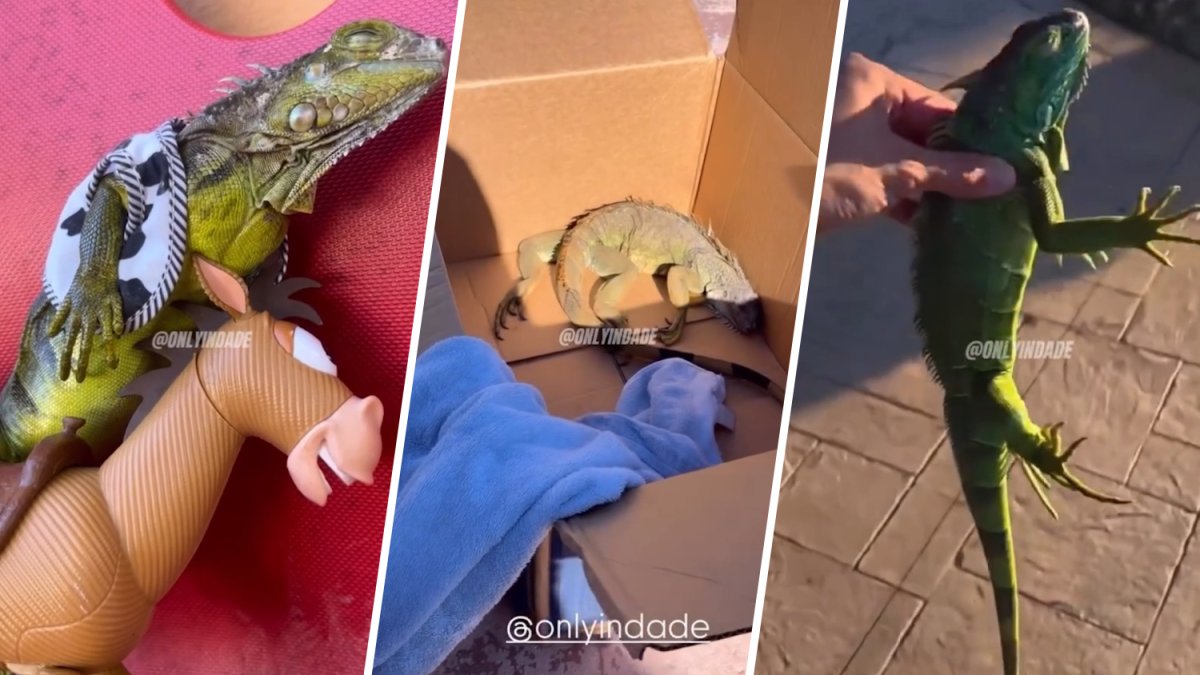
Meteorologists warned us this would be a common sight, and it happened: intense cold has arrived in Florida, and iguanas fell victim to the chilly weather.
As a cold front sweeps through South Florida, bringing historically low temperatures, it comes as no surprise that many iguanas have been left frozen and immobile.
While some people watch from afar, others take action to provide warmth and help revive these reptiles.
The cold front responsible for the drop in temperatures comes with a freeze warning starting at 7:00 p.m. on Sunday. According to the National Weather Service (NWS), this warning will remain in effect until 9:00 a.m. on Monday, covering areas in Miami-Dade, Broward, and Palm Beach counties.
Only in Dade shared multiple posts showing residents carrying iguanas, warming them inside cars, using towels, and even blow dryers.
However, there are regulations in place. The Florida Fish and Wildlife Conservation Commission (FWC) has issued an order allowing the public to capture these reptiles for a limited time.
FWC Temporarily Permits Iguana Capture
On Friday, the Florida Fish and Wildlife Conservation Commission issued an executive order permitting individuals to temporarily capture green iguanas that are stunned by the cold, without requiring a special license.
Green iguanas are an invasive species in Florida and pose significant environmental and economic risks to the state, the FWC stated.
Where Can You Take Stunned Iguanas?
FWC staff will accept cold-stunned iguanas collected by the public on Sunday, Feb, 1, and Monday, Feb, 2, during the following hours:
Sunday from 9 a.m. to noon
Monday, February 2nd, from 8 a.m. to 4 p.m.
Drop-off locations include:
FWC South Florida Regional Lab, 2796 Overseas Highway 119, Marathon
FWC Office, 10052 NW 53rd Street, Sunrise
FWC Tequesta Field Lab, 19100 SE Federal Highway (U.S. 1), Tequesta
FWC Law Enforcement Office, 2423 Edwards Drive, Fort Myers
FWC Southwest Regional Office, 390 Drane Field Road, Lakeland
Property owners or members of the public, with the owner’s consent, can remove green iguanas. These regulations also apply to properties managed by the Commission in the southern and southwestern regions of the state.
How to Safely Capture Frozen Iguanas
The FWC advises using protective gloves, long pants, and long-sleeve shirts to avoid scratches. Iguanas should be placed into a secure, escape-proof bag made of breathable fabric, which must be tightly sealed. Only cloth bags are approved as primary containment methods to allow for sufficient ventilation.
Before transportation, the sealed bag should be placed inside a secondary locked container labeled “Prohibited Reptiles.” Iguanas collected by the public should be delivered to the FWC immediately to reduce the chances of them regaining mobility.
During transit, collection bags must remain sealed until dropped off with FWC staff to prevent escape or injury in case the iguanas recover from their stunned state.
When temperatures approach freezing or dip below, reptiles and amphibians, including green iguanas, may enter a state of torpor, temporarily losing muscular control and, in some cases, falling from trees.
The FWC cautions the public against taking cold-stunned iguanas into homes or buildings for warming purposes, and recommends against placing them in vehicles unless transporting them directly to an FWC office.
This story was translated from Spanish with the help of a generative artificial intelligence tool. An NBC digital editor reviewed the translation.