
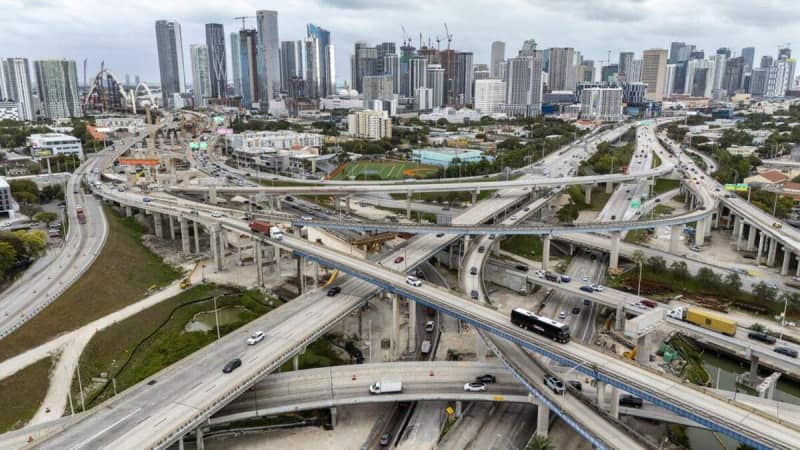
Every morning and every evening, tail lights bathe Miami’s major highways in red. Despite traffic being at a near standstill, drivers manage to cut each other off. Horns whine in constant protest.
Greater Miami is the second most traffic-congested metro area in the United States, trailing just Los Angeles, according to a new report by location technology company TomTom.
That’s meant longer trips for commuters and more car dependence, particularly in greater Miami’s increasingly far-flung developments, where public transit is limited — spelling higher costs for residents who are struggling with affordability. Miamians already spend more on transportation than residents of any other large U.S. metro area.
Miami’s traffic surge has accompanied its population boom during and after the pandemic. And as housing prices in and around the urban core have surged, more commuters have been pushed farther from their jobs — south, toward Homestead, or north, to Broward and even Palm Beach counties.
On an average day in 2025, traffic made Miamians’ trips nearly 50% longer than they would have been on clear roads — up almost 20 percentage points from 2019, according to data from TomTom. During rush hour, drivers crawled along at an average speed of just under 19 miles per hour.
In the morning, the average congestion level — which TomTom defines as the percent increase in travel time compared to free-flow conditions — was 74%, with drivers averaging 20.1 miles per hour. During the evening commute, congestion rose to 89%, and drivers crept along at 17.7 miles per hour.
On the worst day, congestion peaked at 114%, and it took drivers 15 minutes to crawl less than 4 miles.
That’s a lot of time in the car.
Last year, the average greater Miami commuter spent roughly 36 minutes driving to work, according to data from the U.S. Census Bureau. While the census doesn’t track trips home from work, TomTom’s report suggests that evening rush hour trips are roughly 11% slower than morning commutes, so it follows that that same driver spent 40 minutes in the car on the way home.
That works out to 76 minutes behind the wheel each workday, or 19,700 minutes per year — just under two full weeks spent navigating some of the most congested roadways in North America.
Heavy traffic can mean people show up late to work and leave early, affecting both workers’ productivity and that of their employers.
It can also shape career decisions that impact people’s advancement — what jobs workers feel they can reasonably make it to, given commute times, said Cathy Dos Santos, director of Transit Alliance, a local nonprofit promoting walkability, bikeability and better public transit.
It’s a matter of zoning, said Dos Santos.
Greater Miami is built low and spread out — dominated by single-family homes that take up lots of land. As people moved into South Florida over the past decade, the region had to make room for them. And if it wasn’t going to build up, it had to build out.
That outward growth pushed residents farther from the places where they work, shop, dine out and study, deepening their reliance on cars. “It’s really hard to provide good public transportation options in those areas,” Dos Santos said. “Basically, we force everybody to drive.”
At the same time, she added, much of the transportation funding that could go toward transit instead goes to expanding highways — a short-term fix that often does little to fix congestion in the long run, she said.
The phenomenon is known as induced demand: Add more road space, and people will drive more, creating even more traffic.
“For billions of dollars,” Dos Santos said, “we end up, in as little as a couple of years, with the exact same problem.”
For starters, “(Miami) should look beyond lane-widening” — or increasing highway space — to address its traffic crisis, said Pete Costello, a senior account manager at TomTom.
One potential option: land-use changes. Building more housing near transit, something both the city of Miami and Miami-Dade County have tried to promote, is part of the equation, said Dos Santos, especially if it’s affordable housing.
But another, less obvious, fix could be parking reform.
“Parking is absolutely central to creating that (traffic-generating) sprawl,” Dos Santos said.
Local zoning codes often mandate 1.5 to two parking spaces per housing unit. But only half — 53% — of greater Miami’s 2.4 million households have more than one car, according to data from the U.S. Census Bureau.
The Transit Alliance estimates that, in Miami-Dade alone, parking requirements mandate roughly a half-million more parking spaces than are actually needed. Reducing those requirements could free up land for gentle increases in density, which would make public transit more viable and households less car-dependent. When homes are spread out — that is, when density’s lower — people often have to travel too far to reach a transit stop, so they end up driving instead.
“It doesn’t mean that, just automatically, less parking is going to exist,” Dos Santos pointed out. “Let’s allow the private market to tell us how much parking they need.”
Making it easier to get around on bike or foot could also help reduce congestion, said Costello.
If people could more comfortably walk or bike for short trips — to work, the grocery store, the salon — that would ease traffic and help Miami residents cut back on car-related expenses.
In fact, because of traffic delays and the cost of driving, short trips by foot or bike are already competitive with driving, said Dos Santos. But the problem is infrastructure. Protected bike lanes, safer crossings and pedestrian-friendly streets are still lacking across much of greater Miami.
But for local governments, those projects can be relatively quick, effective and, crucially, inexpensive alternatives to large-scale transit investments.
“We’re not talking about billions of dollars, we’re talking about millions,” said Dos Santos, adding that such projects are often easier to maintain and cheaper to operate than major transit systems.
“It’s a step toward getting more people for those short trips, from point A to point B,” she said.
This story was produced with financial support from supporters including The Green Family Foundation Trust and Ken O’Keefe, in partnership with Journalism Funding Partners. The Miami Herald maintains full editorial control of this work.