
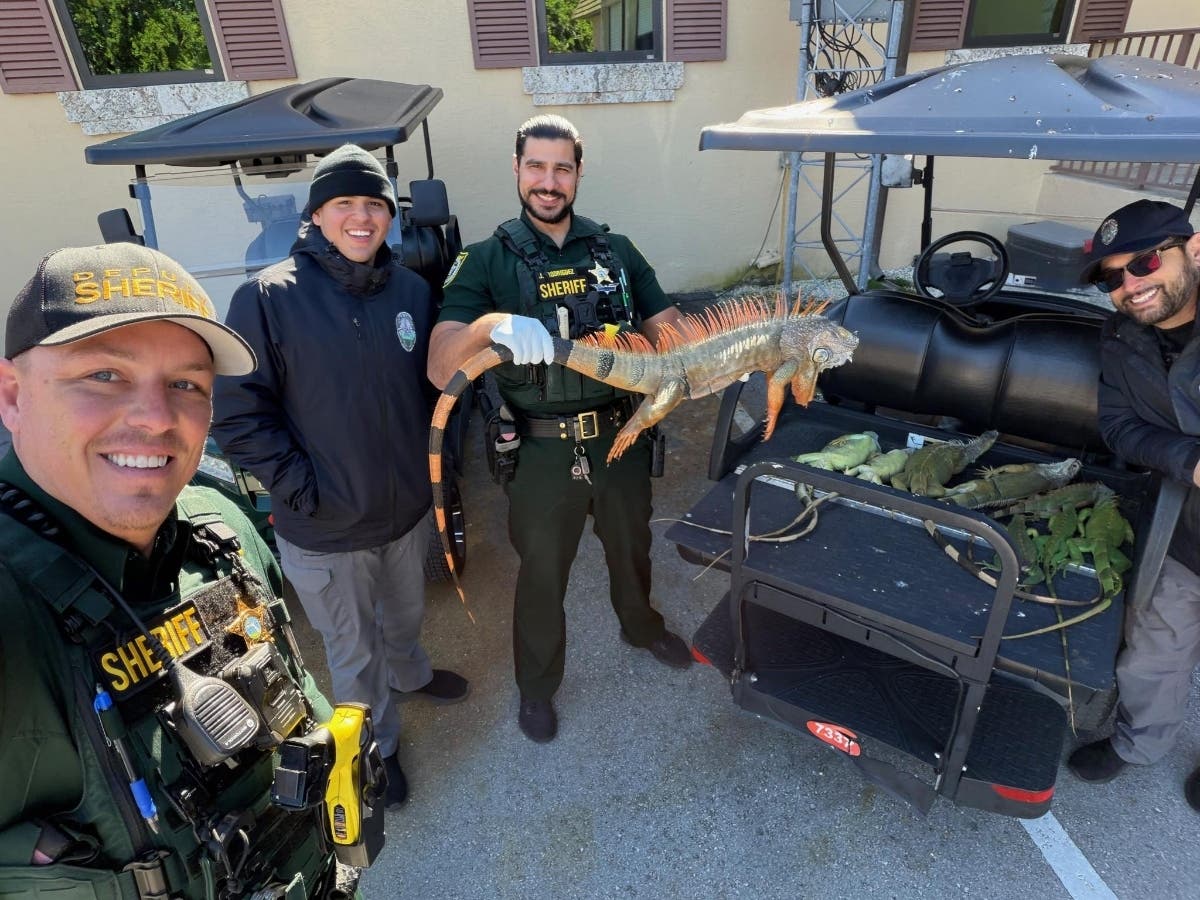
After a strong cold front brought wind chills in the teens and low 20s, as well as snow flurries, to parts of the state over the weekend, the Florida Fish and Wildlife Conservation Commission is temporarily allowing people to remove live, cold-stunned green iguanas from the wild without a permit.
The frigid temperatures continue Sunday night into Monday with wind chills as low as 17 degrees to the upper 30s across the Tampa Bay area and a freeze warning in all counties in the region except Pinellas, according to the National Weather Service.
People can bring these iguanas, an invasive species, directly to five designated FWC offices in the South and Southwest Regions on Monday from 8 a.m. to 4 p.m.:
FWC South Florida Regional Lab, 2796 Overseas Highway 119, MarathonFWC Office, 10052 NW 53rd, SunriseFWC Tequesta Field Lab, 19100 SE Federal Highway (US 1), TequestaFWC Law Enforcement Office, 2423 Edwards Drive, Fort MyersFWC Southwest Regional Office, 3900 Drane Field Road, Lakeland
Freeze warnings are in place for inland areas of South Florida, and widespread temperatures will range from the mid-20s to the low-40s across the region, the National Weather Service’s Miami office said.
Temperatures this low come with the likelihood of green iguanas, an invasive species that are prevalent across South Florida communities, falling from trees.
“When it gets this cold like this, it’s funny to those who aren’t from here to see the news people talking about iguanas falling from trees, but … it can and will happen,” said Joe Wasilewski, a conservation biologist with the King Cobra Conservancy and a member of the International Union for Conservation of Nature’s Iguana Specialist Group, previously told Patch.
He added, “If it’s under 40 (degrees), it’s gonna happen. If it’s in the 50s, they’re slow. If it’s in the 40s, they’re on the brink of falling. And if it’s in the 30s, they’re down.”
Green iguanas, which are cold-blooded, were introduced to Florida decades ago from Central and South America.
Those are areas “that very rarely dip below 45 or 40 degrees,” Dermot Bowden with the South Florida Herpetological Society, previously told Patch. “It just doesn’t happen, so they’re not that cold tolerant. So, the few times the temperatures get that low here, they get what we call cold stunned.”
Usually, that “magic number” is 45 degrees, he said. Any temperature below that, and the iguanas become inactive, meaning they’re more likely to fall from trees and other high places in which they might be sleeping or hiding.
People often mistakenly think the lizards found lying on the ground during a cold snap are dead, but they aren’t.
If anyone comes across a cold-stunned iguana, “the best thing to do is just leave them the way they are,” Bowden said. “They will recover.”
As temperatures rise, usually when they hit around 50 degrees, the lizards start moving again. It’s only when the extreme cold lasts for several days that the iguanas can’t recover, he said.
The FWC’s special “special regulations under Executive Order 26-03 provide a unique opportunity for members of the public to remove green iguanas from their property during this unusual cold-weather event and bring them to the FWC, no permit required, to be humanely killed or, in some cases, transferred to permittees for live animal sales,” the agency said.
Normally, green iguanas are a prohibited species in Florida and, other than during this executive order, people can’t possess them, even temporarily while taking them to an FWC office or elsewhere.
Under the executive order, people without a permit may only have live green iguanas to bring them to the FWC.
The removal of these iguanas may only be done by property owners or by members of the public with landowner permission.
Those collective live, cold-stunned green iguanas should wear protective gloves, pants and long-sleeved shirts to protect themselves from potential scratches, the FWC said.
The iguanas must be contained in a secure, escape-proof, cloth sack or bag. The bags should remain closed or sealed until they are brought to FWC staff to keep the iguanas either from escaping into a new location or getting loose in a vehicle.