
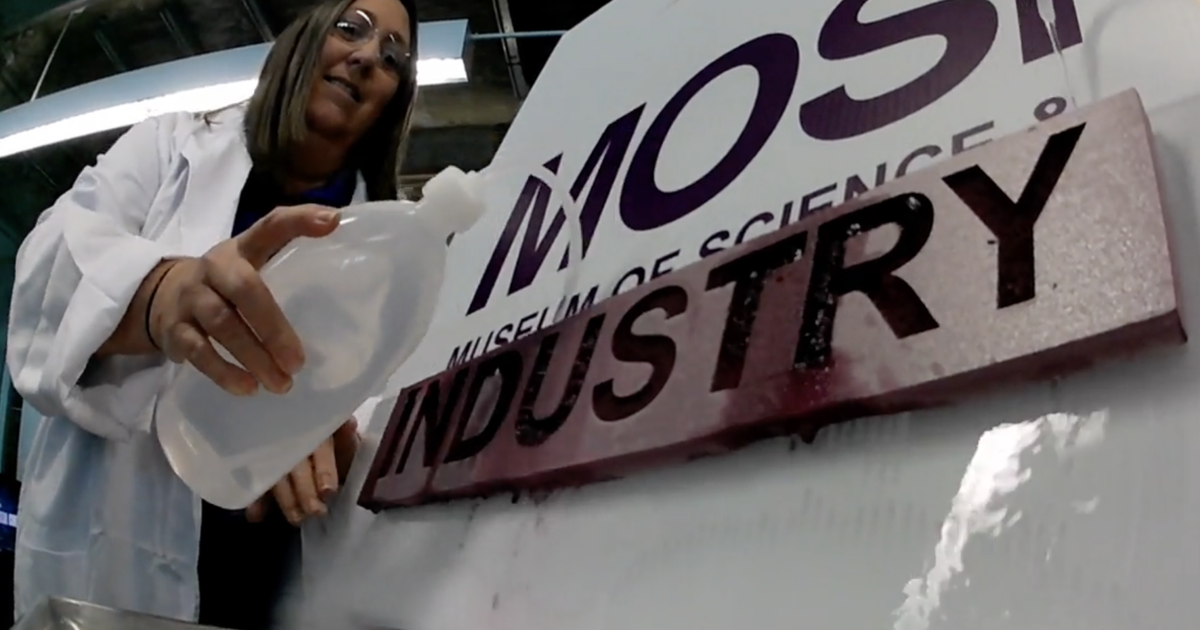
TAMPA — The Museum of Science and Industry is no more.
MOSI, however, lives on.
The longtime Tampa museum on Fowler Avenue announced its name change, its third since it opened in 1962 as the Museum of Science and Natural History, the best way a science museum can — with a scientific presentation.
Museum staff poured Acetone over the word industry laser cut into Styrofoam. The chemical reaction melted the word, revealing a new i-word behind it —“innovation.”
Changing the name to the Museum of Science and Innovation is a change that John Grayson Smith, MOSI’s president and CEO, thinks is overdue. He said the new name better reflects the museum’s mission and the direction it’s heading.
There won’t be any more confusion between MOSI and the Museum of Science and Industry in Chicago, which predates MOSI by more than 30 years.
MOSI has been on a mission to renew and expand since Smith took over in 2022 with the directive to turn it around. He previously revitalized museums in New York and Pennsylvania. Since his arrival, there have been numerous changes, including the reopening of the Saunders Planetarium in April of last year.
Smith believes the core mission of the museum should be teaching young learners about the scientific world and about the jobs of the future. Toward that end, MOSI also announced an expansion of learning space among three areas adjacent to the Dome.
Classroom space to the tune of 30,000 square feet is now in use for school field trips and breaks, increasing the capacity of the museum to host field trips from one school per day to four.
“That allows us to put 300 kids at once in the Dome and a different 300 kids in the classrooms and a different 300 kids on the floor of the museum and a different 300 all eating lunch and so, instead of 300 as a daily max, we can now do 1,200 as a daily max,” Smith said.
That’s important, he said, because schools often want to do their field trips at the same time due to calendar and testing constraints. Typically, the museum would have had to turn other schools away if one had already booked that day.
“You can only get turned away so many times before you say, ‘Oh, well, forget it, we’ll go some other place’,” Smith said.
Furthermore, he said, Hillsborough County Public Schools recently directed that all fourth-grade students take a field trip to MOSI. He said this additional space will be essential to accommodating that directive.
In addition to the new classroom space, MOSI announced its new Digital Content Lab, largely funded by Bloomberg Philanthropies. The lab is full of state-of-the-art computers and equipment that will enable learners to experiment with technology.
Mackenna Wood, an astronomer and the museum’s Director of the Saunders Planetarium, is most excited about the ways that equipment can be used to create new content for the planetarium and enable the planetarium to be used to display the creativity of young learners.
“If they want to make a 360-degree movie of a bear riding a bicycle around the outside of the Dome, they can do that on these computers (in the Digital Content Lab), which all have visual development software,” she said. “Then we can bring it over to the show and we can put that on the Dome and then actually see students’ work on this giant eight-story screen.
She added: “It’s a really great opportunity for us to take what we have over there in the Saunders Planetarium — already a state-of-the-art system, already the second largest planetarium in the country — and really take it to the next level with new content and new experiences for students.”
Wood said the museum has also entered into a partnership with the University of South Florida to enable their graphic design students to use MOSI’s new facilities to advance its students’ learning and enable them to work on longer term projects.
The lab is also connected to the nearby Maker Space, which is equipped with 3D printers, laser cutters and other equipment students can use to turn their ideas into physical objects.
Jose Catayo, an education specialist at MOSI, detailed the specifications and the software installed on the computers. He demonstrated how a student might use them, as in the museum’s popular Saturday workshop, Minecraft Mania or during the Minecraft modding camp available in the summer.
“I’m really looking forward to what kids will be able to do with these tools in their hands,” he said. “Because not everybody is able to afford all these really nice computers at home or even at school, so having them in a place where they have access to these top-of-line tools is going to be a game changer for them.”
According to Smith, the additional classroom space and the new labs are just one among a series of phases of the same project.
Already, the new Dome has increased gate attendance by 35%, justifying even more projects. The funding for these phases came from various places, including the operational budget, the county and Raymond James, which funded the amphitheater.
And they’re not done.
“The next big thing that we’ll be unveiling — we’re not talking real specifically yet — but what was the old planetarium in the other building, that domed room is going to be repurposed into a new state-of-the-art experience — let’s say — in 2027,” Smith said.