
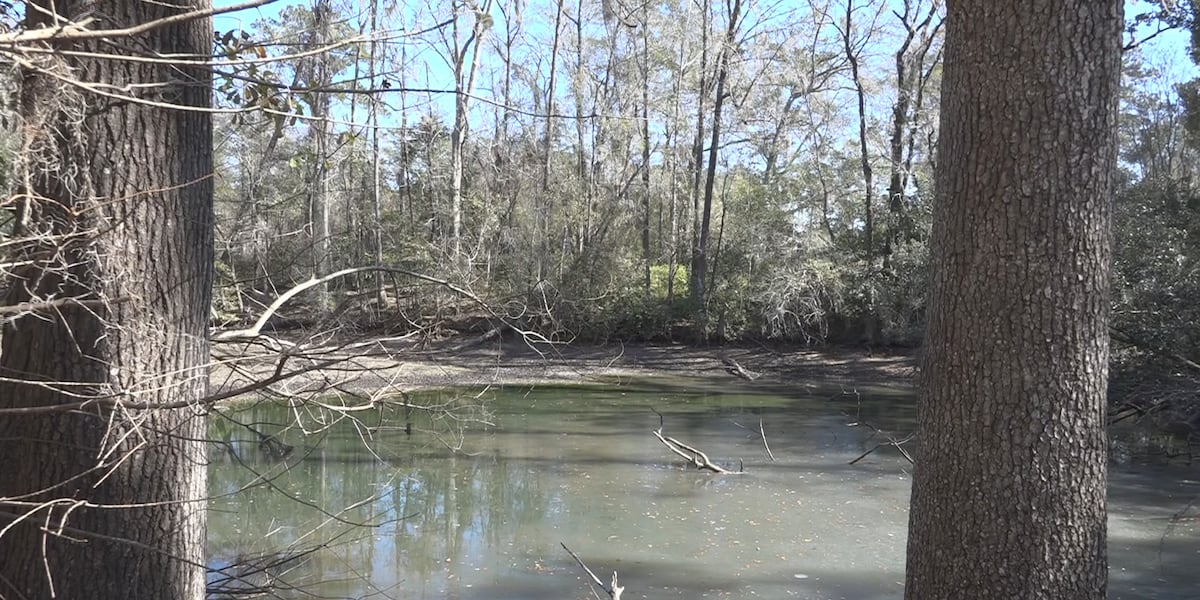
TALLAHASSEE, Fla. (WCTV) – Neighbors are still a bit rattled after a harmful algae bloom was discovered near Dorothy Oven Park last month, especially since the air may never have been tested.
The site was declared clear two days after the initial notification.
Terry Ryan, the president of the Tallahassee Region Environmental Group, would like to see more widespread testing of airborne toxins following harmful algae blooms (HABs) when those blooms occur near homes.
A representative from the Rose Hollow Neighborhood Association, who feared retaliation from the state or local authorities, said the neighborhood was at first really only concerned with making sure pets didn’t go to the water’s edge. But they learned of the HAB notification through social media or a news report, even though the association owns a third of the pond. Now, the association wonders if it has liability for its portion of the pond even though it borders a city park.
According to the neighborhood association contact, the Florida Department of Health told the association that there are little risks for airborne toxins if the water is still. The contact said the water is still now, but can be shaken by high winds or high water levels.
“Airborne toxins called derma toxins are prevalent in harmful algal blooms,” Ryan said. “And we’ve been urging the Florida Department of Environmental Protection Biology Department to automatically test for toxins, especially when the pond or lake is within a few hundred yards of residential area.”
Ryan said it is the Florida Department of Environmental Protection’s (DEP) job to test the water and air, while the Department of Health (DOH) sends out the alerts.
More Tallahassee news:
The January 21st alert from DOH for this bloom indicated water samples had been taken, but doesn’t mention if air samples were taken or not. By January 23rd, DOH issued an all clear.
According to researchers from the University of Michigan, HAB particles can become airborne.
“We’ve realized that not only are these important for water quality issues, but that you also generate atmospheric pollutants from these harmful algal blooms. We’re the first to show that wave-breaking of these blooms can release material into the atmosphere, which can have impacts on people breathing it in,” said Andrew Ault, an assistant professor of environmental health sciences, and chemistry, in a 2018 article.
The New York State Department of Health concurs, writing on its website that exposures can occur when droplets are inhaled. In a 2019 study from Florida Gulf Coast University, researchers found the particles, in low concentrations, could potentially travel up to a mile in the air.
A representative for DOH in Leon County referred WCTV’s questions to DEP. A DEP spokesperson has not yet responded, but if they do, we’ll update this article.
An initial DOH alert said the algae bloom occurred at a pond inside Dorothy Oven Park, though a City of Tallahassee spokesperson later clarified the bloom was in a pond adjacent to the park. According to the neighborhood association contact, some neighbors hope future testing won’t be impeded by the jurisdictional mix-up.
While they want people to enjoy the park, they also want to make sure their pond is safe.
To keep up with the latest news as it develops, follow WCTV on Facebook, Instagram, YouTube, Nextdoor and X (Twitter).
Have a news tip or see an error? Write to us here. Please include the article’s headline in your message.
Be the first to see all the biggest headlines by downloading the WCTV News app. Click here to get started.
Copyright 2026 WCTV. All rights reserved.