
A cold snap across the Palm Beach and Treasure Coast has led to an influx of cold-stunned iguanas being dropped off at Florida Fish and Wildlife Conservation Commission locations, including a busy field laboratory in Tequesta.Phil and Lisa Bennet, who recently moved to Martin County, were among those who dropped off iguanas. Your neighborhood: Local coverage from WPBF 25 News”I had never seen this before. This is new to us. We’re only new to Martin County, but it was intriguing to see this whole thing and to hear so much about it. So, we figured, why not bring it down, see what’s going on?” they said.The FWC reported that around 600 iguanas were dropped off Sunday, with hundreds more dropped off Monday. On the professional side, Steven Kavashansky, owner of Iguana Busters, said he collected 200 iguanas from a Lake Worth golf course in one day. “Our process for the last few days has just been drive around, picking them up underneath trees. So, it’s been pretty easy,” he said.Kavashansky explained that these cold-blooded reptiles are invasive to Florida and cause various problems, such as burrowing into canal banks, eating plants and making other animals sick. “They also carry the salmonella bacteria in their digestive tract. And then, some of the iguanas actually carry ticks. So, we found ticks behind here. So, that’s really bad for the horse community, for the equestrian community,” he said.It is important to note that since iguanas are considered an invasive species, once collected, they are routinely killed and not sent back into the wild.Get the latest news updates with the WPBF 25 News app. You can download it here.
TEQUESTA, Fla. —
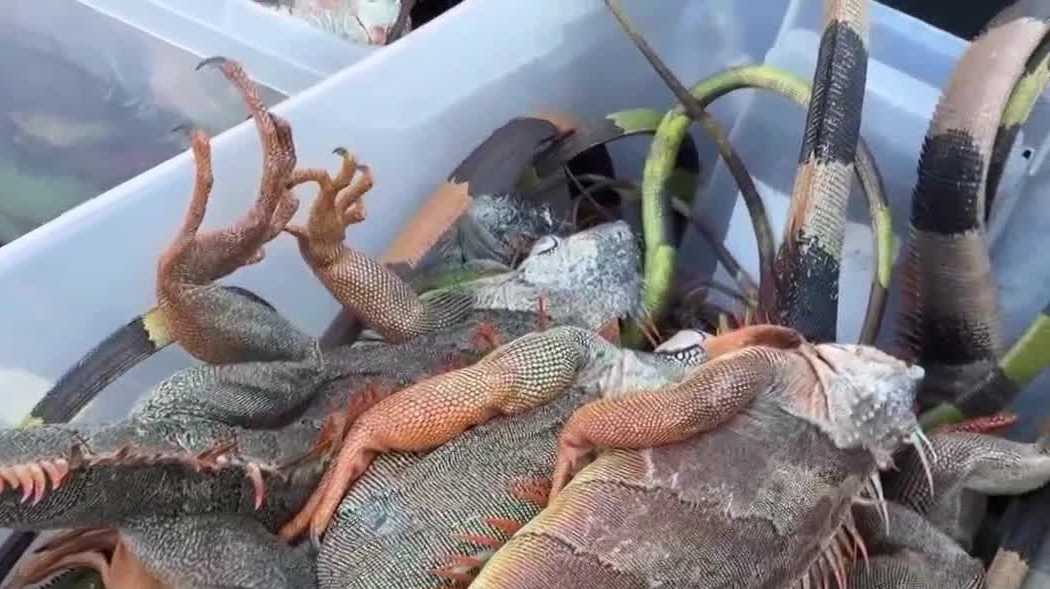
A cold snap across the Palm Beach and Treasure Coast has led to an influx of cold-stunned iguanas being dropped off at Florida Fish and Wildlife Conservation Commission locations, including a busy field laboratory in Tequesta.
Phil and Lisa Bennet, who recently moved to Martin County, were among those who dropped off iguanas.
1 of 11
Avery Moody rounding up Iguana’s in West Boynton Beach.
PHOTO: Don Sieker
2 of 11
Cold-stunned iguana
PHOTO: WPBF 25 News
3 of 11
Iguanas are freezing in North Miami Beach
PHOTO: Martín Zara
4 of 11
Frozen iguanas in Lantana.
PHOTO: Samantha Smith
5 of 11
Frozen iguanas in Lantana.
PHOTO: Samantha Smith
6 of 11
Frozen iguanas in Lantana.
PHOTO: Samantha Smith
7 of 11
Will Jacobs and Logan Delafe of Southwest Ranches are helping iguanas get to warmer locations in style on Sunday, Feb. 1, 2026.
PHOTO: Will Jacobs and Logan Delafe
8 of 11
Will Jacobs and Logan Delafe of Southwest Ranches are helping iguanas get to warmer locations in style on Sunday, Feb. 1, 2026.
PHOTO: Will Jacobs and Logan Delafe
9 of 11
Will Jacobs and Logan Delafe of Southwest Ranches are helping iguanas get to warmer locations in style on Sunday, Feb. 1, 2026.
PHOTO: Will Jacobs and Logan Delafe
10 of 11
Outdoor finds from dawn to dusk in West Palm Beach
PHOTO: Lori Stark
11 of 11
Iguana Singer Island
PHOTO: David Willow
Your neighborhood: Local coverage from WPBF 25 News
“I had never seen this before. This is new to us. We’re only new to Martin County, but it was intriguing to see this whole thing and to hear so much about it. So, we figured, why not bring it down, see what’s going on?” they said.
The FWC reported that around 600 iguanas were dropped off Sunday, with hundreds more dropped off Monday.
On the professional side, Steven Kavashansky, owner of Iguana Busters, said he collected 200 iguanas from a Lake Worth golf course in one day.
“Our process for the last few days has just been drive around, picking them up underneath trees. So, it’s been pretty easy,” he said.
Kavashansky explained that these cold-blooded reptiles are invasive to Florida and cause various problems, such as burrowing into canal banks, eating plants and making other animals sick.
“They also carry the salmonella bacteria in their digestive tract. And then, some of the iguanas actually carry ticks. So, we found ticks behind here. So, that’s really bad for the horse community, for the equestrian community,” he said.
It is important to note that since iguanas are considered an invasive species, once collected, they are routinely killed and not sent back into the wild.
Get the latest news updates with the WPBF 25 News app. You can download it here.