
Port St. Lucie, which passed a resolution last year to cooperate with the Florida DOGE effort, received no specific policy recommendation or criticism in the task force’s highly publicized report, which “exposed more than $1.86 billion in excessive wasteful spending” from county and city governments.
The city, however, was mentioned in a graph visualizing how government personnel costs have “surged” for the state’s largest cities.
The Florida DOGE effort was patterned after the federal Department of Government Efficiency, created by President Donald Trump and directed by billionaire Elon Musk.
“Across the 10 largest cities, personnel compensation increased by over $1 billion in just four years,” the Florida DOGE report said. “Of the 10 largest cities, only Orlando held its growth in personnel costs since 2021 to the level of inflation and population growth.”
Port St. Lucie officials were unavailable for comment.
Port St. Lucie’s government payroll increased by $38 million since 2021, the report said, which is the third lowest of Florida’s 10 largest cities, after Tallahassee and Cape Coral. The city saw a growth rate of 51.4% — the highest among the state’s top cities.
Orlando grew by 25.3% and its government payroll increased by $87 million since 2021. Miami had the largest payroll increase, $279 million, and the second-highest growth rate, 47.3%, over that period.
The Florida DOGE report concluded that government general-fund spending in the state’s 10 largest cities “exceeds population and inflation” by $660 million in total since 2017.
It was a culmination of the task force’s record requests to local governments and nearly a dozen site visits to areas such as Jacksonville, Palm Beach County and Gainesville.
The report focused predominately on politically Democratic-leaning regions of the state and was highly critical of excessive government salaries, DEI initiatives and policies implemented to curb climate change.
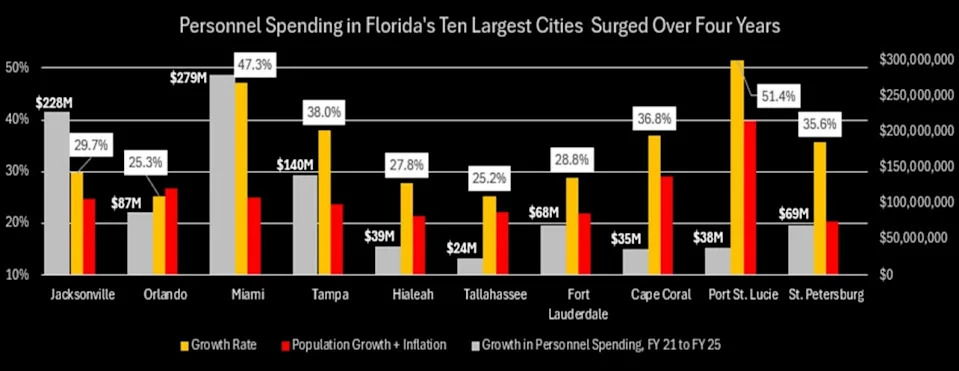
Across Florida’s 10 largest cities, personnel compensation increased by over $1 billion in just four years, and nearly $1.5 billion since 2017, according to a Florida DOGE analysis of city budget data.
Port St. Lucie, despite massive growth, has decreased its staffing ratio to 5.95 employees per 1,000 residents, down from 7.45 employees per 1,000 residents 15 years ago, city spokesperson Sarah Prohaska said in an Oct. 27 statement to TCPalm.
“Conservative financial management is the city’s foundation,” she said. “We operate with a lean, efficient government and emphasize long-range financial planning. That has allowed us to increase services while decreasing staffing ratios.”
Port St. Lucie’s total budget and revenue are 155% and 265%, respectively, more than they were 10 years ago, according to a TCPalm analysis that examined county and municipal budgets from 2016-2026.
Jack Randall is TCPalm’s economy and real estate reporter. You can reach him at jack.randall@tcpalm.com.
This article originally appeared on Treasure Coast Newspapers: Did Port St. Lucie catch a stray from Florida DOGE report?