
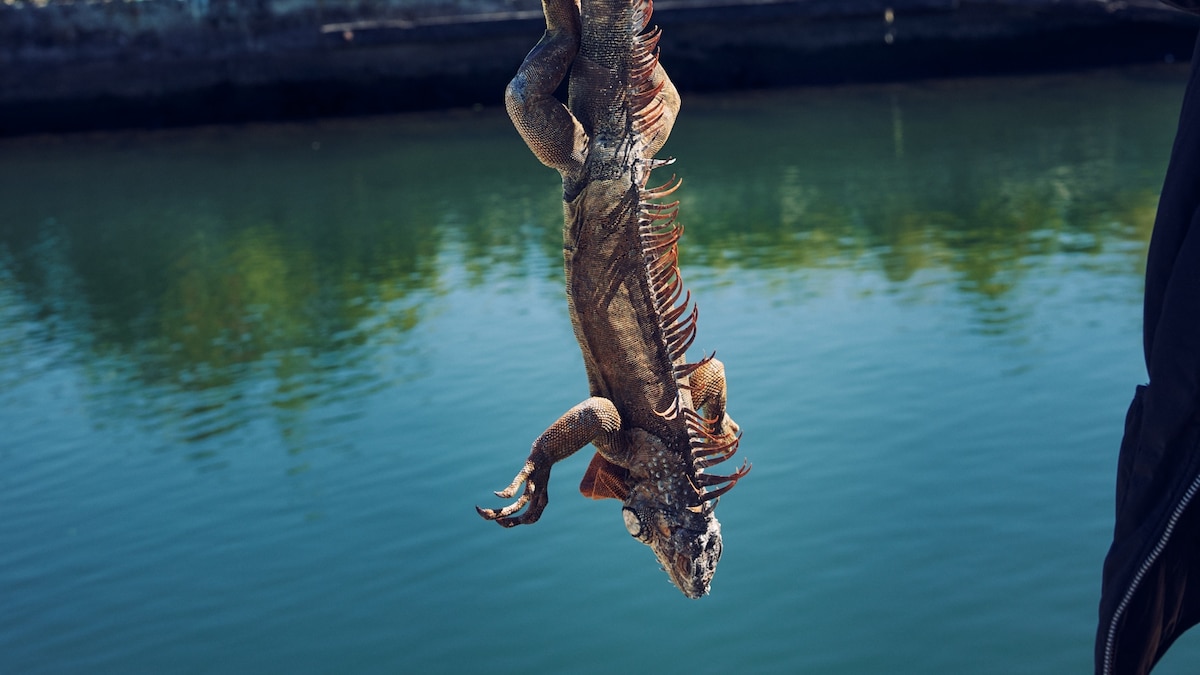
While the Western Hemisphere’s largest lizard is capable of violence, with sharp teeth and powerful, whip-like tails, these slow-moving animals mostly keep to themselves. That is, except for when a cold snap moves through the region, slamming the brakes on the iguanas’ metabolism and ultimately turning them into scaly projectiles.
“The phenomenon of cold stunning is not unique to green iguanas,” says Natalie Claunch, a wildlife biologist with the USDA Wildlife Services National Wildlife Research Center. “But the phenomenon of observing them falling from trees during these events is due to them being established in a climate outside of their native range and without many of their natural predators.”
What happens to a cold-stunned iguana?
Like all reptiles, green iguanas are ectotherms. Ectotherms’ body temperatures are mostly determined by the external environment, rather than creating their own heat like mammals.
In turn, an iguana’s body temperature influences its internal processes, such as its metabolism.
“During a cold spell, these processes will slow down and can reach a torpor-like state, where their heart rate and breathing rates are slowed down [A1] [JB2] and overall signaling in the body is slowed as a result,” says Claunch.