
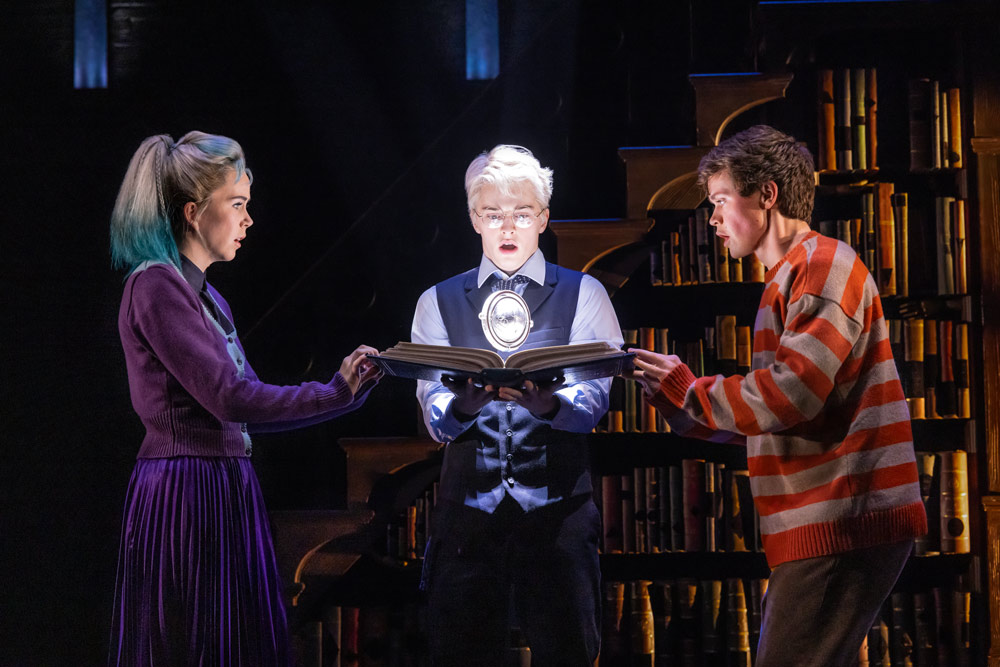
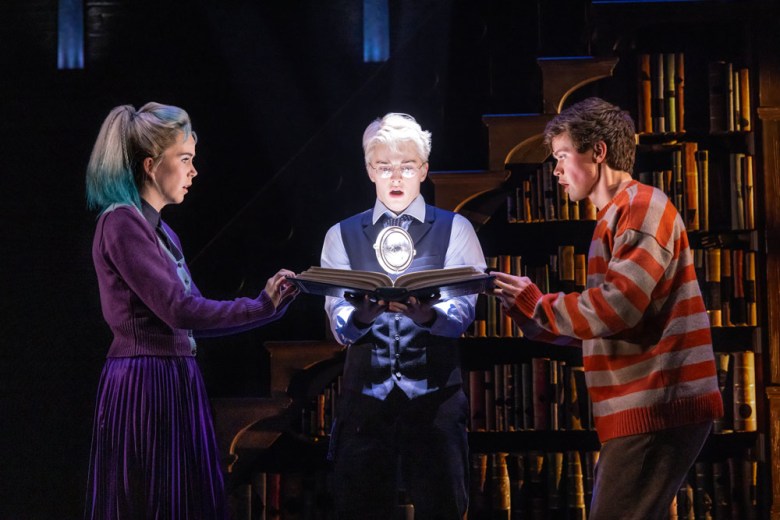
 Credit: Matthew Murphy/courtesy of Dr. Phillips Center
It’s been a quarter-century since Harry Potter and the Sorcerer’s Stone arrived in cinemas, launching Wizarding World mania into the mainstream, and many Muggles fantasize about flipping the calendar back to that less problematic era. Harry Potter and the Cursed Child, the theatrical sequel to the best-selling septology, attempts to do exactly that by employing every stage illusion in the book. But the trimmed-down touring version of this once-epic tale that’s taken over Orlando’s Dr. Phillips Center proves that even with a Time-Turner, you can’t go home to Hogwarts again.
Picking up exactly where the epilogue of Deathly Hallows ended, Cursed Child begins 19 years after the victory over Voldemort, as Harry Potter (Nick Dillenberg) and Ginny Potter (Erica Sweany) are sending their youngest son, Albus (Adam Grant Morrison), off to wizard school for the first time. Already alienated from his famous father, Albus becomes fast friends with Scorpius Malfoy (David Fine), the endearingly awkward offspring of his dad’s old nemesis, Draco (Ryan Hallahan). Delphi Diggory (Julia Nightingale), Cedric’s comely cousin, convinces the odd couple to travel back to the Tri-Wizard Tournament where he was slain and rewrite history by saving him. Unfortunately, the protagonists fall prey to the classic Back to the Future Part II trap, returning to an alternate timeline where Albus’ cousin Rose Granger-Weasley (Naiya Vanessa McCalla) doesn’t exist and the Death Eaters are back in control.
If every single word of the preceding paragraph didn’t make perfect sense to you, prepare yourself with the multi-page refresher on harrypottertheplay.com, because this show makes few concessions for the uninitiated. As scripted by Jack Thorne, from a story by him and J.K. Rowling with director John Tiffany, Cursed Child’s convoluted plotline combines alternate perspectives on familiar scenes (as seen in Universal Studios’ Escape From Gringotts ride) with the reality-warping timey-wimeyness of Epic Universe’s Battle at the Ministry. But while those attractions can be appreciated without any prior knowledge, anyone not deeply familiar with Potter lore will feel Confunded by the opening half-hour, a breakneck parade of frustratingly elliptical scenes in which hastily identified characters hurriedly shout at each other in impenetrable English accents.
Much of the play’s manic pacing must be attributed to its truncation from four acts spread across two evenings — with an original total runtime of over five hours — down to a single show that lasts less than three hours, including intermission. Sacrificed in the editing was any sense of nuance or character development during the first act, as the performers speed-read through their dense exposition so exuberantly that they sometimes seem to be in a StarKid fan-fiction parody, rather than an authorized product. Lyrical transitions devised by movement director Steven Hoggett provide the only moments of respite from the relentless verbal roller coaster; the ballets of swirling cloaks and spinning staircases are beautiful to behold, but often feel out of balance with the staccato scenes surrounding them.
What was not sacrificed was any of the spectacle, as several nonessential scenes seem to have been retained simply for Jamie Harrison’s magic tricks, which are the production’s true stars. The special effects range from amusingly effective old-fashioned “black art” levitations and cleverly choreographed body swaps to brain-bending time-warp projections (by video designers Finn Ross and Ash J. Woodward) accompanied by bowel-loosening bass (by audio designer Gareth Fry). A couple of key proscenium-breaking moments, as well as a briefly used swimming pool, didn’t make the tour for obvious technical reasons, but the flying and flame-throwers of the finale remain as impressive as they were on Broadway.
However, Harry Potter fandom was never about the special effects; it was about the characters. Fortunately, Cursed Child’s central relationship between Albus and Scorpius manages to cut through the narrative noise, thanks largely to Fine’s fabulous physical and vocal flexibility; I only wish he was able to code his character as explicitly queer on the road the way his counterpart does in New York. Morrison does an admirable job in a role that mostly requires him to whine and pout, making Albus somewhat more likable than prior interpretations. Sadly, Dillenberg is unable to do the same with the title character, as Harry’s mopey midlife crisis becomes the biggest misuse of a beloved hero since Luke Skywalker in The Last Jedi.
Standouts among the scores of supporting characters include Mackenzie Lesser-Roy as Moaning Myrtle, and especially Larry Yando as both Dumbledore and the deliciously droll Snape, who instantly evoke their iconic characters without imitating their cinematic forebears. Ultimately, however, despite a dreary series of 11th-hour scenes attempting to tug on audience’s heartstrings, the fundamental failure of Harry Potter and the Cursed Child’s father-son story to connect emotionally makes all its stagecraft sorcery disappear in a puff of smoke.
“Harry Potter and the Cursed Child” runs through Feb. 15 at the Walt Disney Theater, Dr. Phillips Center for the Performing Arts, 445 S. Magnolia Ave., drphillipscenter.org, $49-$178.
Orlando’s daily dose of what matters. Subscribe to The Daily Weekly.
Related Stories

Even for audiences willing to return to Rowling, the truncated touring version of ‘Cursed Child’ running at the Dr. Phillips Center may not connect
Two Miami bars recently issued apology statements after hosting Clavicular. That was weeks before Knight Library publicly advertised tickets to attend his ‘special’ appearance
This article appears in Feb. 4-10, 2026.
Related