
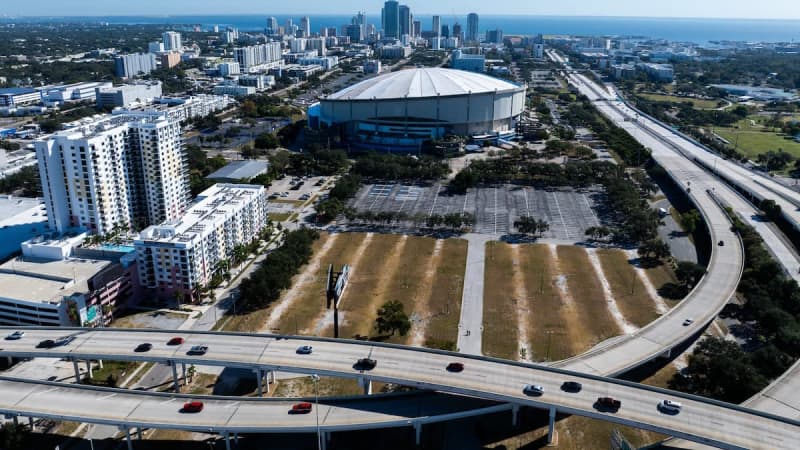
St. Petersburg received nineproposals by a Tuesday deadline as part of a renewed effort to find a developer for the Historic Gas Plant District, home to Tropicana Field.
The city’s 30-day window to submit bids for the project closed at 10 a.m. It is the third attempt in six years to devise a plan for the city’s most talked-about 86 acres.
No specific guidelines were issued as Mayor Ken Welch said the priorities from a 2022 request for proposals remained the same, with the exception of no longer considering a stadium for the Tampa Bay Rays. Competitors were invited to present alternatives to an unsolicited bid that one group, Ark Ellison Horus, made in October.
A wide swath of developers expressed interest. Several had asked the city for additional time. Welch obliged, pushing the window for submissions from November to January.
Welch said after he filed paperwork to seek a second term as mayor this week that the process to get a deal in place with a chosen developer could take months. He said his staff will look at strengths and weaknesses of each proposal. There will also be a public forum where developers will present to the community.
Any deal will ultimately be decided by the City Council, which controls the city’s purse strings. Council member Brandi Gabbard, who has said she will also run for mayor, has an item on Thursday’s agenda “expressing opposition” to Welch’s administration moving forward with selecting a developer before creating a planning framework.
At least two groups who expressed interest, Red Apple Real Estate and Kolter Group, did not submit bids of their own. Here’s what we know so far.
This development team made up of Ark Investment Management, Ellison Development and Horus Construction submitted an unsolicited proposal in October.
It includes a new 50,000-square-foot home for the Woodson African American Museum of Florida west of 16th Street South, as well as 446 affordable homes for households with low incomes to be built by 2028.
There are plans for a land bridge to Campbell Park known as “Unity Arch,” making the total area of development 95.5 acres. It would unfurl over four phases, with the project wrapping up in 2043.
The bid estimates a total investment of $6.8 billion. It would create 15,296 permanent jobs with local-hire priority, according to the group’s offer.Plans include building a music hall, an amphitheater and retail, hotel and office space.
ARK Ellison Horus is offering $202 million to buy the land, which it says includes $50 million in community benefits and covers the demolition of the Trop. To pay for it, the development team plans to pursue a mix of debt, equity and public incentives to finance each phase. That could also include using county tourist tax dollars, municipal bonds and property tax incentives through the state’s Live Local Act, which aims to promote affordable housing construction.
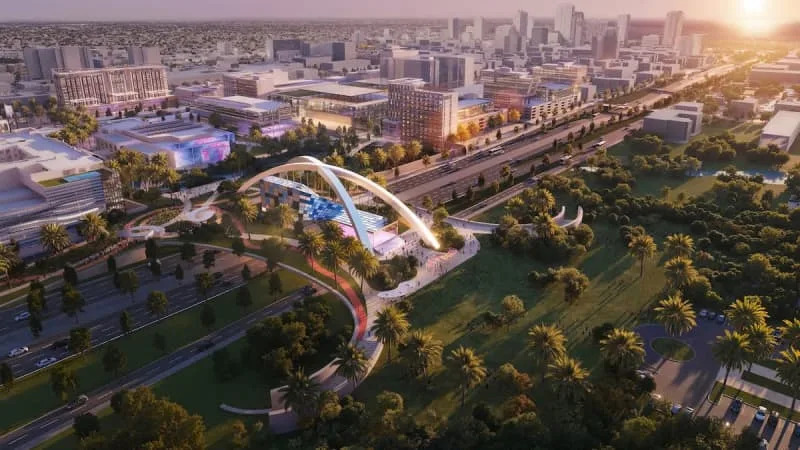
Blake Investment Partners is a local private equity firm founded by St. Petersburg native Thompson Whitney Blake. They’ve worked on several local real estate projects and are currently spearheading a mixed-use development on land next to the Jim & Heather Gills YMCA.
The Related Group out of Miami is the other lead developer on the project. Related has completed luxury and affordable housing developments in at least five countries. It has built at least 2,000 residential units in Tampa.
The centerpiece of their proposal is a 13-acre park and a pedestrian focused “museum row.” This will be a new home for the Woodson African American Museum and a public art museum co-chaired by local art leaders Chad Mize and Mark Aeling.
“We can let Art Basel have 14 days, but we want the spotlight to be on St. Pete for 50 of the 52 weeks a year when it comes to art,” said Blake in a statement.
A transportation hub would be designed to accommodate light rail to Tampa International Airport.
A small business success center called the “Collaboratorium” would offer workforce training. There’s also room for a potential outdoor water and surfing facility.
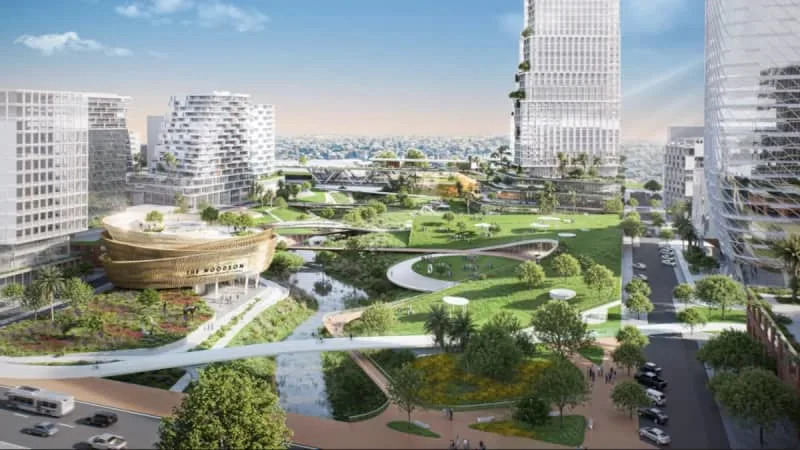
Former members of the Rays and Hines development team partnered with Will Conroy of Backstreets Capital to pitch a different kind of plan to the city.
Foundation Vision Partners is seeking to master plan the site and do all the infrastructure work — roads, streets, sidewalks and green spaces — to create development-ready parcels. The city would retain control and ownership of the site, meaning leaders could determine what kind of development would go where and sell off each piece when it gets the right proposal.
That would also allow the city to fetch better cumulative return on the land rather than unloading at once at a discount, the proposal read.
The idea comes from Conroy, former Hines development partner Alex Schapira, and Anddrikk Frazier of Best Source Consulting. Schapira and Frazier were on the Hines and Rays team that the city had selected to develop the entire site with a replacement stadium before the team did not move forward with the deal in March. Engineering firm Stantec and Gensler, the architectural firm that was also part of the Hines and Rays group, are also involved.
Under the latest proposal, St. Petersburg would pay an estimated$67 million up front for streets, sidewalks and green spaces. Foundation Vision Partners would get paid a percentage of construction costs along the way. The plan allows for different kinds of development on the site, including for competing bidders to develop and buy parcels.
Throughout four phases of development, the city would pay $239 million total, according to the proposal. St. Petersburg’s contribution for roads and sewers under the Rays and Hines plan was $142 million.
Foundation Vision Partners estimates the 86 acres are worth $299 million today. They project that if the city were to hang on to the land and phase the sale of parcels, the city could stand to make an extra $210 million.
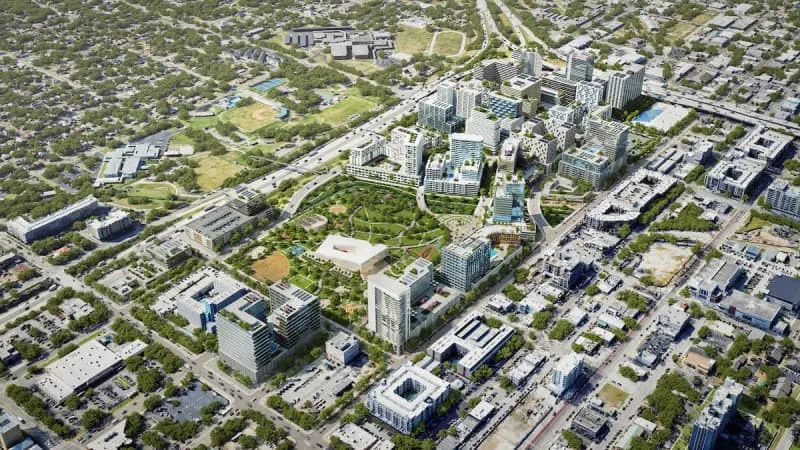
Freedom Communities Company, led by founder Sarellyn Hamatani, submitted a six-page proposal to develop a mixed-use building with restricted rents on 1 to 1.5 acres in the Gas Plant.
Called Sanctuary St. Pete, the development would be anchored by either Sprouts Farmers Market or ALDI. In its first phase, it would have 80 affordable apartments and 20 workforce apartments. Future phases could include senior housing and more workforce housing.
The proposal put the estimated development cost at $300,000 per unit. There would be a two-year pathway from renting to home ownership. The proposal said Freedom Communities Company would like to partner with Habitat for Humanity.
This group is led by Seminole residents Thomas and Jennifer Rask. Thomas Rask publishes a conservative blog and has written about the Gas Plant District and failed Rays stadium deal.
Their proposal aims to achieve “100% affordable housing” on the site. This would include senior living and homes for people with intellectual disabilities.
The plan included few details about what else would be built but mentioned a convention center, park space, hotel rooms, retail, office and a new home for The Woodson African American Museum as possible additions.
They plan to fund the project through “a strategic combination of debt, equity, and public incentives, designed to ensure strong alignment between public and private interests,” according to the bid.
The county housing authority resubmitted an unsolicited proposal that appears to be almost exact to a proposal it submitted back in October.
The housing authority pitched building a seven-story, 80-unit affordable senior housing building at 1659 Third Ave. S. That city-owned lot is east of Lot 3, which is used for Rays games.
The county housing authority and the St. Petersburg Housing Authority are included in Ark Ellison Horus’ proposal to handle that project’s affordable housing.
The St. Petersburg Housing Authority announced Friday that it has signed letters of interest expressing its willingness to collaborate with both Blake Investment Partners and ARK Ellison Horus. The letters of interest are non-exclusive.
St. Petersburg dentist R. Brian Ligon submitted a 76-page proposal for a mixed-use district with “sports-adjacent” projects. It calls for the purchase of the Gas Plant property, phased redevelopment of the site and the acquisition of the Rays.
It does not say how much Tampa Bay Boom would offer to pay for the site but said property acquisition, the Rays acquisition and vertical development would be paid for through private equity and institutional capital.
Tampa Bay Boom lists its development team as HOK, Populous, MMQ, AECOM, Vanward Enterprises, JE Dunn Construction and JLL.
Renderings show options for the Gas Plant, including a renovated Tropicana Field and an additional stadium built for an NBA franchise to be called the Tampa Bay Boom. They also depict Tropicana Field or an arena built on the downtown waterfront.
Tempo Novus, an investment firm co-founded by St. Petersburg native Sean Hampsey, is teaming up with DPZ CoDesign, a Miami-based architect that’s worked on master planned communities across the country including Seaside, a walkable community on the Florida panhandle.
Rather than providing a specific site plan, this team wants the community to lead the design process, allowing local stakeholders to decide exactly what gets built.
They plan to lease the land from the city, not buy it.
“The city contributes land, approves each phase, and enforces commitments,” the bid states. “The city is not a silent partner. It holds the gates.”
The plan highlights walkable, green infrastructure and lower-rise buildings that blend into the surrounding neighborhood.
They have committed to making at least 35% of housing units affordable. At least 25% of construction contracts and 20% of professional services will be awarded to minority- and women-owned businesses.
The International People’s Democratic Uhuru Movement submitted a seven-page proposal to pitch a development that would secure reparations by seizing “large tracts of city-owned or corporate-owned land.”
The Reparations Land Trust and Development Authority would be a “quasi-governmental department” that would oversee land between 49th Street to Third Street between First Avenue South and 54th Avenue South. It would buy, sell and develop land within those boundaries by using eminent domain and use Black contractors, workers and businesses for development.