
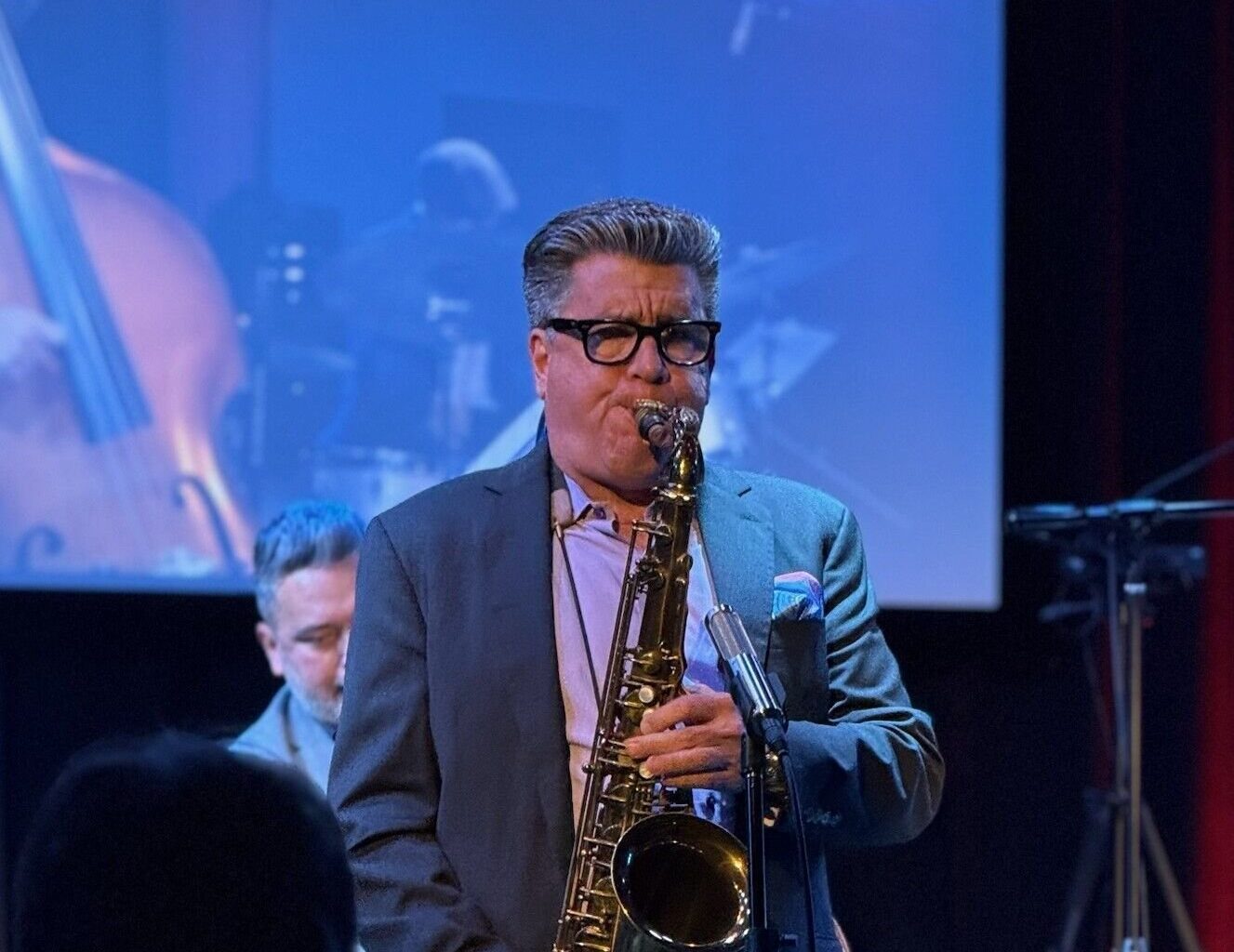

Jeff Rupert plays his opening set at the Blue Bamboo Center for the Arts on Jan. 23.
Joseph Wiedeman
The crowd fell silent as a man with jet-black glasses and a wrinkle-free blazer, saxophone hanging on his hip, calmly took the stage at the Blue Bamboo Center for the Arts in Winter Park on January 23.
Jeff Rupert, director of jazz studies at UCF, gazed out over the small crowd that gathered in anticipation for his first show since returning from New York with UCF’s premier jazz ensemble, the Flying Horse Big Band.
Then, with a little flick of the wrist and a lick of his lips, he counted in the set.
Slowly at first, the Jeff Rupert Quartet played the opening tune and was completed only by the introduction of Rupert’s saxophone, as the echoes of his past were bound to the very music that now bounced off the walls of the performing arts center.
Though now well-established as both a renowned professional musician and award-winning professor, at age 10, Rupert was already conducting Mozart in the mirror to himself while practicing his “Custom Z” tenor saxophone on the side, he said.
By 15, he was playing gigs for local businesses outside of the New York metropolitan area, as well as coming up with creative big band names. Rupert said his mother worried about what a music career might look like, while his father had little doubt in young Rupert’s talent, as his father had built his own career off believing in passionate people.
“He ran a company that did scientific testing and services. We’re doing all this scientific work, but his second-in-charge was a history major in college. His third-in-charge was an English major,” Rupert said.
From Rupert’s father’s perspective, Rupert said, those who are passionate about their majors in college have the desire to learn, whatever the medium may be.
Rupert said he believes that the ability to adapt is the very DNA of a musician, a belief he inherited from his father. The ability to adapt to a new tempo is the basis not just for music, but also for life’s flow. After seeing the passion in his son, Rupert’s father knew that he would adapt to any realm he put his mind to.
The next step in his career was the prestigious Mason School of the Performing Arts at Rutgers University. This was where Rupert was able to connect his passion with the educational foundations, as Rupert said that the school hosted an “unprecedentedly talented” roster of professors at the time.
In 1987, Rupert graduated with his bachelor’s in music from Rutgers. His passion pushed him further, and by 1993, he earned a master’s in jazz studies from the same school.
Rupert explained that getting one’s foot in the door is easier said than done. He said he did well for himself early into the music scene, playing in local show halls and performance centers to get his name out there, but he quickly discovered that the bell curve of life meant he had to adapt to changing circumstances.
“The tension in a symphony might last 45 minutes, and by the end, you realize, ‘oh, there’s this arc we’ve been traveling on, and now it’s coming to an end,'” Rupert said. “And I think that’s more realistic and more exemplary of what life is actually all about.”
Rupert’s own arc in New York was coming to its apex around this time. The digital age had made its way into the realm of music. No longer did artists need to watch how many recordings they made or repeat specific melodies for their limited tape storage; new technologies allowed the reuse and recycling of old sounds, Rupert said.
This drastically reshaped the outlook of the commercial music industry in Rupert’s mind. Reused sampling was sapping up classic commercial jobs for saxophonists, and Rupert believed this could possibly be the end of the commercial music industry.
He said up to this point, he had been on a convergent quest to conform his sound to everyone else’s. The rise of reuse sampling and the loss of many commercial jobs meant pivoting into teaching would be more than necessary — but it was not as obvious a path as it might seem.
“You know, it was hard to leave. But yeah, I didn’t see myself doing this,” Rupert said.
Yet that push came in 1995, in the form of a job offer from a rapidly expanding school based out of Orlando — UCF.
His assurance came from his own professor at Rutgers, William Fielder, who told him that the university would allow him to grow a great program. Rupert said that he didn’t see this as a true possibility, and “it sort of went in one ear and out the other.”
That is, until he arrived on campus. This is where, as he put it, his divergent quest began, as he was able to create his own unique sound.
Despite the technological innovation, the change in the culture and musicians’ fundamental understanding of the music was warping as time went by, Rupert said. But his father’s advice always held true for him, he said, as the passion his father spoke about helped him overcome any obstacle set in his way.
“There always seems to be room in the music business for a good musician with a good attitude,” Rupert said.
In 2008, the partnership between Rupert and UCF birthed the Orlando Jazz Festival, a yearly citywide festival dedicated to jazz. That was followed by the establishment of multiple ensembles, including the faculty sextet The Jazz Professors in 2011, and the formation of UCF’s Flying Horse Big Band in 2012, known at the time as UCF Jazz Ensemble I.
Professor Rupert (left) brings his son Django Rupert up to play the last song of the set together at the Blue Bamboo Center for the Arts on Jan. 23.
Joseph Wiedeman
To this day, Rupert teaches both Saxophone V and Jazz Ensemble. His student, Atlas Egli, a sophomore in jazz studies, said that there are certain things that any student preparing to study under his tutelage should know.
“You’re definitely gonna grow as a musician,” Egli said. “I’d say he might seem hard at first. He may [seem] to have a hard outer shell. But he definitely cares about you and your growth as a musician.”
Rupert explained that his mission to reframe the narrative around Orlando is far from over. On April 4, at Steinmetz Hall, he will be hosting a suite looking at Orlando through six different lenses. It will be called “Artists’ reflection on living in Orlando,” and will be an homage to the music he believes has defined this city.
“A lot of people think of Orlando, you know, Disney, or the Space Coast, or maybe Daytona Beach,” Rupert said. “You know, I have my own take on what it’s meant to live in Orlando for 31 years.”
His vision is best embodied in his quartet, the individual sounds of which echoed around the Blue Bamboo Center for the Arts, with each member having their own unique pattern and still falling in line with one another.
The heart of jazz reverberated down the halls, and Rupert took to the microphone. He invited his son, Django Rupert, onto the stage and closed the set in a duo with his son, playing Jeff Rupert’s original piece “Soul of Orlando.”
“It’s always, it’s funny, you know, I’ve made a lot of albums,” Rupert said. “I never listen to them. [I never] Listen to the albums I’ve made because I’m going somewhere else.”