
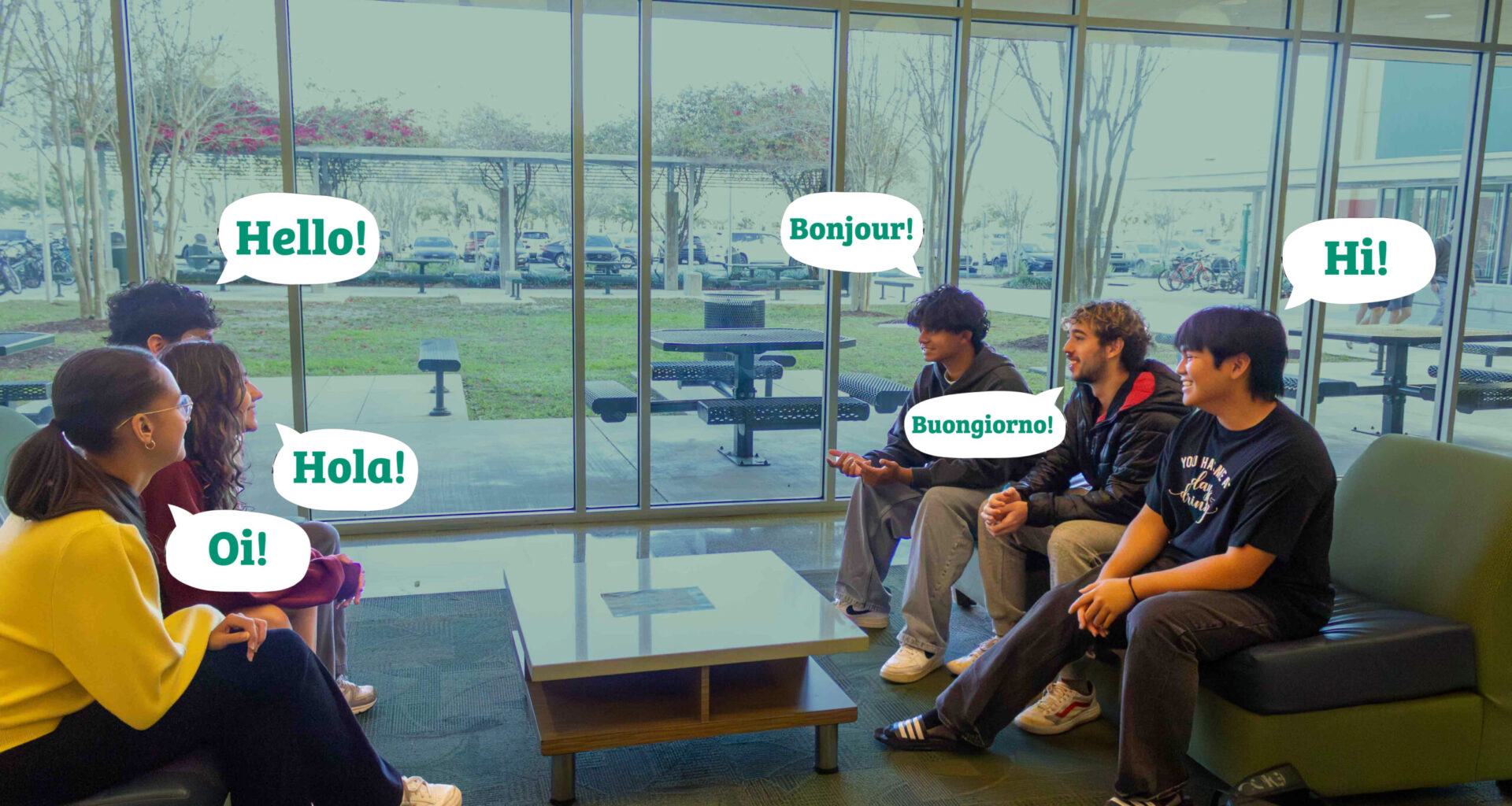
 Language learning apps pale in comparison to the cultural and social value that in-person classes provide. ORACLE PHOTO/VIOLET VASQUEZ PIMENTEL
Your Duolingo streak is nearing the triple digits, yet you feel like you haven’t learned anything.
But it isn’t for lack of trying — these apps simply aren’t designed to facilitate higher-level learning.
While language learning apps are good for memorizing basic phrases, they struggle at relaying more complex conversational skills, according to a 2019 New York Times article.
Luckily, Madeline Camara, a USF professor of Spanish, believes you’re already at one of the best places in the world to learn a language — a college campus.
Camara said she strongly favors a “face-to-face” method of teaching.
“Human contact is vital for the learning of a foreign language,” Camara said.
And USF is perfect for this, offering undergraduate classes in French, Arabic, Russian, among many others, according to the Department of World Languages’ course flyers.
USF students pursuing a Bachelor of Arts are required to complete eight credit hours of the same foreign language to graduate, according to USF’s Degree Requirements.
Still, other degrees simply need to fulfill the basic foreign language entrance requirement, which consists of two units of a language in high school or an equivalent, also according to the degree requirements.
But even if it’s not required by your degree, taking a foreign language class at USF is still absolutely worth it.
Related: USF prepares for major changes to gen ed curriculum by 2026
I started Beginning Spanish I this semester — at first, just to meet the requirements for my Literature degree — and it quickly became one of my favorite classes I’ve taken at USF.
The best part of the class is — like Camara said — the opportunity to practice complex, one-on-one Spanish conversational skills with other students.
In just three weeks of classes, I feel more proficient in the language than I did after several years of on-and-off Duolingo use.
This focus on conversation has also made this class one of the most social I’ve ever taken.
In many of my other classes, students remain awkwardly distant throughout the entire semester.
But the atmosphere throughout Beginning Spanish is always alive and talkative, even after the mandated Spanish conversations end.
I now consistently look forward to the class every week.
But the biggest benefit of taking a foreign language is broadening your cultural horizons.
Kaityln Dawes, a junior international relations major currently enrolled in Russian II, said the class has given her insight into Russia’s cultural norms.
“My professor is Russian and has done a fantastic job teaching us not just the language, but the culture and everyday life of a Russian citizen,” Dawes said. “[And] with wanting to work in the foreign affairs and policy area, with one of my regions of interest being Russia, it just made sense to take Russian.”
But Dawes said the information taught in the class is still relevant even if you’re not aspiring for a career in international affairs.
“I would definitely recommend that other students take this class,” Dawes said. “It’s definitely a hard class, but the professor sets you up to succeed.”
And Professor Camara agrees — the cultural exchange is what makes learning a language so important.
Related: OPINION: Attacking international students, staff won’t make Florida stronger
Camara said that teaching Spanish helped her get by in the U.S. after immigrating from Cuba in 1992.
“I remember the years of initiation in surviving the cold weather and navigating the foreign sounds of the English language,” Camara said.
But Camara’s students are often also in unfamiliar environments when learning Spanish — something she described as a bonding experience.
“I taught elementary Spanish and sometimes early classes in the chilly mornings,” Camara said. “Students were not happy to be there too. I believe this mutual uneasy situation was the key to mutual solidarity – we both needed to overcome these challenges. Crossing the bridge between our cultures was the way to success.”
Camara said she believes that learning a second language has become a “requirement” for all citizens in the modern world.
Unfortunately, many of the most intensive majors lack the flexibility for a foreign language elective.
Balancing between 4000-level classes and several labs is stressful enough without adding a language into the mix.
But if you do have the space, taking a foreign language is a no-brainer.
The cultural and social benefits are invaluable, and in-person feedback from peers and professors alike puts it miles ahead of Duolingo.