
Never miss an important update on your stock portfolio and cut through the noise. Over 7 million investors trust Simply Wall St to stay informed where it matters for FREE.
D-Wave Quantum (NYSE:QBTS) has agreed to acquire Quantum Circuits, creating what it describes as the world’s first dual-platform quantum computing company.
The company is expanding collaborations with U.S. defense agencies and academic institutions, including installing a quantum computer at Florida Atlantic University.
D-Wave is relocating its global headquarters to Boca Raton, Florida, marking a shift in its corporate footprint and regional presence.
D-Wave Quantum is drawing fresh attention from investors as it moves through a busy period of corporate change and product progress. The stock closed at $20.11, with a 1 year return of 221.2% and a very large 3 year gain, while the 7 day, 30 day, and year to date returns show double digit declines. That mix of strong longer term gains and recent weakness gives this news extra weight for anyone tracking NYSE:QBTS closely.
The acquisition of Quantum Circuits, new U.S. defense and academic partnerships, and the shift of headquarters to Boca Raton collectively point to a company reshaping its business footprint and technical capabilities. For investors, the key questions now center on how effectively D-Wave integrates the dual platforms, executes on government and university relationships, and manages liquidity as it pursues broader commercial adoption of its quantum technologies.
Stay updated on the most important news stories for D-Wave Quantum by adding it to your watchlist or portfolio. Alternatively, explore our Community to discover new perspectives on D-Wave Quantum.
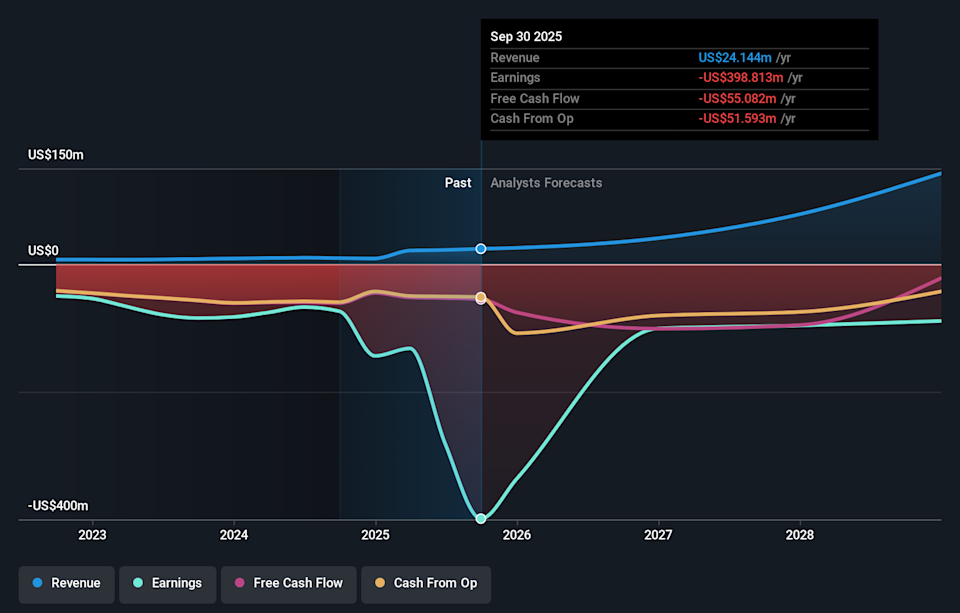 NYSE:QBTS Earnings & Revenue Growth as at Feb 2026
How D-Wave Quantum stacks up against its biggest competitors
The Quantum Circuits deal, new defense and academic partnerships, and the Boca Raton move all point in the same direction: D-Wave is trying to broaden from a single product line into a full-stack, dual-platform quantum provider. By combining its annealing systems with Quantum Circuits’ gate-model technology, the company is positioning itself to compete more directly with players such as IBM and IonQ across a wider set of use cases, while contracts like the US$10 million QCaaS agreement and the US$20 million Florida Atlantic University system sale help validate commercial and research demand for its approach.
These developments line up closely with existing investor narratives that focus on growing real-world adoption, a three-part revenue model across cloud services, professional services and system sales, and reuse of superconducting know-how across both annealing and gate-model programs. The Fortune 100 QCaaS contract, the FAU installation and the planned Boca Raton R&D hub all speak to the same theme: larger multi-year deals and on-premises hubs that can expand usage and potentially support higher value engagements over time.
🎁 Dual-platform capability and U.S. defense and enterprise collaborations may strengthen D-Wave’s competitive position against peers such as IBM and IonQ.
🎁 Recent contracts of roughly US$30 million across FAU and a Fortune 100 customer show that commercial and academic buyers are willing to commit to larger quantum deals.
⚠️ The Quantum Circuits acquisition involved about US$275 million in stock and rising operating expenses, so dilution and the path to profitability remain important watchpoints.
⚠️ Analysts have flagged four key risks, including share price volatility, ongoing losses and past dilution, which may keep the stock sensitive to execution setbacks.
From here, the key things to watch are how quickly D-Wave integrates Quantum Circuits technology into a working gate-model system, whether the Boca Raton hub leads to more large contracts and how often defense and Fortune 100 style deals repeat. If you want to see how different investors are connecting these dots, check community narratives for D-Wave Quantum on the company’s narrative page and compare them with your own expectations on execution and risk.
This article by Simply Wall St is general in nature. We provide commentary based on historical data and analyst forecasts only using an unbiased methodology and our articles are not intended to be financial advice. It does not constitute a recommendation to buy or sell any stock, and does not take account of your objectives, or your financial situation. We aim to bring you long-term focused analysis driven by fundamental data. Note that our analysis may not factor in the latest price-sensitive company announcements or qualitative material. Simply Wall St has no position in any stocks mentioned.
Companies discussed in this article include QBTS.
Have feedback on this article? Concerned about the content? Get in touch with us directly. Alternatively, email editorial-team@simplywallst.com