
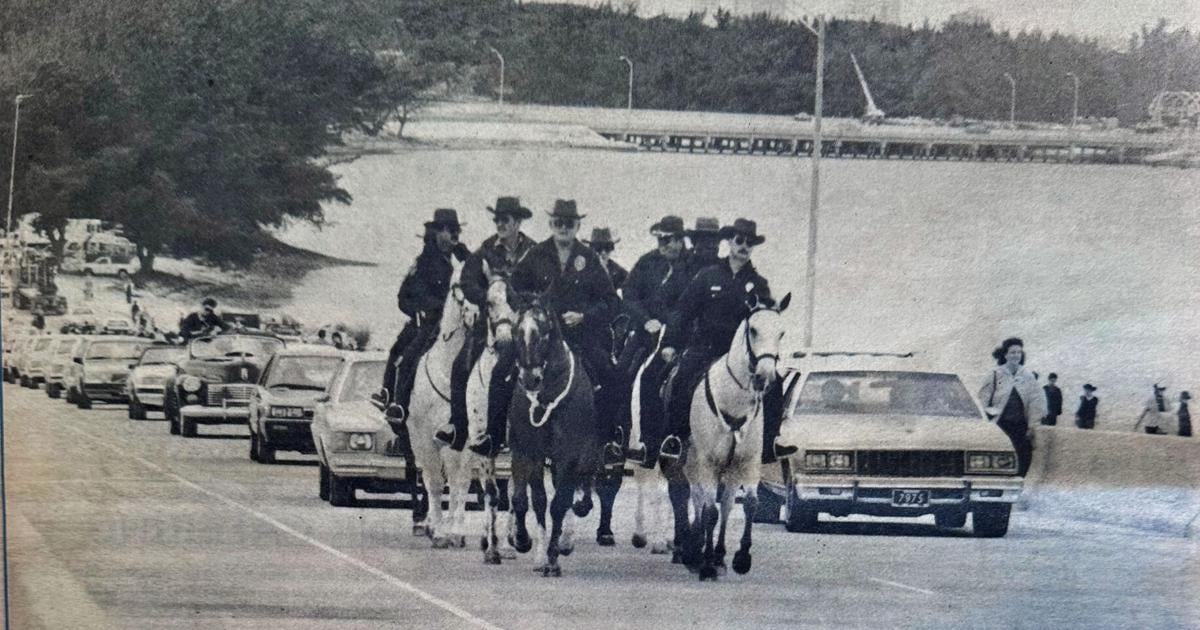
Bridge Dedication

Two very different ways of life will be drawn closer once the bridge opens Monday. The placid shoreline of the foreground and the busy skyline of Miami in the background are representative of the diverse dynamics that will come into play.
High-bridge named after Public Works Director Powell
Metro Dade Police’s Mounted Patrol lent the procession of traffic over the bridge a touch of the traditional American parade. The bridge was finished under cost, before the deadline at no cost to taxpayers.
The new bay bridge was inaugurated and named the William M. Powell Bridge, amid much back-slapping by politicians, Key Biscayne civic leaders, construction engineers and Public Works officials.
Everyone had a reason to be pleased because the bridge was finished under cost, before deadline, at no cost to taxpayers and promised to solve traffic problems on the Rickenbacker Causeway.
The dedication ceremony was described by Commissioner Harvey Ruvin as “a true piece of Americana, a Norman Rockwell painting before our eyes.”
Uniformed horseback riders and antique cars were on parade, school children sang while carrying balloons, Boy Scouts presented the colors, a pigeon walked through the crowd, turkey buzzards flocked nearby and helicopters and boats abounded.
Coalition of Citizens discuss Island’s needs
Members of the community met in a classroom at the Key Biscayne Community School and discussed the Island’s short-term problems.
Ranging in age from the 30s to the 60s, condominium and house owners, Jews and Christians, Anglos and Cubans, members of the Key Biscayne Property Taxpayers Association, the Chamber of Commerce and Key Biscayners for a Responsive Government and some long-time residents who could remember when the Island was first settled, found they could agree on what Key Biscayne needed whether or not they could agree on what was the most expedient form of government to attain these goals.
Attorney Gene Stearns, who proposed the coalition, said he wanted “to create an environment where there can be intelligent discussion.”
Stearns served as monitor and called the meeting to initiate the idea of forming a temporary coalition of residents called the Key Biscayne Study Group in order to “create an environment where there can be intelligent discussion” between what are sometimes warring factions of the community.
“Let’s concentrate on the issues that unite us,” said Sylvia Iriondo.
Participants had no trouble agreeing that they would like to have storm sewers and pumping stations, landscaping of the median on Crandon Boulevard, sidewalks in certain areas, lighting, better trash pickup, an athletic facility including an equipment storage area, a youth center, lighted fields, and beach restoration, among others.
Commissioner Harvey Ruvin had requested a list of needs in order to address specific issues when he comes to talk to the group in the next few weeks.
No one advocated higher taxes in order to implement these improvements in the quality of life on Key Biscayne, although it was explained that the county levied special taxes to provide some of these services. The tip of the iceberg of more controversial subjects was also touched. Who could best represent and lobby for Key Biscayne before the County Commission? Existent groups or an elected body? Who should decide how to allocate the funds for improvements if a choice had to be made between such things as storm sewers or a youth center? Are there more pros than cons to incorporation? And, is the best form of incorporation a contract city?
No consensus was reached about these topics pending the completion of a separate study commissioned by the Property Taxpayers to analyze the feasibility of incorporation. Ed Smith said the study would be ready in a month. Participants did agree that Key Biscayne needed more leaders, more people to get involved in both existent and new civic organizations. Fewer than 20 people attended the meeting.
“Be counted and make a stance,” urged Mrs. Iriondo.
Sunday Bunch
The Key Biscayne Beach Club is, for many residents, the place to meet to relax and exchange news and views of the week. Seen above is a happy Sunday bunch; (l. to r.) Yeg Wilson, Buddy Ralston, Egg Young, Dick Vernon and John Felton.
Islander Sports
The intramural teams B and C played an excellent game last Sunday and the atmosphere was filled with tension when team B took a penalty shot in the first half, which goalie Gonzalo Rodriguez-Fraille fearlessly saved.
A Walk in the Park
A view of the lighthouse keeper’s house and the grounds from the lighthouse.
As a walker, you may want to escape the wind and water chill and the sameness of the beach, the cyclist traffic on sidewalks never designed for pedestrian-cyclist use, or perhaps you yearn for a touch of woods and country as a change of pace. Then try Bill Baggs Cape Florida Park for 50 cents per day, or a yearly pass good at all state parks for $10.50 individual or $26.50 family.
Traffic
Bumper-to-bumper traffic backed up as far as the Towers of Key Biscayne should only have been a memory from past years but it was a fact last Sunday afternoon.
When the heavy rains began in the afternoon, thousands of beachgoers rushed to get off the Island. Cape Florida State Park reported a total of 6,461 visitors, whereas Crandon Park had 16,000, a record for February. Traffic was slow until past the construction on Bear Cut bridge, after which the new lanes on Virginia Key and the new bridge facilitated the exit of thousands of vehicles.
Acid rain study Earns student Science Fair second place
Ada Pozo and Franz Tarafa.
Franz Tarafa, 13 year-old seventh grader at St. Agnes Academy, took a second-place award in the Dade County Science and Engineering Fair for his project, “What A Pain Is Acid Rain.”
The project, which also earned Franz a rating of excellent in the fair, a place in the Youth Fair, a trophy and a cash prize, involved the watering of three hibiscus plants every day for four weeks, with, respectively: water; water and a 1 percent acid solution; and water with a 10 percent acid solution. The plant watered with the 1 percent solution showed brown patches, while the one treated with the 10 percent solution (the same amount found in acid rain in the United States) died.
Ada Pozo, a 13-year-old eighth grader at St. Agnes, took a third place and honorable mention in the fair for her project, “Synthetic vs. Natural,” where she used seven samples of different materials, both natural, blends and synthetics, and subjected them to various tests to show that in most cases, synthetics stood up better than natural.
For the last #islanderthrowback, click here.