
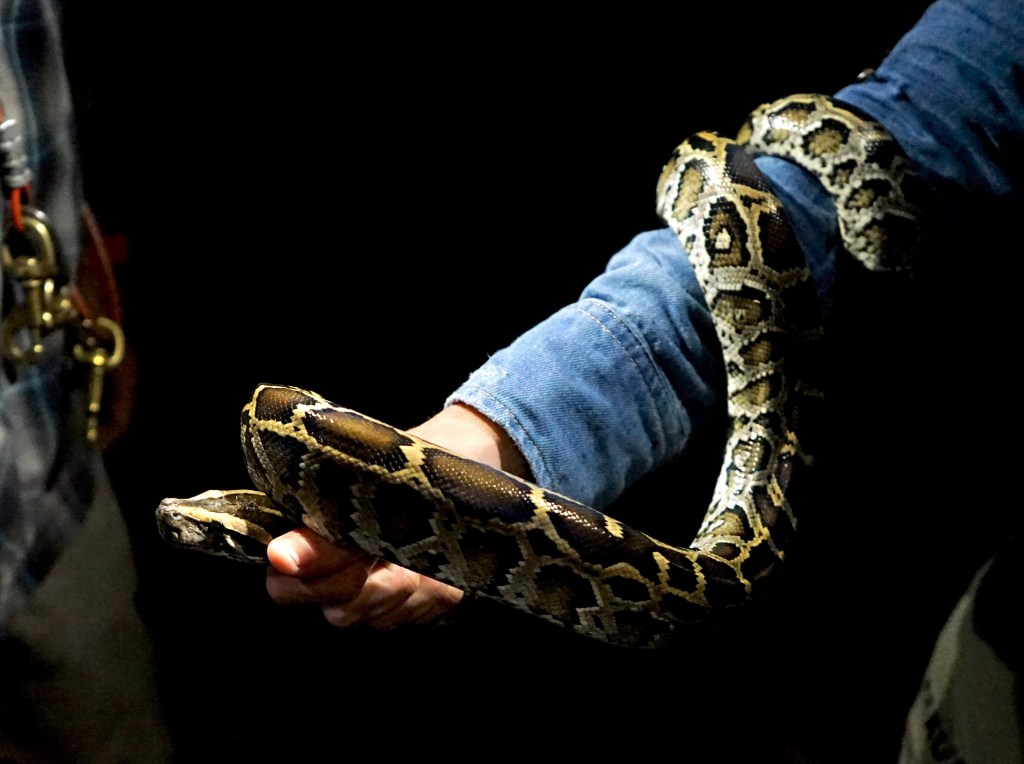
The state of Florida has entered into a public-private partnership with Inversa — a leather company that specializes in invasive species — to support the fight against Burmese pythons.
The partnership has Inversa overseeing the Florida Fish and Wildlife Conservation Commission’s Python Action Team Removing Invasive Constrictors (PATRIC) program, which employs 50 professional, trained python hunters.
The hunters are paid by the hour and by the foot, just as they were previously, but now they have the option of selling the snake’s skins to Inversa, which pays them additionally, depending on the size of the snake and the condition of the skin.
During a news conference in Stuart on Tuesday morning, Gov. Ron DeSantis first asked if anyone wanted to pet the captive python that wildlife officials had on hand, then announced that the initial few months of the partnership had been successful.
“Today we can celebrate the fact that they delivered on their objective 1½ years ahead of schedule,” DeSantis said. “In the first three months since transitioning to the program with Inversa on May 1, the FWC and Inversa have tripled the number of python removals.”
He said that in July 2025 the state and Inversa removed 748 pythons, compared to 235 last July. And more than 1,000 pythons were removed from May to July.
“FWC management workload is down 89%, giving staff biologists valuable time back to focus on science, policy and the other thing the agency does well.
“This means more pythons out of Florida, this means more jobs and income for Floridians, and most importantly, this means that native biodiversity in the Everglades has a chance to rebalance naturally,” said Inversa co-founder and CEO Aarav Chavda.
Critics say market incentives might motivate illegal python breeding. An Inversa spokesperson said that all hunters must be logged into a GPS-enabled mobile app throughout their field survey in order to get paid. This is to “ensure hunters are submitting pythons that have been verified and approved as to their origin to meet the State’s requirements.”
Miami-based Inversa also markets skins from lionfish from the Caribbean and Florida waters and silverfin carp from the Mississippi basin.