
A Hyundai SUV unexpectedly caught fire near a school in Longwood on Wednesday, drawing attention to a recall affecting millions of vehicles.Edgar Franceschi, the vehicle’s owner, described the frightening experience, saying, “It went from just little wispy smoke to just full-blown exploding in like a minute.”Cellphone video captured Franceschi standing on Raymond Avenue near Interstate 4 as Seminole County fire crews arrived to extinguish the flames.The 2013 Santa Fe Sport exploded several times, leaving Franceschi with less than a minute to escape.“And I was like, no. I’ve got to go! I’ve got to get away from the car and call 911. Because, like I said, it was like, really bad and really fast. That was the scariest thing,” he said.In a 911 call obtained by WESH 2 Investigates, Franceschi, audibly shaken, told the dispatcher, “My car just caught on fire. I have no idea why. Firefighters are here.”After the fire was extinguished, the vehicle was taken to a local towing company and deemed a total loss. Franceschi expects to receive compensation from his insurance company.Franceschi was surprised to learn from WESH 2 Investigates that his vehicle had an unrepaired recall, according to safercar.gov.The recall, announced by Hyundai and Kia in 2023, affects 3.3 million vehicles at risk of fire due to a potential leak in the anti-lock brake system module, which can cause an electrical short and an engine compartment fire.Franceschi recalled receiving the notice but never acted on it, saying, “You wouldn’t expect a brake issue to lead to a massive fire like that.”Hyundai spokesperson Ira Gabriel emphasized the importance of acting on recall notices, stating, “These letters outline the nature of the safety concern, the available remedy and clear instructions for scheduling no-cost repairs.”Gabriel also noted that customers can verify their recall status through the National Highway Traffic Safety Administration’s online VIN lookup system or Hyundai’s recall website.Auto safety groups are concerned about the number of Kia and Hyundai vehicles still at risk. Research by the Center for Auto Safety shows that only 32% of affected Kia vehicles and 29% of affected Hyundai vehicles have addressed the recall.Michael Brooks, executive director of the Center for Auto Safety, estimates that over a million unsafe vehicles remain on the road.Brooks urged immediate action on safety recalls, warning, “You could have this fire risk issue or you could have a broken axle and fly off the road, a loss of power steering, a loss of power brakes, and so the list goes on and on, so all of these situations are dangerous.”Brooks partly blamed the federal government for not enforcing more aggressive notification methods for safety recalls.He advocated for digital notifications to supplement regular mail, noting resistance from the automotive industry. “We think there should be a little more effort on the part of manufacturers to impress on consumers the severity of these issues and how they can be life-threatening, and it should highlight the dangers more,” Brooks said.Gabriel responded, “We support measures that help increase customer awareness of safety recalls. Digital methods can be helpful, but they require customers to maintain accurate contact information. Hyundai uses digital outreach when possible, and we will continue to align with any future NHTSA requirements.”In January 2025, NHTSA announced a rule requiring digital notification of recalls, but no action has been taken as Congress considers the Surface Transportation Reauthorization Act.
LONGWOOD, Fla. —
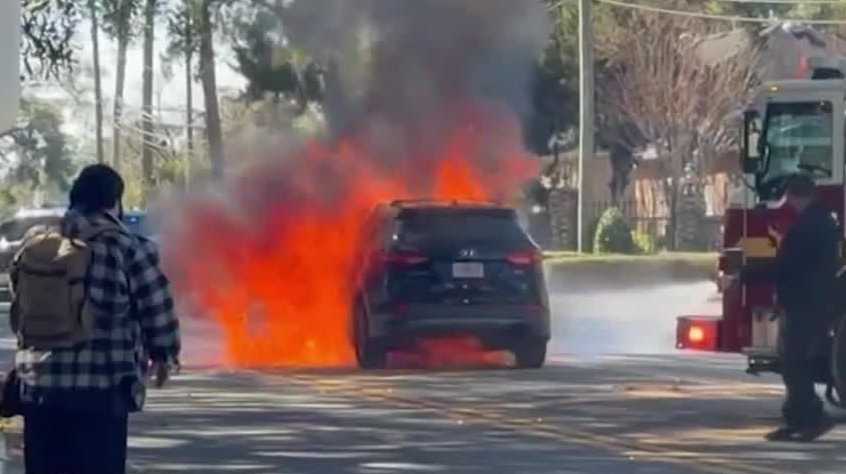
A Hyundai SUV unexpectedly caught fire near a school in Longwood on Wednesday, drawing attention to a recall affecting millions of vehicles.
Edgar Franceschi, the vehicle’s owner, described the frightening experience, saying, “It went from just little wispy smoke to just full-blown exploding in like a minute.”
Cellphone video captured Franceschi standing on Raymond Avenue near Interstate 4 as Seminole County fire crews arrived to extinguish the flames.
The 2013 Santa Fe Sport exploded several times, leaving Franceschi with less than a minute to escape.
“And I was like, no. I’ve got to go! I’ve got to get away from the car and call 911. Because, like I said, it was like, really bad and really fast. That was the scariest thing,” he said.
In a 911 call obtained by WESH 2 Investigates, Franceschi, audibly shaken, told the dispatcher, “My car just caught on fire. I have no idea why. Firefighters are here.”
After the fire was extinguished, the vehicle was taken to a local towing company and deemed a total loss. Franceschi expects to receive compensation from his insurance company.
Franceschi was surprised to learn from WESH 2 Investigates that his vehicle had an unrepaired recall, according to safercar.gov.
The recall, announced by Hyundai and Kia in 2023, affects 3.3 million vehicles at risk of fire due to a potential leak in the anti-lock brake system module, which can cause an electrical short and an engine compartment fire.
Franceschi recalled receiving the notice but never acted on it, saying, “You wouldn’t expect a brake issue to lead to a massive fire like that.”
Hyundai spokesperson Ira Gabriel emphasized the importance of acting on recall notices, stating, “These letters outline the nature of the safety concern, the available remedy and clear instructions for scheduling no-cost repairs.”
Gabriel also noted that customers can verify their recall status through the National Highway Traffic Safety Administration’s online VIN lookup system or Hyundai’s recall website.
Auto safety groups are concerned about the number of Kia and Hyundai vehicles still at risk. Research by the Center for Auto Safety shows that only 32% of affected Kia vehicles and 29% of affected Hyundai vehicles have addressed the recall.
Michael Brooks, executive director of the Center for Auto Safety, estimates that over a million unsafe vehicles remain on the road.
Brooks urged immediate action on safety recalls, warning, “You could have this fire risk issue or you could have a broken axle and fly off the road, a loss of power steering, a loss of power brakes, and so the list goes on and on, so all of these situations are dangerous.”
Brooks partly blamed the federal government for not enforcing more aggressive notification methods for safety recalls.
He advocated for digital notifications to supplement regular mail, noting resistance from the automotive industry. “We think there should be a little more effort on the part of manufacturers to impress on consumers the severity of these issues and how they can be life-threatening, and it should highlight the dangers more,” Brooks said.
Gabriel responded, “We support measures that help increase customer awareness of safety recalls. Digital methods can be helpful, but they require customers to maintain accurate contact information. Hyundai uses digital outreach when possible, and we will continue to align with any future NHTSA requirements.”
In January 2025, NHTSA announced a rule requiring digital notification of recalls, but no action has been taken as Congress considers the Surface Transportation Reauthorization Act.