
The Miami Marlins system has a lot of players who project to some big-league value, but the system is very light on impact players, and its 2024 draft class is already in a lot of trouble. The Florida Complex League and Low-A teams will have some potentially higher-upside players signed as international free agents, although their age and inexperience make them high-risk, as well.
(Notes: Ages are listed as of July 1, 2026. Scouting grades are on the traditional 20-80 scouting scale. EV = exit velocity. EV50 = the average exit velocity of the top half of all of a player’s balls in play, ranked by exit velocity — that is, the top 50 percent of his batted balls.)
Height: 6-5 | Weight: 220 | Bats: R | Throws: R | Age: 22
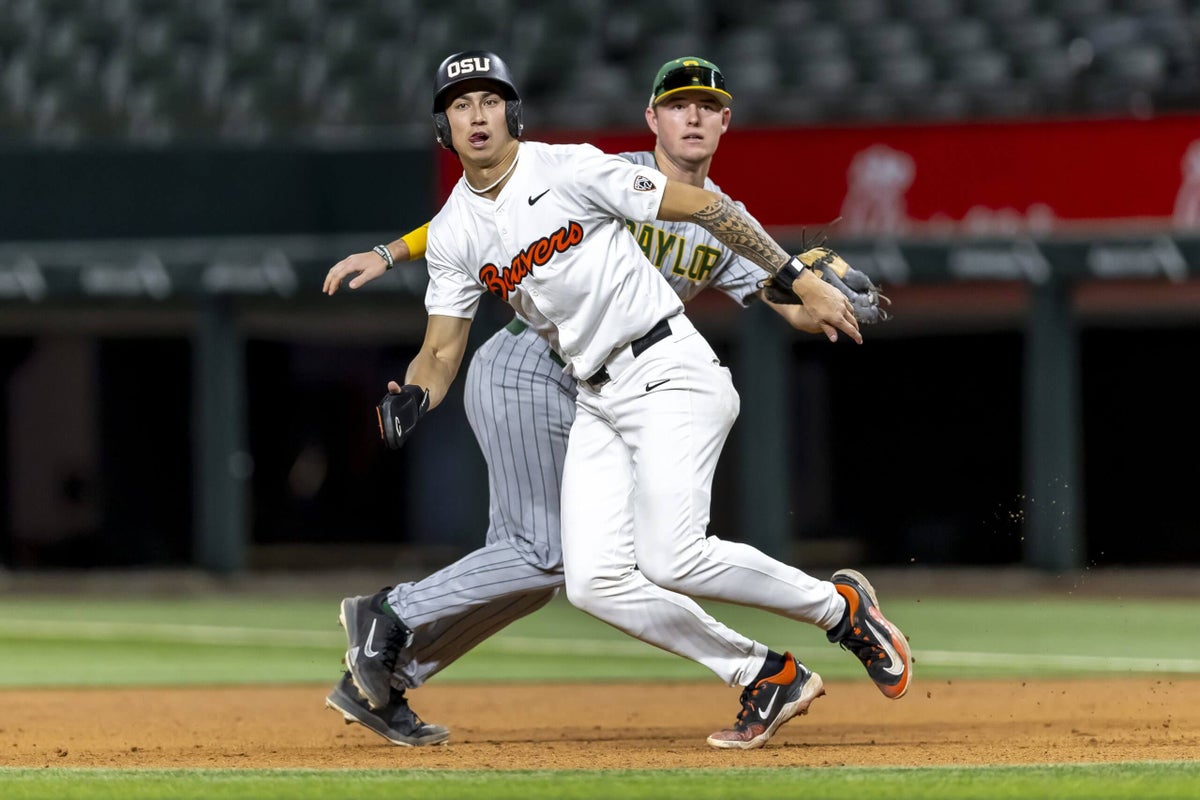
Arquette was the first college hitter taken in the 2025 draft, going at pick No. 7 to a Marlins organization that needs bats like his. He excelled last spring for Oregon State as the Beavers played an independent schedule, showing outstanding hand-eye coordination and rarely swinging-and-missing, especially when he swung at strikes. Arquette is built like a 747, at least for a shortstop, as he’s legitimately 6-5 and already 230ish, which will make him one of the biggest shortstops in MLB history if he stays at the position. It’s much more likely he ends up at third base, even though he has good hands and a plus arm. The main question I had on Arquette from the draft was how he’d fare against pitchers with better secondary stuff; in his brief time in High A after signing, he whiffed about a third of the time against sliders and changeups, not alarming, but an area for improvement for him. He has 25-30 homer upside with a good feel for the strike zone. If you think he can stick at shortstop, he’s a potential All-Star who could be the best player on the Marlins when he arrives.
Height: 6-5 | Weight: 240 | Bats: L | Throws: L | Age: 21
White was the second high school pitcher the Marlins took in 2023, but he has blown past the first pick, Noble Meyer, as White throws far more strikes and has already had success in Double A, even finishing last year with two starts in Triple A. White sits 95-97 with a very easy arm stroke, although the pitch can be flat and might not miss as many bats in the majors as it has through Double A. His sweeper — I’ve seen it called a slider or a curveball, the name doesn’t matter a lot — is plus, easily, with big tilt and a lot of horizontal break, reminiscent of Andrew Miller’s slider at the same stage of his career. White’s changeup actually generated more whiffs in Double A, although it’s more of a 50/55 pitch, with some late fade and good separation from the fastball, benefiting also from the fact he maintains a consistent release point on all of his pitches. He’s been a big kid since the draft, listed now at 6-5, 240, and even with that easy arm stroke, he’s still learning his body and has to gain more coordination, such as getting extended better out front, to help him throw more strikes and command the ball better in the zone. He struck out 39 percent of batters he faced in Double A while walking 12.6 percent, then in two Triple-A outings, he walked 10 batters and struck out 17, all of which implies he is probably going to miss bats at a very high rate if he trusts his stuff more and can work in the zone consistently.
I’ve seen him only twice, in the past two Futures Games, and he hasn’t thrown strikes either time, unfortunately, throwing just 26 strikes in 58 pitches — a very small sample, but one that at least lines up with his results at the higher levels so far. He has No. 2 starter upside, with a wide range of outcomes depending on how the command and control develop. He’s one of the top left-handed pitching prospects in baseball, and with more and better strikes, he could be the best one in a year.
Height: 6-0 | Weight: 210 | Bats: L | Throws: R | Age: 23
Mack might be the rare high school catcher drafted up top (pick No. 31, the Marlins’ second pick in 2021) who pans out as a catcher in the big leagues, as he’s a plus defender with the pull power to get to 20 homers a year, more than enough to be a regular in the big leagues right now. He has a very pull-oriented swing that puts the ball in the air a lot, probably at the cost of some contact, and striking that balance will be the key variable in whether he’s a second-division regular with sub-.300 OBPs or can be an occasional All-Star. He did start to chase more pitches out of the zone last year than he had in Double A and below, and he still needs to make more contact on pitches in the zone after a marginal improvement there last year that still has him well below the MLB median at 77.9 percent. He can really catch and throw, nailing a third of opposing base stealers last year, even though it seems like no one is ever holding runners anymore. (Insert old man yells at cloud dot gif.) The one outstanding question on the defensive side is Mack’s game calling, as the Marlins, for reasons I will probably never understand, have coaches call pitches in their farm system like this is high school, so Mack hasn’t been able to work on that aspect of his game.
He’s a potential 20-homer catcher who saves runs with his defense, which plays every day for most clubs. Whether he’s more than that depends on whether he can improve his swing decisions, deciding when to go all out for power and when to lay off or just be satisfied with putting the ball in play. The goal for Mack this year should be to keep his swing on plane, and for the Marlins to let him run the show by calling pitches even in Triple A.
Height: 6-3 | Weight: 210 | Bats: R | Throws: L | Age: 22
Snelling was on my top-100 list going into 2024, then dropped off when he lost several miles an hour off his fastball that summer, which included (and probably precipitated) his trade from San Diego to Miami that July. The Marlins did well here as Snelling got his fastball back, sitting 94-95 in Triple A last year with a plus slider and average changeup, throwing strikes across the board, so he projects as a mid-rotation starter with a chance to be even better. The four-seamer gets some swing-and-miss because it’s a high-spin fastball that has some ride at the top of the zone, and on the rare occasions he’s allowed to work deep into games, he holds his velocity. The changeup is his worst pitch for now, although he showed no platoon split in the minors last year. He’s a premium athlete who was also a quarterback and linebacker in high school, moving well on the mound and repeating his delivery. He could be someone’s No. 5 starter right now, with a realistic ceiling of a No. 3 and a chance he becomes even more if his command continues to improve and he develops the changeup more.
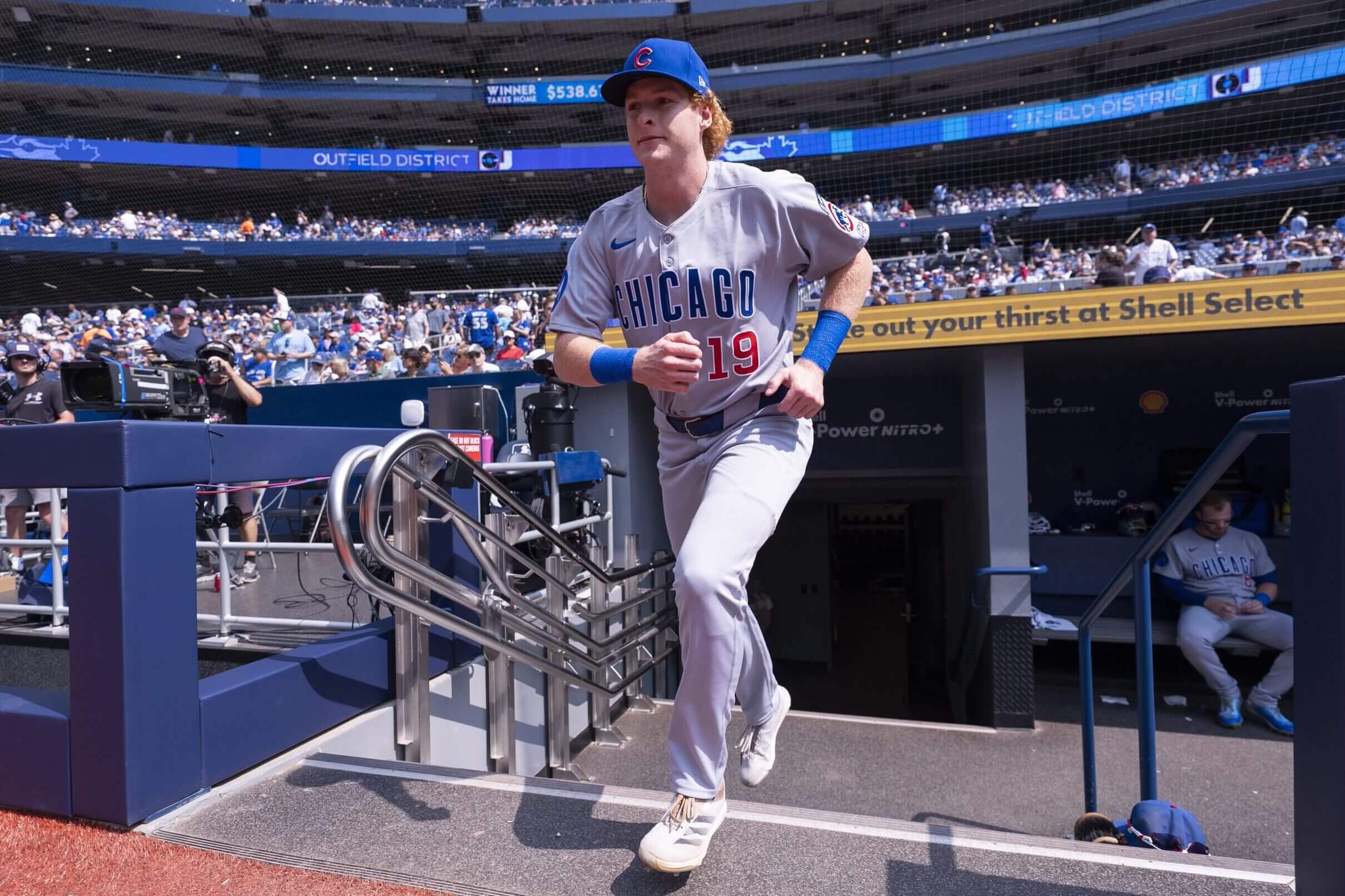
Owen Caissie made his major-league debut for the Cubs in 2025. (Mark Blinch / Getty Images)
5. Owen Caissie, OFHeight: 6-3 | Weight: 190 | Bats: L | Throws: R | Age: 23
Part of the return for Edward Cabrera from the Chicago Cubs, Caissie is a power-hitting right fielder with a lot of swing-and-miss in his game, whiffing on 28.2 percent of his swings while repeating Triple A last year and hitting just .217/.351/.359 versus southpaws. It’s a broad contact issue rather than something in the swing or a specific pitch type or location, and the Cubs were unable to remedy it despite several years of effort. He’s made himself a capable defender in right — he was quite bad when he first signed with the San Diego Padres in 2020 — to the point where he’s got 45 range and a 50 arm, and he’s a better runner now as well. He has a similar profile to Kyle Stowers, another low-contact power bat with platoon problems whom the Marlins acquired in a trade. I’m not saying Caissie will be the Marlins’ lone All-Star this year, more that there is reason for Marlins fans to be excited even with Caissie’s limitations.
6. Starlyn Caba, SSHeight: 5-9 | Weight: 160 | Bats: B | Throws: R | Age: 20
Acquired from the Philadelphia Phillies in the Jesús Luzardo deal, Caba is one of the best defensive shortstops in the minors; I’ve seen 80 defense from him myself, like, devil magic stuff, how on earth did he do that kind of defense? He wasn’t always at that level last year with the glove, and he didn’t hit much at all after a hand injury cost him two months in the spring. He did make harder contact overall than he had the year before, carrying it over into the Arizona Fall League, so though he will never have real in-game power, he’s on track to make hard enough contact to hit for average and take some walks. He could be a leadoff hitter in the best-case scenario; he could also be a No. 9 hitter, an Adam Everett type who generates most of his value from his glove.
7. Karson Milbrandt, RHPHeight: 6-2 | Weight: 190 | Bats: R | Throws: R | Age: 22
Milbrandt’s stuff has come on in the last few years, and his command and feel to pitch still lag behind the rest of his game. He’s 94-97 with good ride, getting whiffs on the fastball, while showing an above-average slider and average changeup (which gets tagged sometimes as a cutter by Statcast). He has No. 2 starter stuff, and he has the size and delivery to handle that kind of role and workload. He hasn’t pitched much, with fewer than 300 innings in his pro career over four years, so some of this stuff should or could improve with more repetitions. The Marlins are preaching the value of attacking hitters more in the zone with his premium stuff, and more generally approaching at-bats and games with more of a plan for using all of his weapons. I see a lot of upside left here, and if he does what the team is encouraging him to do, he’ll see the majors in the second half of 2026.
8. Cristian Hernandez, SSHeight: 6-2 | Weight: 175 | Bats: R | Throws: R | Age: 22
Hernandez came over with Caissie in the Cabrera trade, having already gone through plenty of ups and downs since the Cubs signed him for $3 million in 2021. He still hasn’t filled out completely and wore down over the last two months or so of the 2025 season, before which he’d shown more contact and a little more pop, although he still put the ball on the ground too often (47 percent) because he wasn’t squaring it up consistently enough. He does project to stay at shortstop, although he’s not close to Caba defensively, and he’ll get to 20 homers a year — even though he has 24, total, in 430 career games in the minors. I wrote at the time of the trade that I thought the Marlins bought in before what should be a big spike in Hernandez’s stock.
9. Cam Cannarella, OFHeight: 6-0 | Weight: 185 | Bats: L | Throws: R | Age: 22
The Marlins definitely bought low here, as Cannarella seemed like a certain top-10 or at least top-15 pick going into spring 2025, but his shoulder did not come back from surgery the previous summer, so his throwing in center was limited or nonexistent, and he didn’t swing the bat nearly as freely as he had before. He can stick in center as long as he has even a 45 arm, with plus range already, and he has a good approach with the eye to post solid OBPs. He has 12-15 homer power if he’s healthy, and with the rest of the package, that will make him at least a good regular, maybe a very good leadoff hitter at his peak.
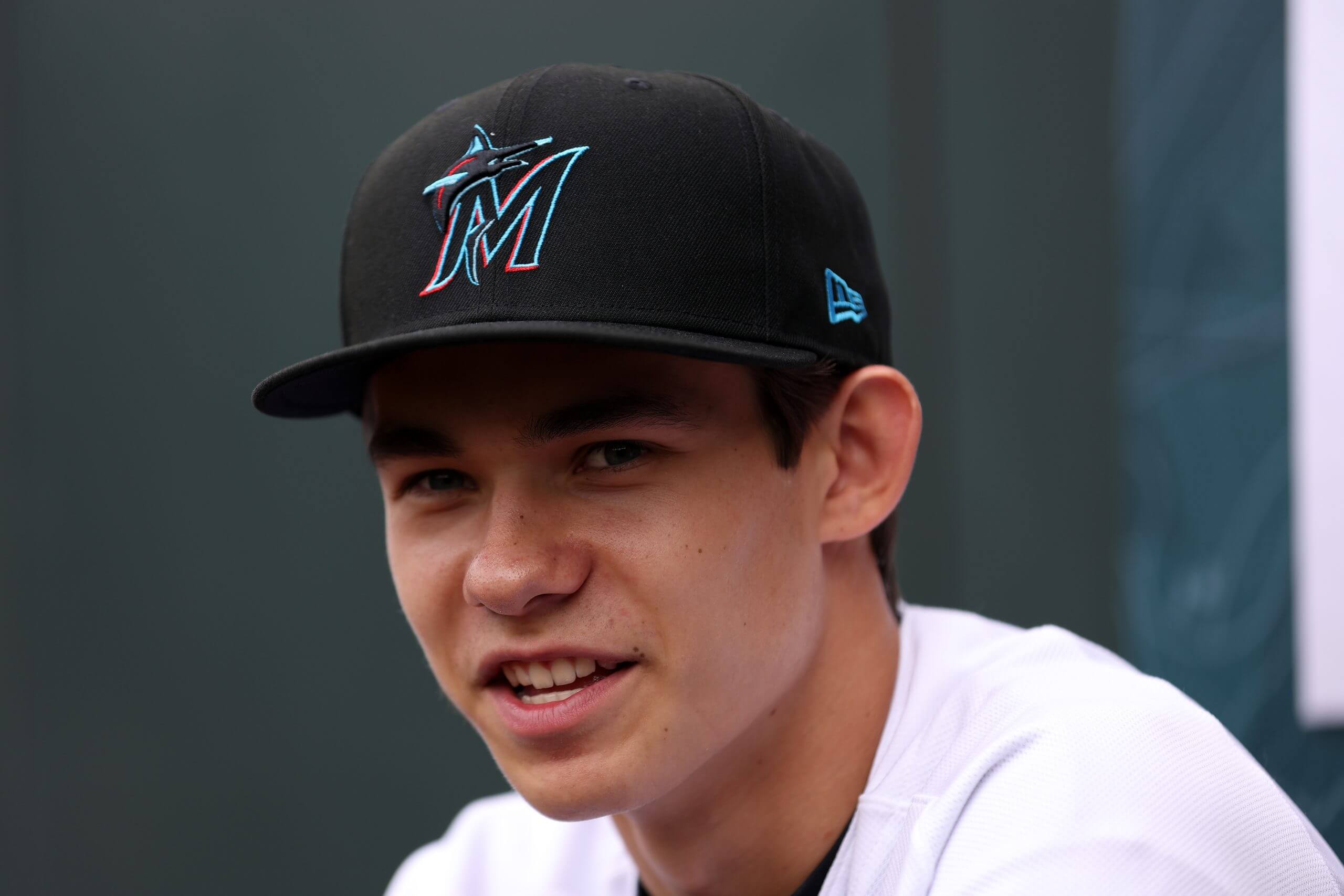
Noble Meyer was the No. 10 pick in the 2023 MLB Draft. (Steph Chambers / Getty Images)
10. Noble Meyer, RHPHeight: 6-5 | Weight: 185 | Bats: R | Throws: R | Age: 21
Meyer was the No. 10 pick in 2023 and the first high school pitcher taken because he had the best stuff, but two-plus years on, he has not been able to throw enough strikes or miss enough bats. His velocity isn’t quite what it was in high school; he’ll hit 98 but sits more 92-94, still getting huge ride up at the top of the zone on the fastball, and his slider and changeup are both at least 55s. The delivery works, and he should have better command and control than he has now; he walked 12.8 percent of batters he faced in High A last year, even though he made 10 starts there the year prior. I see Meyer as a guy who could take off at any time; if he throws more strikes and better strikes, if he changes his mindset and attacks more, if the velocity creeps back up a little bit — any one of these things would make him a potentially above-average major-league starter again. High school pitchers, man.
11. Kevin Defrank, RHPHeight: 6-5 | Weight: 202 | Bats: R | Throws: R | Age: 17
Defrank turned only 17 in August and has already hit 100 mph with some feel already for a changeup, and the Marlins are trying to help him figure out his breaking ball. His current one gets caught between a curveball and a slider. The team has also been working with him on a sweeper to try another shape. His arm is very quick, as is his whole delivery, with a low three-quarters slot where he still gets on top of the ball well, and he moves well on the mound already to provide hope he can make adjustments as he gets older and fills out physically. He hasn’t pitched outside of the Dominican Summer League yet, but I wouldn’t be shocked to see him jump to Low A given how good the stuff is already.
12. Dillon Lewis, OFHeight: 6-3 | Weight: 205 | Bats: R | Throws: R | Age: 23
Lewis was the main prospect coming back in the trade that sent Ryan Weathers to the New York Yankees; the other three, Brendan Jones, Dylan Jasso and Juan Matheus, missed the cut for this list. Lewis is a scouting model darling, posting big exit velocities with high overall hard-contact rates and plus speed while showing limited feel for the game and a below-average hit tool. The Yankees took Lewis in the 13th round in 2024 out of Queens University of Charlotte, which has never had a player get beyond A-ball. He went to Low A as a 22-year-old to start 2025, hit .250/.323/.477, then moved up to High A and hit .228/.320/.426 there, whiffing on 29 percent of his swings at the higher level. His exit velocity has been up to 113.9 mph off the bat with a hard-hit rate of 54.6 percent in Low A, and he has the speed to stick in center. There’s power, which has shown up in games, while the hit tool needs a lot of work, and he won’t be young for High A if he returns there. You can see why the Marlins wanted him, as he has that 20-20 upside at a key position, and why the Yankees were willing to give him up. (For more on the other three prospects from the Weathers trade, see my write-up of the deal.)
13. Andrew Salas, OF/IFHeight: 6-2 | Weight: 180 | Bats: B | Throws: R | Age: 18
A scout for another team told me he thought putting Salas in the Florida State League at barely 17 years old did him a disservice. Salas was the youngest player there by a long shot, and showed some tools — average run, 55 raw power, approaching average defense in center — but was overmatched physically and hit .186/.319/.345. The younger brother of Padres prospect Ethan Salas and Minnesota Twins prospect Jose Salas (a former Marlin, as well), Andrew signed in January 2025 for $3.6 million and did support the claims he had an advanced approach for his age: His chase rate was 17.2 percent, way above the median, and he whiffed on just 24.6 percent of his swings. He didn’t swing much, since walking was by far his most likely method of reaching first base (second most likely: a wormhole opens beneath him in the batter’s box and he reappears 90 feet away). There are clear positives here if you look, but we’ve also seen Salas move way too aggressively up the ladder before without success, and we all know the sequel is never as good as the original.
14. Brandon Compton, OFHeight: 6-1 | Weight: 225 | Bats: L | Throws: L | Age: 22
Compton was much better as a sophomore for Arizona State than as a junior, so the Marlins once again swooped in and bought low last season in the second round on a college hitter with serious juice, which he showed off again at the predraft combine. He’s a great candidate for some swing work to get him to lift the ball more, as the power he shows in BP doesn’t translate well into games. He has to get to more power as he’s a left fielder, with fringy speed and an arm that didn’t come all the way back from Tommy John surgery.
15. Keyner Benitez, LHPHeight: 6-1 | Weight: 165 | Bats: L | Throws: L | Age: 20
Benitez tried to pitch through elbow inflammation last year, which went about as well as you’d expect; he walked 24 in 37 innings in Low A before the Marlins shut him down at the end of July. Even with the discomfort, he was still sitting 93-94 on his two-seamer, up about a mile an hour from 2024, working mostly with a cutter and changeup as his offspeed pitches because he doesn’t spin the ball all that naturally. There is an outside chance he’ll end up as a starter, although he’d have to improve his command a full grade to get to that.
16. Fenwick Trimble, OFHeight: 6-3 | Weight: 200 | Bats: R | Throws: R | Age: 23
The Marlins’ fourth-round pick in 2024 out of Eton by way of James Madison, young Lord Trimble can run and doesn’t miss pitches in the zone, lacking the power to be an everyday player anywhere but probably ending up a good fourth outfielder because of his speed and consistently high contact rates.
17. Dillon Head, OFHeight: 6-0 | Weight: 185 | Bats: L | Throws: L | Age: 21
Head came back from a fairly serious hip injury and surgery that ended his 2024 season quite early, hitting .223/.334/.318 in Low A last year while still somewhat favoring the repaired hip and dealing with some fatigue within the season and even within a series. He does still run plus and can definitely stay in center, at least with plus range out there, and the hard contact is in there, just not frequently enough. It’s almost like the 2025 season was a proof of concept, and in 2026, we might see the real Dillon Head again.
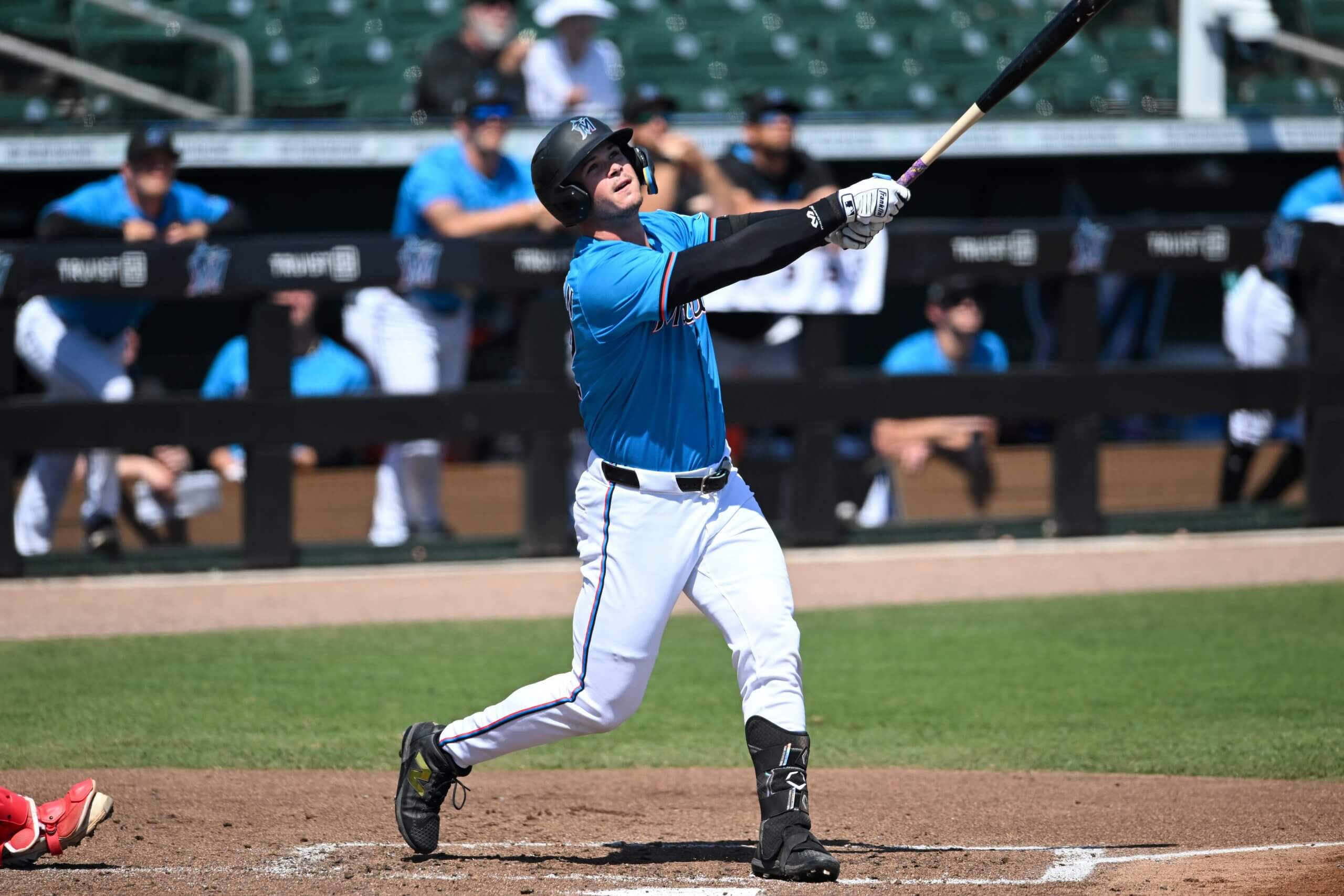
Kemp Alderman has plus power but needs to be more selective at the plate. (Nick Cammett / Diamond Images via Getty Images)
18. Kemp Alderman, OFHeight: 6-2 | Weight: 235 | Bats: R | Throws: R | Age: 23
Alderman is power over hit, with exquisite hard-contact data — he averaged 95 mph off the bat in his stint in Triple A, with a hard-hit rate of 61.8 percent there — and a negative approach that major-league pitchers are going to exploit. If he walked more, or just laid off more pitches out of the zone so there was a chance he would walk more in the future, I could see a Russell Branyan sort of upside here. Even without that, he might hit 30 homers if he had 500 PA in the majors, just with an OBP low enough to cancel much of that out.
19. Andres Valor, OFHeight: 6-3 | Weight: 180 | Bats: R | Throws: R | Age: 20
Valor was on that super-young Florida State League team with Salas and the team’s top two picks from 2024, whom I’ll discuss in a moment, flashing plus speed and power despite an unimpressive stat line. His exit velocity peaked at 110 mph last year, and he should be able to handle center field, mostly playing right last year because Salas was also there and had priority. He has a pull-oriented swing and approach, which could get him to 20-plus homers when he fills out in a few years if he can make more contact. He had trouble with breaking stuff last year, unsurprisingly, as he was still 19 and hadn’t been out of the Florida Complex League yet. It’s everyday upside with low probability.
20. Yoffry Solano, 2BHeight: 5-10 | Weight: 155 | Bats: B | Throws: R | Age: 21
Solano repeated the FCL, an unusual move for the Marlins as they’ve been so aggressive with their teenage hitters, and hit marginally better in 2025, probably well enough that he should have gotten some run in Low A to finish the season. He has plenty of bat speed and uses the whole field well, while also playing above-average defense at second. He’ll be 21 this year and really should be in High A by now, or at least by the midpoint of the season. He’s a quiet prospect but is definitely a prospect.
Others of note
Shortstop Chase Jaworsky came over in the deadline deal that sent Jesús Sánchez to the Houston Astros; he hit .228/.351/.338 in 2025, doing next to nothing on contact, while playing average defense at short. The makeup is apparently outstanding, and he has a high baseball IQ, but he has got to get a lot stronger to leverage that into a big-league role. … Outfielder Max Williams was Miami’s third-round pick out of Florida State, another clear draft model selection, as he makes very hard contact as a byproduct of hacking at everything he sees. He’s in center field now and is maybe 60/40 to move to a corner. … 2025 fourth-rounder Drew Faurot played with Williams in college and has plus power with — wait for it — a bad approach; he’s at second base, so the bar for his bat is a little lower. … Luis Cova repeated the DSL to work on his swing decisions and give his body a chance to fill out a little before he came to the U.S. He’s a center fielder with plus speed and should stay out there, and he tied for third in the DSL with nine homers last summer. … Right-handed reliever Josh Ekness wore down later in the season and ended up on the development list. He’s a fastball/slider guy who’s very cross-body and doesn’t get lefties out enough.
2026 impact
Caissie could be their Opening Day right fielder or part of a platoon there. Mack should be their Opening Day catcher, although I imagine he’ll come up in May or June. White and Snelling will likely debut before the year is out.
The fallen
I don’t usually talk about players who were drafted in the last two years in this section; the Marlins’ 2024 draft is off to such a bad start, however, that I couldn’t put their top two picks on the top 20, even though you can see the list thins out in the teens. First-rounder PJ Morlando has had left elbow surgery, a hamstring strain, a concussion and a back injury in the 18 months since he was their first-round pick, so you can cut him quite a bit of slack on his performance, which hasn’t been good: He hit .226/.361/.353 as a 20-year-old in Low A, then got overwhelmed in the AFL, going 8-for-59 with no extra-base hits and a 33 percent strikeout rate. He’s left field only due to his arm and is an average runner at best. The big power he was supposed to have in high school has been gone since 2023. Their second pick, Carter Johnson, has been worse, hitting .177/.275/.261 in Low A, playing shortstop more than second base but needing to go to the latter position. He was only 19 last year, so he has some more time to right the ship. I’m not saying these guys are done, by any means, but every scout I asked who saw these guys came back saying they weren’t prospects.
Sleeper
Cristian Hernandez was set to be my Cubs sleeper, so now he can be my Marlins sleeper instead.