
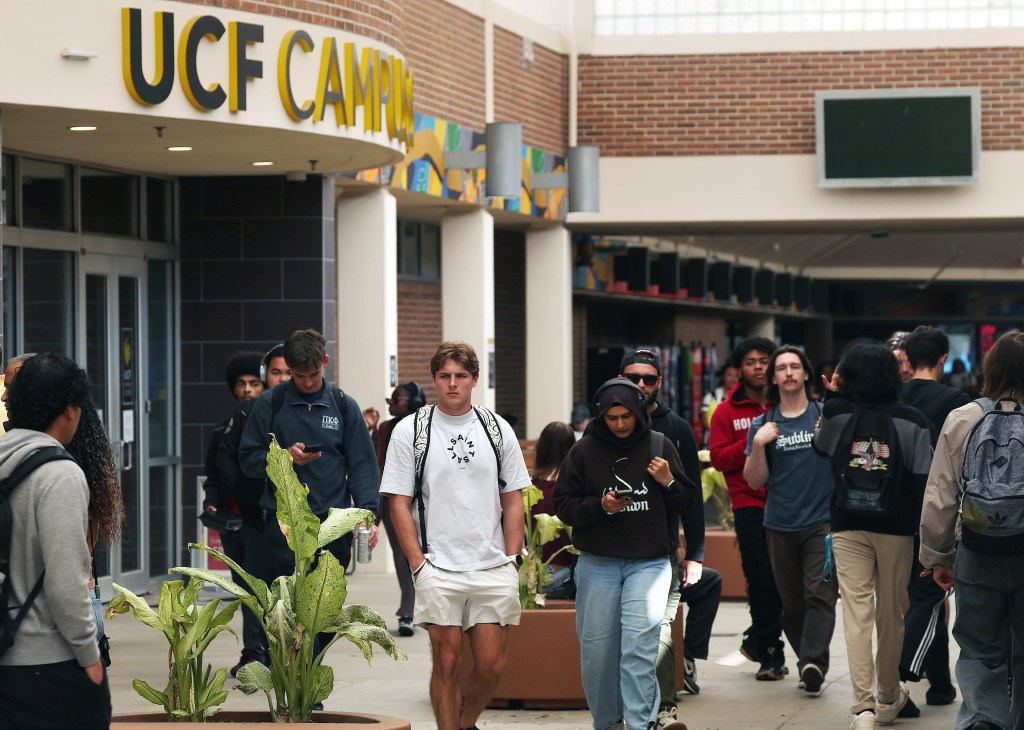
A Polk County lawmaker wants to slash the number of out-of-state students allowed in Florida’s top public universities, arguing such a move would be “putting Florida’s students and families first.”
Rep. Jennifer Kincart Jonsson’s bill (HB 1279), which got a first favorable vote in committee in late January, would impact undergraduate enrollment at Florida State University, the University of Central Florida, the University of Florida and the University of South Florida. It taps into concerns that state residents are losing their college slots to wealthy aspirants from beyond its borders, including foreigners, even though Florida’s schools have far fewer such students than many state university peers.
If the Lakeland Republican has her way, each could have a fall, first-year student enrollment that included no more than 5% out-of-state students.
Those universities, which are the state’s most selective, now have out-of-state enrollments above that, with FSU and UF at nearly 15% and 20% respectively for their first-year classes.
“We have valedictorians and top ranked students who are being denied or deferred from our flagship institutions,” Kincart Jonsson said during the Jan. 28 meeting. “We have tax paying parents sending their children out of state, not because those schools are better, but because it’s their opportunity to attend a four-year university after being squeezed out here at home,” she added.
Florida’s current rules cap out-of-state enrollment at 10% of the university population, but that figure is calculated as an average for the state’s 12 public universities. That means the more selective schools can enroll more students from outside Florida as long as others enroll fewer.
Jonsson’s bill in the Florida House does not have a companion in the Senate, so it is not clear if the full Legislature will support it.
Her proposal will likely appeal to parents anxious about whether their children can earn a spot in Florida’s increasingly competitive universities. But it could also cost those schools money.
Out-of-state students at UCF, for example, pay $22,482 in tuition compared to $5,954 for in-state students.
UCF raised out-of-state tuition last summer by 10%, looking to collect money for faculty salaries by making about 5,000 students who aren’t Florida residents pay more.
Florida universities’ acceptance of out-of-state students has increased in recent decades, but compared to public, particularly flagship, universities in other states, the Sunshine State still gives higher priority to its residents.
At the University of Michigan and the University of Wisconsin-Madison, for example — schools similar in academic rank to UF — more than half of all students come from another state.
At FSU, the percentage of first-time-in-college students from outside of Florida was 8.4% in 2005 — and that figure has almost doubled since. UF’s percentage of out-of-state students has more than doubled in the last decade.
USF says about 12% of its students are from outside Florida. The Tampa school bragged this fall that its new first-year class had the highest SAT scores in its history and included students from 45 states.
UCF has historically admitted fewer out-of-state students than FSU or UF, with just under 4% from outside Florida in 2005, and just over 6% now. So a reduction to 5% wouldn’t impact UCF as drastically as other “preeminent” universities, Florida’s designation for its top-performing schools.
Given the trend at UF and FSU, focusing on Florida students is the right direction for the Legislature to go, said Jodi Furman, a Florida-based independent college admissions counselor.
“I’m very happy to see some attention being paid to our students who are in state, having some priority, whether or not this is the exact way to best address it,” Furman said.
But going as low as 5% could have “potentially extreme” consequences, she said, particularly to those schools finances.
Furman runs a Facebook page called College Smart Start where parents of prospective college students discuss the admissions process. Kincart Jonsson posted to the group about her bill.
Some parents were delighted.
“Thank you Jennifer Kincart Jonsson for standing up for Florida students and families! It’s ridiculous the kids who are getting denied by UF and FSU,” one mother wrote.
Others, however, were worried.
“The preference is that our students are prepared to face high levels of competition to get into college no matter where they go or who decides to apply to Florida schools,” another parent wrote.
Most concerning is the financial hit, wrote Paul Cottle, a professor at FSU and chair of its physics department, in a post to his blog on K-12 science education.
FSU could lose $44 million over a four-year period if it reduced out-of-state students to just 5%, he calculated.
“The only real solution to the problem that Representative Kincart Jonsson described is to double the capacity of the preeminent institutions,” a designation FSU, UCF, UF and USF hold. “But that would require enormous investments in additional personnel and facilities that the Florida Legislature wouldn’t want to support,” Cottle wrote.
Under Jonsson’s bill, the four universities would calculate their out-of-state, undergraduate enrollment as a three-year average and, starting in 2030, could lose state money if they do not comply with the 5% cap.