
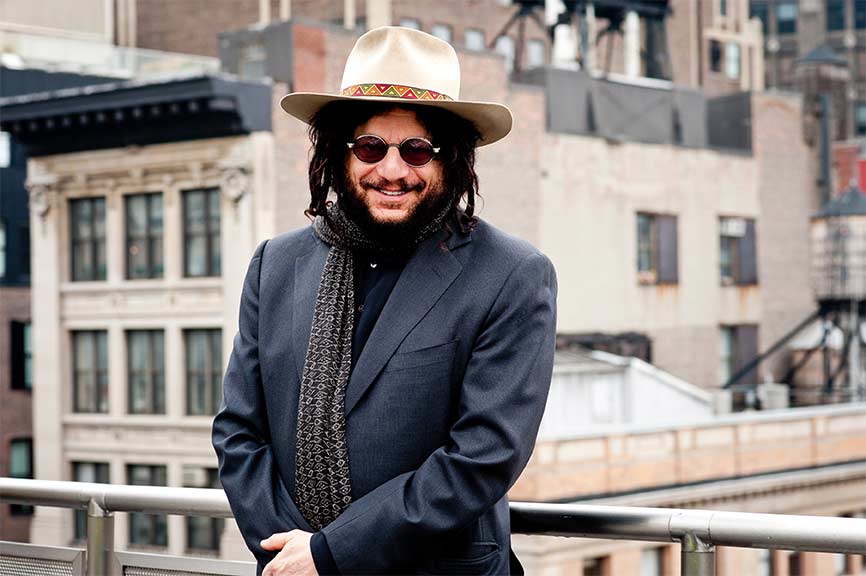
As a record producer, Don Was is an A-lister. He might even be the whole A list.
He’s helmed albums for the Rolling Stones (Voodoo Lounge, Bridges to Babylon, A Bigger Bang and others), Bob Dylan (Under the Red Sky, MTV Unplugged), Brian Wilson (I Just Wasn’t Made For These Times), Van Morrison (Born to Sing) and the likes of John Mayer, Iggy Pop, Willie Nelson, Bonnie Raitt, Elton John, Ziggy Marley, Stone Temple Pilots, Ryan Adams and Gregg Allman. That’s the short list.
So yeah, serious producer cred.
Detroit-born and bred, Was (aka Don Fagenson) is a singer, songwriter and rock ‘n’ roll bassist who first caught the eyes and ears of the music business as a member of the pop/funk outfit Was? Not Was (“Walk the Dinosaur,” 1987).
In addition to his career as an in-demand, all-star producer, he continues to write and perform whenever he gets the chance. He tends to pop up all over the place, just hanging back as the bass player.
From 2025, Groove in the Face of Adversity, a six-song EP by Don Was & the Pan-Detroit Ensemble, turns out to be the first record issued under Was’ own name as an artist, despite 50 years in the biz.
The jazz/blues/funk group performs at the Capitol Theatre Thursday; tickets for the 7:30 p.m. show are at this link.
As if that wasn’t enough, since 2011 Was has served as President of the venerated jazz label Blue Note Records.
St. Pete Catalyst: You’re a studio rat, but you’re also a live performer. How do they work together? What’s the balance?
Don Was: Whether you’re producing a record, you’re the artist or you’re the record company, you’re doing the same thing: You’re basically trying to be a part of delivering music to people that’s going to get under their skin, and make ‘em feel something, and make ‘em feel better about life, bring ‘em some comfort in times of chaos and confusion, and just help ‘em understand some of the existential craziness of being a human being alive on earth, right?
You’re in a bubble in the studio. Which is kinda nice – you can create in an unfettered manner in that environment. But there’s really nothing like being onstage with people who are listening in the audience. Having a great conversation, musically, among the band, and then including the audience in that conversation.
And when they start sending energy back to the stage, it actually impacts your choice of notes. Whatever you’re going to play next is influenced by the audience’s energy. You get this energy exchange going, it’s one of the most exhilarating things I’ve ever experienced in my life, man, you can blow the roof off the theater.
Let’s talk about the band you’re bringing here, the Pan-Detroit Ensemble.
Here’s what happened to me: Somewhere in the early ‘90s, I got on my first roll as a producer. And in very short order I got to work with a lot of my heroes – Bob Dylan, Brian Wilson, Willie Nelson, Kris Kristofferson, Leonard Cohen, Mick & Keith … and it gave me a tremendous writer’s block, man, because every time I’d sit down at the piano to write something I’d just think “Ahh, what’s the point? Brian Wilson lives 10 minutes away, just give him the lyric.” And it took about five years to get over that.
One day I was in the studio with Willie Nelson, and I was again bemoaning the fact that I could never be Willie Nelson, and then it hit me: Willie Nelson can never be me. He didn’t grow up in Detroit in 1967, and drop acid and go see the MC5 at the Grande Ballroom. And he didn’t have George Clinton come and play a sock hop at his junior high school. That kind of thing.
So I thought all right, the thing that makes you different, which often times in the music business is considered a marketing nightmare, is actually your superpower. It’s not a problem. I can’t be Willie Nelson, but I’ve got something he hasn’t got.
Parenthetically, I love Across the Borderline, the album you produced for Willie.
Thank you, man. I really appreciate that. Of all the albums I’ve worked on, I think that is my favorite.
OK … so you’re drawing on your teenage years in Detroit …
Well, I’m just drawing on who I am. And when it came time to put a band together I thought “Don’t try to be like the other guys. What’s the thing that makes you different?” I grew up in Detroit in the ‘50s and the ‘60s. Go back, find some musicians who grew up listening to the same radio stations s you, who played in the same bars, for the same audiences, and who speak this musical language of Detroit. So that’s what I did.
And in the very first rehearsal, about 10 minutes in, it felt like we’d been playing together for a decade already.
Why did taking the job behind the desk at Blue Note appeal to you? And tell me I’m wrong about the desk thing.
You’re definitely wrong about the desk thing [laughing]. The allure was, I’d been collecting Blue Note records since 1966. A huge fan. And what I pictured was “Oh man, everyone’ll knock off at five o’clock, I’ll be able to go down in the basement, put on the master tapes, smoke a joint and listen.”
Is that what happened?
No, of course not! All the master tapes are stored in a mountain someplace. They’re super-safe. If I want to hear one reel of something, 15 minutes of something, I have to requisition it. And it takes weeks to get to me.
[still laughing But I can access it, though. I’ve heard stuff that hasn’t come out, that blew my mind.
But you are making decisions for the company …
Oh yeah, it’s not a goofy job. I actually feel a tremendous responsibility to be the custodian of this incredible legacy of music that means so much to people.
Up until that point record companies, they were the enemy to me. They were the guys that came down to the sessions, brought it to a halt, gave you terrible suggestions … and if you managed to sell records in spite of their suggestions, they’d steal your money. [laughing] That was what I thought of a record company.
I had to revise that thinking once I got inside, because that’s like a caricature; that’s not what really happens. If you really want to know what a record company is, it’s a bunch of 30-year-old kids who just love music, love musicians and are willing to stay in an office till 11 o’clock at night to work on a record where they may not even know the artist, but they just love the music, and they love the label so much.
So it’s really just a bunch of dedicated music fans. And I had to open my mind up. And I also had to learn how to do the job properly. I’d never had a job in my life. I never thought about producing records as being a job, or playing music as being a job.
But this was a gig where I had to answer to somebody, and we had benefactors who needed a return on their investment. It took about five years to figure out how to do it in a style that matched who I was. That was copacetic with my life. This is my 15th year.
You’re one of those producer/musicians who’ve frequently said that producing records isn’t really a job.
Well, it’s a cool job. Around the year 2000, Bob Dylan was getting the Kennedy Center Honor. I was in the band, and they invited me to the dinner at the State Department the night before. I got off the elevator with Bruce Springsteen, and I thought I was pretty hot shit. The elevator door opened, and there’s Walter Cronkite talking to Edward Kennedy. I thought OK, now we’re in a different league of hot shit here!
There were people at that dinner whose politics I really disagreed with. Somewhere in the middle I looked around the room and there was musicians, actors, or artists in general, and politicians. And I thought aw, what the f—, man, it’s just a bunch of guys who didn’t want to lift heavy boxes for a living. Which I could relate to.
You don’t really have a choice in these things. You are who you are. If you’re lucky, you figure out a way to be yourself, and feed your kids.