
Central Floridians have always prided themselves on the warm welcome they extend to people from around the world. But there are limits to our hospitality. Those who take advantage of resources paid for by local taxpayers while abusing and terrorizing our residents and keeping county elected officials in the dark about large-scale plans should not be surprised when they receive a frosty reception.
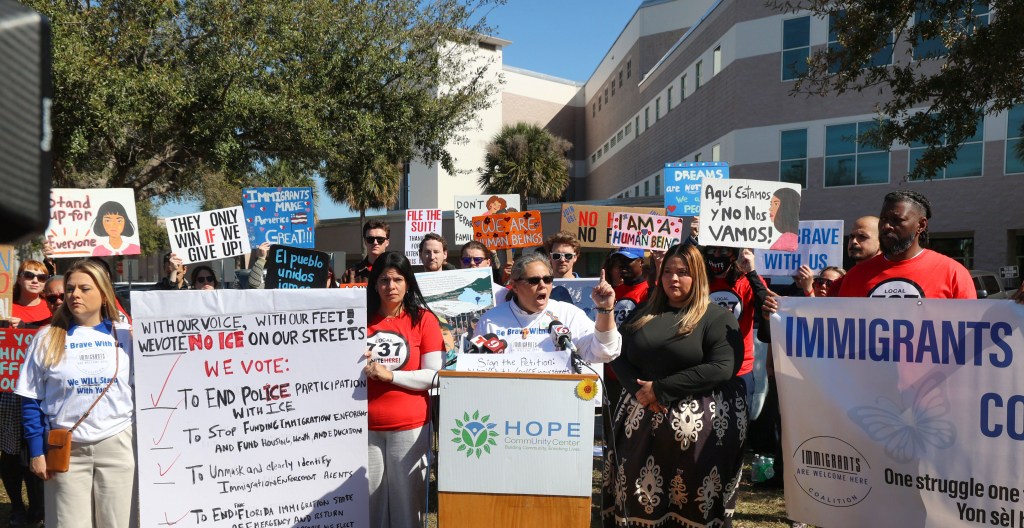
And yes, that extends to our federal government — in particular, the Department of Homeland Security, which is fast wearing out its welcome here. That’s been evident just driving around Central Florida, where protest gatherings of dozens, even hundreds of people have become a commonplace sight. They are focused on the human injustices wrought by Immigration and Customs Enforcement officers who have stopped cars on roadsides, rounded up job-seekers and even laid in wait outside hearing rooms to detain people complying with required appearances in immigration court.
People used to say that immigrants who followed the rules had nothing to fear. They can’t honestly say that anymore, as stories proliferate of people being questioned, wrongly held and even mistakenly deported. As the Sentinel’s Cristobal Reyes has reported, federal judges based in Orlando have scolded prosecutors multiple times in recent weeks for detaining people who should have been set free, with one judge memorably comparing the current actions of ICE to those of a third-world country. It’s a cruelty magnified by the fact that among the people most vulnerable to unjust deportation are people from oppressive regimes such as Cuba, Haiti and Venezuela seeking asylum.
We’ll be honest: Despite the outpouring of public anger over ICE’s activities in Central Florida, we know that not everyone is moved by the wave of anti-immigration enforcement. But there’s more to worry about — particularly, the federal government’s demand that local taxpayers help foot the bill for their activities, and their decision to keep Orange County and Orlando leaders in the dark about rumored plans to put a 1,500-inmate immigration detention center in an area that’s projected to be the next hub of residential and commercial development in Orange County.
Pay the bills
As reported by the Sentinel’s Ryan Gillespie, the high-handedness came to a head last week. The first shoe to drop: A letter from Orange County Mayor Jerry Demings, who informed the local head of ICE that the county jail could no longer be abused as a discount parking lot for federal detainees who were being held on immigration-violation charges alone. Orange County is one of a handful across Florida with a contract to hold this kind of prisoner — other area jails only accept inmates who have been arrested on charges in that county, then found to have an immigration hold. Orange County’s agreement with ICE only obligates the county to detain up to 114 people, but the county was housing, on average, 140 inmates a day in January and last week, the count hit 182.
The county is capping that number after March 1, Demings wrote, and will only allow ICE to leave 66 men and 64 women at any given time in Orange County’s jail unless they have pending criminal cases here in Florida. That’s a generous offer. But ICE officials had better pay attention to the other point Demings made last week: He’s putting a stop to the ludicrous dodge-and-weave game ICE has been playing to defeat the 72-hour time limit on ICE detentions in local jails. Immigration officers would pick up an inmate whose three days were nearly expired, then bring them back shortly thereafter and leave them for another few days, forcing county officials to go through the work of processing the same inmate multiple times and leading to some being lost in the system, unfindable by attorneys or family. Some inmates spend upwards of a week in Orange County facilities.
Making matters worse, the federal government pays Orange County $88 per day to house immigration detainees — yet it costs the county more than $180 a day to house, feed and care for them. In a letter to a local group called Immigrants are Welcome Here, Demings said he was considering whether the county could go to court to ensure ICE pays its fair share. It shouldn’t come to that. The Department of Homeland Security is slinging money around like mad. Federal officials shouldn’t expect Orange County taxpayers to foot the bill for their overzealous pursuit of injustice.
No ugly surprises
Nor should DHS withhold information that local officials — and residents — deserve: A yes-or-no answer to increasingly credible rumors that it plans to convert a warehouse in east Orange County into a giant immigration-detention center that could house up to 1,500 people.
Gillespie’s story, in Sunday’s print edition, delves into the reasons we suspect the rumors might be true. If they are, DHS is following a playbook it’s used in other communities, where details were cloaked in secrecy until it was almost too late to protest. That’s a massive problem, because a detention center that’s open 24 hours a day and houses enough humans to populate a small city will put a far greater strain on public resources than any warehouse could.
“A facility this size is going to create a mark that will be felt,” says Wanda Bertram, a communications specialist at the Prison Policy Initiative, a national think tank, adding that when any kind of incarceration facility is being constructed, corners tend to be cut and impacts under-studied. In this case, there’s significant concern about overburdened local roads in an area that might soon be slated for more intensive development — much of the surrounding land is owned by local land magnate Tavistock and the Mormon church. The facility is also likely to drain more than its share of the area’s water resources, since inmate facilities tend to consume more water per-person than private residences.
The site technically lies within the city limits of Orlando, and City Attorney Mayanne Downs has already said she doesn’t think the city can challenge the project. City Council members should challenge that position — at the very least, to ensure that any proposed facility gets the kind of development review that any big, intensive project deserves.
Both Orange County and Orlando leaders are confronted with the same dilemma. If things were as they should be, well-intended local leaders would have an easy time cooperating with the might and power of the federal government. That isn’t the case here. As Deming noted in the letter to . But what they can do — what their constituents should expect — is to stand their ground for the principles of good government, including fair treatment and transparency from DHS. That’s the right thing to do, even if it is an uphill battle.
The Orlando Sentinel Editorial Board consists of Opinion Editor Krys Fluker, Executive Editor Roger Simmons and Viewpoints Editor Jay Reddick. Use insight@orlandosentinel.com to contact us.