
For young adults aging out of the foster system, turning 18 presents an immediate problem.
Where to live?
A St. Petersburg nonprofit leader is raising money to build supportive housing that eases the transition.
The project will be among the first to take advantage of Florida’s new Yes In God’s Backyard law, which relaxes zoning restrictions to make it possible to build affordable housing on land owned by religious institutions.
St. Petersburg adopted the measure in December, becoming the first city in the state to opt in.
Up to 40 young adults in the St. Petersburg area will be able to move into two-bedroom retrofitted shipping containers, rented far below market rate. Chris Warren, the driving force behind the Ujima Transitional Housing Initiative, said the goal is to bridge the gap for those who have aged out of the foster system but don’t yet have the resources to support themselves.
About 20% of foster youth become homeless as soon as they turn 18. An estimated 25% are incarcerated within two years of aging out, according to the National Foster Youth Institute.
“I think the biggest issue is finding housing,” former foster kid Riley Dearmon said. “But not just any housing. Having a stable, positive, peaceful sanctuary.”
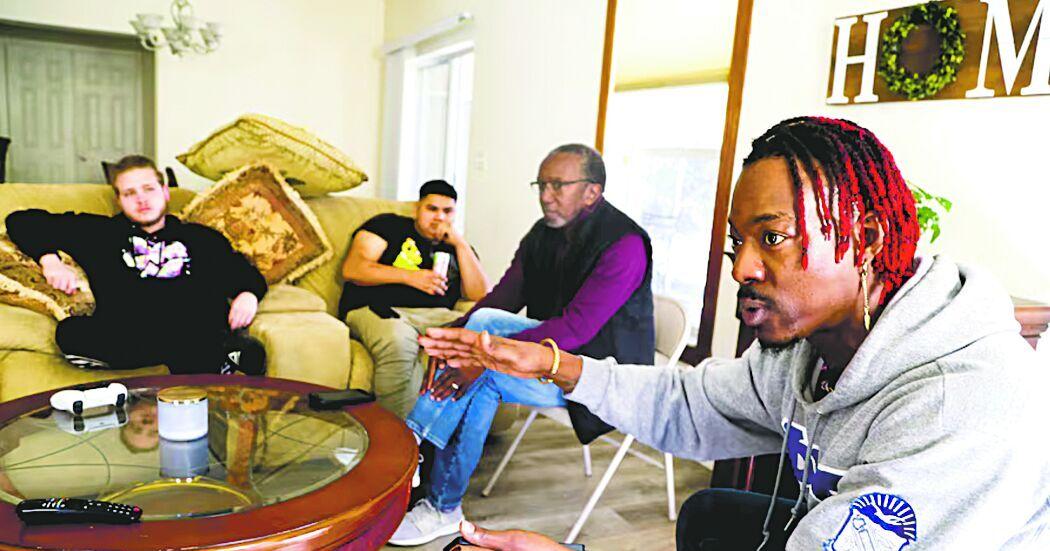
Dearmon had teetered on the edge of homelessness since his 18th birthday. But last year, the 24-year-old secured a spot in a transitional home run by another St. Petersburg nonprofit, Faith Youth Services.
There, he’s received mentorship and financial literacy training that he said has opened up a world of possibilities.
He’s now starting a landscaping business, attending church every Sunday and saving money for his own place. Without his transitional home, “I would probably still be getting in trouble,” he said.
On a recent afternoon, a small group gathered in the home’s living room took a break from playing PlayStation and eating pizza to talk about their experiences in group homes.
“When’s the last time you gave another male a hug?” asked the social worker who was leading the discussion. He encouraged the young men to embrace each other, and everyone stood up to greet their neighbors without hesitation.
“This is not just a place to stay. We try to have a family atmosphere,” said Chris Davis, CEO of Faith Youth Services.
He’s operated this transitional home for more than a year and said he’s seen the difference it has made for residents. But he doesn’t have nearly enough space to accommodate the demand. Without more housing options like this, he fears that young people will continue to fall through the cracks, ending up on the streets, in a jail cell or forced into sex work.
His church, along with Mt. Zion Primitive Baptist Church, will serve as the first two host sites for the Ujima Transitional Housing Initiative.
“The ability to help this segment of the population is extremely important,” he said. “I know it’s what God would want us to do.”
The pilot will feature up to 20 two-bedroom homes built out of shipping containers. Residents will have access year-round to life skills and career development courses. Everyone will have a case manager.
Rent will be locked in at around $600 a month for the duration of a tenant’s four-year lease. Warren said the St. Pete Housing Authority already has signed on to provide residents with housing vouchers to subsidize rent.
Warren, who also is principal consultant for the youth services nonprofit Spring Zone St. Pete, estimates that each unit will cost around $105,000 to build. Future residents will help build the project through a partnership with CareerSource Tampa Bay, which, Warren said, will offset construction costs while providing hands-on job training.
The target move-in date is December.
If all goes to plan, Warren hopes within 12 years to expand to 24 sites serving 600 youth annually. The program is designed to grow, he wrote in an email, “helping vulnerable young people build independence before crisis occurs.”