
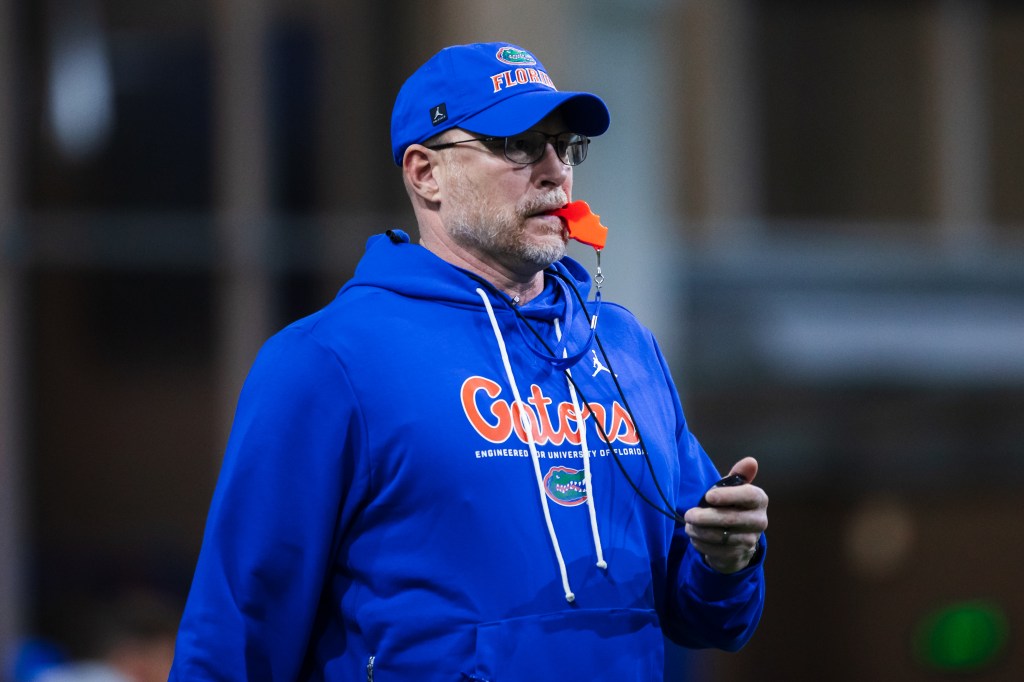
GAINESVILLE — Rusty Whitt is a strength coach, soldier and story teller, a trifecta of talents he’ll use to help head coach Jon Sumrall rebuild the Florida Gators.
As if executing an Olympic lift, Whitt blends complex components into a concentrated, explosive message aimed to inspire discipline and accountability while pushing a talented group of players to strain every fiber of their being.
Whitt and Sumrall face a heavy lift in Gainesville, where the Gators have managed just one winning season in five years.
“Our job is to hone them and get them stronger and understand the professional discipline it is going to take for them to reach their potential,” Whitt told the Orlando Sentinel.
No strength coach in America can match the war stories of Whitt, the only Green Beret to hold his position in Division I football.
“I kind of carry the torch for those guys,” he said.
Few have matched Whitt’s results. He oversaw four conference champions in two seasons each at Troy and Tulane with Sumrall.
Whitt’s gift of gab is next level. The 54-year-old insightfully, entertainingly and at times harrowingly recalled experiences on the football fields of Texas and the battlefields of Iraq. He returned home forever changed and eager to shape the bodies and minds of young men.
During a 45-minute interview with the Orlando Sentinel, the Gators’ master motivator and raconteur engaged in an illuminating and riveting conversation.
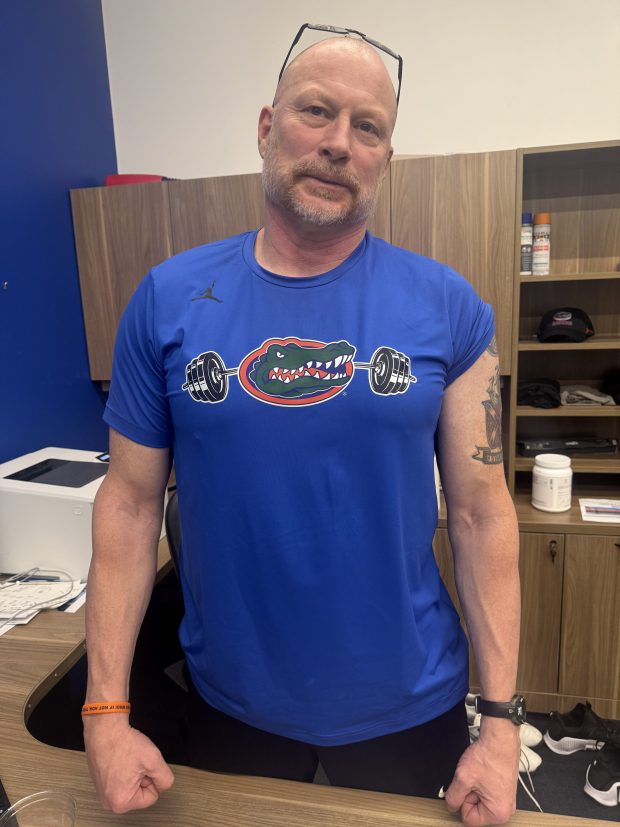 Florida’s new strength and conditioning coach Rusty Whitt held the same position under head coach Jon Sumrall during two seasons each at Troy and Tulane. (Edgar Thompson/Orlando Sentinel)
How do you view your role?
“We’re supposed to be the culture driver. But it has to be set by the head football coach. Coach Sumrall does a really good job of establishing what he wants and aligning that message. His core values are attitude, toughness, discipline and love. You can only control one thing about your day, and that’s how you approach it — the only disability in life is a bad attitude. The attitude that we try to bring on a daily basis is very aggressive, it’s very positive. It’s just demanding.
“The toughness aspect bleeds into that — we’re going to do hard things together. Being gritty is crazy tough. Gritty teams beat tough teams.
“No football coach is going to say, ‘Hey, we’re too disciplined.’ Disciplined football teams will beat sloppy football teams. When you’re fatigued, you make more mistakes. Insert us; we got to be conditioned.
“And then, I’m going to sacrifice for my teammates. I’m going to play hard for my teammates. Protect the team. Don’t do anything stupid outside that’s going to bring you down and bring the team down. And no energy vampires. An energy vampire has bad body language, the complaining look on their face, the vocal complainer. So we enforce those pretty simple concepts daily.”
When did you decide to become a Green Beret?
“I had a partially torn ACL in college, lived on it, played on it, coached on it for seven or eight years. I was training one day with Josh McCown [quarterback at Sam Houston State], doing power cleans. I tore my ACL and cracked the femoral head. It was July 15, 2001. I had surgery a month later. Then 9/11 happened.
“I’m an invalid. I’m facing an 11-month rehab. I’m watching TV. My grandmother called me, and she goes, ‘This is your Pearl Harbor.’ My grandma was 24 years old on Dec. 7, 1941. She was one of 11. All her brothers joined the Army, Navy or Marines. I’m like, ‘Hell, you just drafted me.’ I rehabbed my leg for a year, and at the age of 32 I walked across the street to a strip mall and I joined the Army.”
What was the path from there?
“They said I was too old to go Special Forces, but I could go to Ranger Battalion. I was sent to Fort Benning, two classes behind Pat Tillman; he was out of basic and in Airborne school. I’m older than everybody. I’m older than the drill sergeants. I’m older than the company first sergeant. I’m in Airborne school, going to do five jumps, then go into the Ranger indoctrination program. I’m laying there before a jump. A 6-4, 240-pound guy walks into the hangar, the first Green Beret I ever saw in my life in person. He comes walking in with his clipboard — ‘Holy crap, who’s this superhero?’ He tells me my orders had changed: ‘Report to Fort Bragg 4 January.’
“I jump, land, am getting married in a week, drive to Atlanta for a bachelor party, am married in Nevada, see David Lee Roth at Harris Casino. I fly back to Fort Bragg, Jan. 4, 2004, and that’s when I started the Q Course [qualification course]. So, two years and two months of just complete chaos, and then I got sent to my Special Forces team in Fort Carson, Colorado.”
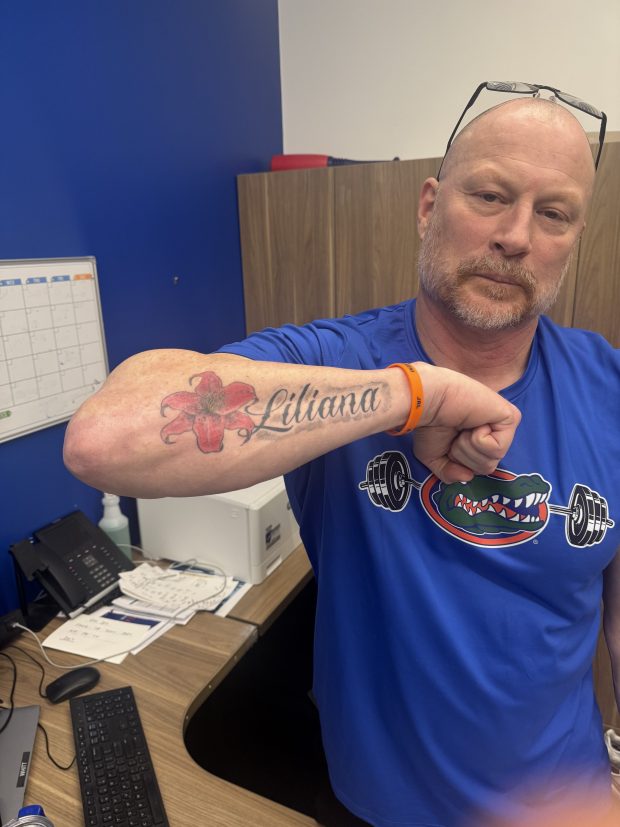 Florida coach Rusty Whitt’s left forearm features a tattoo with the name of his 13-month daughter Lilanna. (Edgar Thompson/Orlando Sentinel)
What then?
“I walk into this team room, and I’m exactly the same age as a team sergeant. When he was 18, he’s Gulf War 1. I’m playing college football. We had this weird parallel life, where he was like, ‘Where have you been the last 15 years? Welcome to the show.’
“I walk in on my team, and they were damaged. They’ve been fighting in Iraq for 250 consecutive days in a gunfight. Then I walk into that environment, this fresh fish, off the bus, and they’re like, ‘Who is this guy?’ I knew that was gonna be the most challenging thing in my life: to get acceptance from this team of guys, to accept a new guy like me at my age.
“It took a year to get absorbed into that team, where they actually trusted you and respected you. I trained for a year, and then did a nine-month tour in Iraq. I went back again, and then by that time, my clock had run out, and I elected to get out and get back into coaching.”
How would you describe your experiences in Iraq?
“Saw amazing things, saw horrible things, and it really changed my perspective on life and on the world, and how good we got it here, and how easily we can lose it, and how many people want what we have. And if we don’t have a strong military, it’d be really easy for somebody to come and take all of it.
“I saw utter desperation in Iraq. People that would lie, cheat, steal, rob, amputate for what we have. We fought against that … what you and I would call evil. At one point, al Qaeda was offering $10,000 for a video killing a soldier. So watch your ass because every time you leave the gate, you’re getting shot at. An Iraqi policeman that you thought you could trust planted a bomb under the street the night before. It creates a paranoid mindset.
“I came back out of the service. I wouldn’t call it post traumatic stress disorder. I would call it post traumatic paranoia. But I met amazing people, did some cool stuff, no regrets. But it did set my career back about 10 years. I’m happy to be here after all that.
“About 11 friends of mine didn’t make it over there in Afghanistan or Iraq. Josh Townsend had this same tattoo [points to left arm]. He was my roommate, he died in Afghanistan and he liked Jameson Whiskey. I got a Jameson Whiskey tattoo and a Celtic knot because he was a big Irish guy.”
How can you apply your experiences with your players?
“Your coaching standards, unrelenting standards. There’s a one-mile obstacle course at Camp McCall, North Carolina, where you go for Special Forces selection. It’s called the Nasty Nick. Nick Rowe was one of the founders of the Green Berets. It has about 15 30-foot rope climbs. There’s about 30 obstacles. Every time you go through it, there’s a cadre standing there with a clipboard. You have your number taped to your leg. You got to complete this obstacle, and if you fail it, ‘Roster 054 you have failed to negotiate this obstacle properly! Do you wish to continue?’” … ” ‘Yes, sergeant!’ … ‘Try it again.’”
“If you fail, you’re out, you’re done, get on the bus, go home, go the 82nd Airborne. It is an absolute cut-and-dry standard. I made it to the Thumper, which was a 15-foot rope climb. You got to grab a bar, pull yourself over, and you got to walk across monkey bars — little one-inch pipes. Then you got to bend, grab a rope, and then hang back down and lower yourself under control. I got to the edge of the Thumper where the monkey bars were. I reached and I tried to swing and I lost my grip. I fell about 12 feet — Boom! I hit the ground.
“Air is knocked out of me. I’m ringing, singing here. ‘Roster 054, you failed negotiate this obstacle properly! Do you wish to continue?’ … ‘Roger, sergeant!’ So I’m like, this is it, one more chance. If I had failed, I wouldn’t be here right now.
“So, absolute standards you have to have to play college football at this level, to play for the Florida Gators. Absolute standards to be a Green Beret. I try to make these guys understand the similarities and standards.”
Would you give an example?
“You have to be able to run across the field and back as a cornerback in less than 14 seconds. The elite ones, the first-round draft picks, can run from the sideline to the other side, touch the right foot, sprint back in around 13.8 seconds. To play starting center for the Houston Texans, like Jake Andrews does, you got to squat 600 pounds — ass to Achilles. If you can’t, you better be a super Javon Kearse-level athlete. I have these standards in my head, and I preach them. My staff knows them, and we hold the standards.
“The other one is, everybody’s pursuing mental toughness. How do you get mentally tough? People write books about it. People go to clinics about it. The secret to mental toughness is self-confidence. I’m going to get a young man who’s 18 or 20. We’re going to do hard things sequentially enough where they can get better at them. They’re going to improve their self-confidence — that’s how you get mentally tough. You develop that level of self-confidence on a team with this level of talent and watch out. Watch out.”
What’s your grandmother’s name?
“Joyce Alva Miller. She passed away 2009. She got to see me come back from Iraq. She passed away about six months later. She had a a little American flag on her front porch. She put it up there when I joined the Army. When I got out, I went to her house, and she pulled it out and she gave up to me, ‘I’m glad you made it.’”
Your maternal or paternal grandmother?
“My mom’s mother. A fabulous woman when she was helped help raise me. My grandfather, her husband, joined the Army before World War II, mid ’30s. He was actually stationed in Schofield Barracks, Hawaii, and got out before the [Pearl Harbor] bombing and our involvement.
“My grandfather wanted to be a cavalryman, and they were eliminating the cavalry from the U.S. Army. When he was out of processing, he had like six months left. They said, ‘You’re going to go to Fort Leavenworth, Kansas, and being a prison guard until you get out of the Army.’ They gave him a 14-inch metal billy club, and they would tie in a square knot on his wrist. They said, ‘Anybody that breaks out on your watch, you serve their time.’ He kept that billy club the rest of his life. My brother has it. Somebody who passed through when he was there was Al Capone.”
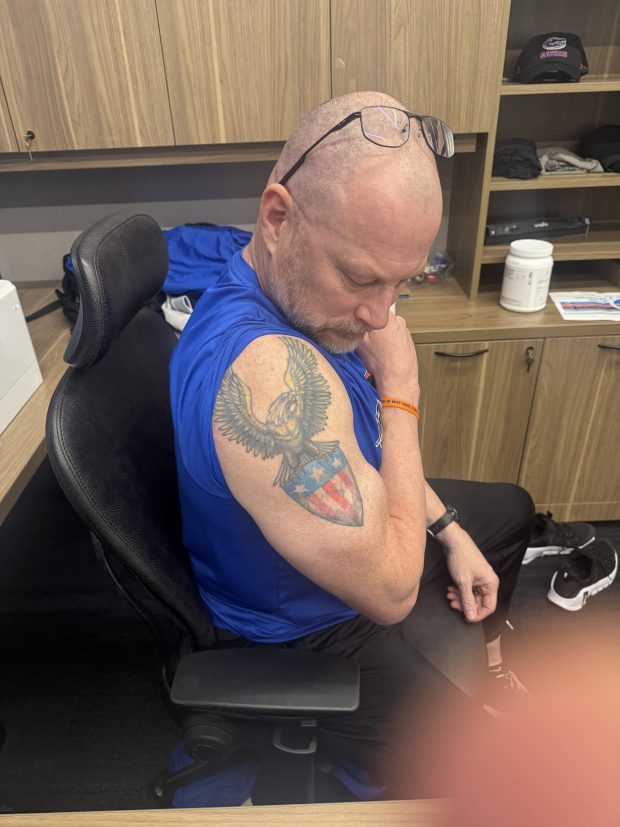 When Florida strength coach Rusty Whitt’s service ended with the Green Berets, he got a tattoo on his left arm of the American seal found on the back of the dollar bill. (Edgar Thompson/Orlando Sentinel)
What’s the meaning of your other tattoos?
“This is getting out of the Army. The American seal on a dollar bill [upper right arm]. This is my my tribute side [left]. My buddy taught me how to play guitar. He passed away in a car accident. Corey Stovall, I got a guitar with with wings on it [left side of abdomen].
“A book written about General Patton called, ‘A Genius for War.’ He said a pint of sweat will save a gallon of blood’ [tattooed fully along the triceps of each arm. It’s kind of cheesy, but when I was a little kid, I watched the movie ‘Patton’ with George C Scott. My dad loved it, so I got into it.”
What was your father’s influence?
“My dad was in the 101st Airborne in the late ’50s, early ’60s. During the Cuban Missile Crisis my dad was camped out wearing his parachute under a wing of a C-130. They were getting ready to fly into Cuba and do a low-level jump. They had gotten called on the bird about to take off. But they had to sleep under the wings of a C-130 for two weeks. My dad had these black-and-white pictures of him in the Army all over the house. My grandfather had pictures him wearing wearing his old uniform. I’d always had this thing in the back of my mind, if football didn’t work out. That was another kind of a call that I had to join up. It took something radical, like 9-11 to push me over the edge.”
What were you like as a player at Abilene Christian?
“This is really dating myself. But August of 1989 I walked on. There was no walk-on limit in Division II – there were 75 of us. I was like the fifth-string free safety. Back then, Day One practice was helmet, jersey, shorts – we were in two-a-days. Day Two was helmet, shoulder pads, shorts. Third day was full pads. On my third day, they scrimmaged. They call it the Toilet Bowl. I went out and they put me at free safety. I was a corner and a quarterback in high school and played a little bit outside linebacker. Had no idea what free safety was. He goes, ‘Don’t let anybody throw the ball over your head.’ It’s like, ‘OK.’
“So my first scrimmage, I hit a guy on a post route back when targeting was encouraged. I targeted the dude in his sternum and knocked him out. I had a really good day just hitting guys. Ronnie Lott was my favorite player. I’m trying to be Ronnie Lott. I got a scholarship that day, and then I redshirted. My first strength coach came in 1992. I gained 15 pounds, and I got moved to SAM linebacker. But I’d had about five concussions at that point. I’m wearing this bizarre concussion cap that [Buffalo Bills safety] Mark Kelso [wore]. I had to wear a it my last year. Wanted to play beyond college — I was pretty fast. Went to a neurologist, he said, ‘You’ve had a brain bleed. We highly recommend you stop playing football.’ So I got into coaching, and here we are.”
Do you share your experiences with your players?
“I try to in small bites. Their attention spans are really short. I tell them little war stories here and there, five-minute long ones. They always have to have a message of being aware, self-reliance, being tough. I learned a lot about myself and learned about selflessness and how far our body could be pushed. I do tell my players those intimate stories because you got to be very real with these young men, to be authentic. I treat them like men. I don’t call them kids or boys or fellas. They’re young men. They appreciate being told factual, graphic stuff, because it helps them. They listen. They know reality from bs.”
Are you coaching higher-level athletes here, across the board?
“You can tell they’ve done a really good job of bringing in top-tier level, NFL-level length. Our job is to to hone them and get them stronger and and understand the professional discipline is going to take for them to reach their potential. But we have some very large guys that are so big they need bigger squat racks. We need to make wider squat racks and longer bars. We’re getting new equipment, and it’s going to be here in a few months.”
Is (edge rusher) Jayden Woods special?
“He’s elite. He’s a strong young man. We have a lot of talented players, but so does everybody else. I’m looking these guys going, ‘We got next-level guys.’ But then Georgia does and Bama does and LSU does, and we got to beat them. It’s kind of a race to improvement.
“Everybody’s in the same boat with transfers, your lack of depth here and there. It’s just wide open right now. I know the strength coach at Georgia, Scott Sinclair. We’re chasing that level of continuity because he’s been there for a while. [Head coach] Kirby Smart’s been there for a while. So we got to get continuity and stability and install confidence in these guys really quick.”
Where do you gain the edge?
“The edge is in your daily standard, and knowing it’s not going to happen overnight, and trying to instill persistence in these guys that. Just keep stacking days — and be a competitor. You just got to compete. We’re going to improve on all those aspects, but it is going to take a segment of time that some people won’t be used to. But it’s just going to take time.”
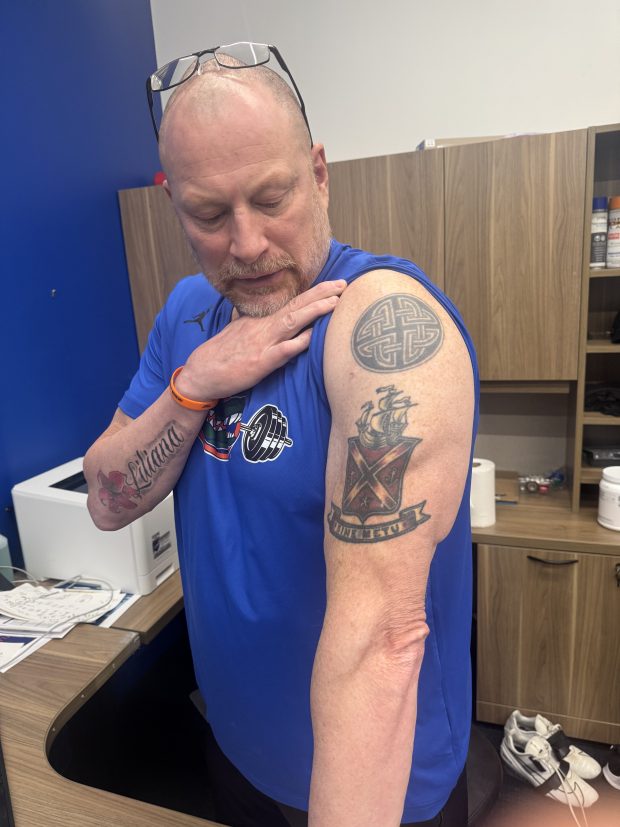 Florida strength coach Rusty Whitt has two tattoos on his right are to honor Josh Townsend, Whitt’s roommate and fellow Green Beret who died Afghanistan. ‘He liked Jameson Whiskey … and a Celtic knot because he was a big Irish guy.”
Sumrall said he nearly fired you at Troy?
“When Chip Lindsey resigned at the conclusion to 2021 season, I was getting ready to start packing my house up because I know the writing’s on the wall. This is before I even knew who they were going to hire. Austin Stidham, our starting Academic All-American center goes, ‘Hey, you don’t worry. I got you. I’m going to go battle for you.’
“Stidham and several of his teammates — this is before the portal went crazy and we had a bunch of juniors who knew they were going to come back. Stidham goes to the AD and says, ‘If Whitt gets fired, we’re going to jump in the portal. We’re all going to transfer.’ Now, whether he would have done that, I don’t know. But I owe my career to Stidham. The AD there goes, ‘I’ll see what I can do.’ He told Sumrall, ‘Hey, I really want you to consider keeping the guy that we have. The players really like what they’re doing.’”
How’d you convince him to keep you?
“He calls me from the road, and he says, ‘Tell me about yourself; tell me what this team needs; what’s missing from this team?’ I tell him, we’re pretty close, but we got to work on standards and aligning our message, blah, blah, blah. He goes, ‘Let’s meet tomorrow in my office. I’ll give you about 20 minutes.’ So I took my little hire packet, my philosophy packet — ‘the best ability is availability and so forth’ — and I go in there and we talk for two hours. He’s like, ‘I think we can make this work.’
“Best season in school history — 12-2, ranked No 19. Our defense led the nation in fewest points allowed in the fourth quarter. We beat UTSA in a Cure Bowl. In ’23, win the conference, beat App State. Have a bunch of NFL players out of Troy. He takes the job at Tulane and brought me along, and we kept the same philosophy mentality. But I owe it to Austin Stidham.”
Sumrall said he would not be here if not for you?
“Wow. I’m going to hold him to that.”
Edgar Thompson can be reached at egthompson@orlandosentinel.com