
In a moment of distress, artist Monika Larsen Dennis places her head in her hands. It’s a small, reflexive gesture, something the body reaches for before the mind has caught up. But for the Fort Myers-based Swedish artist, these unguarded expressions are the raw material she explores in her work.
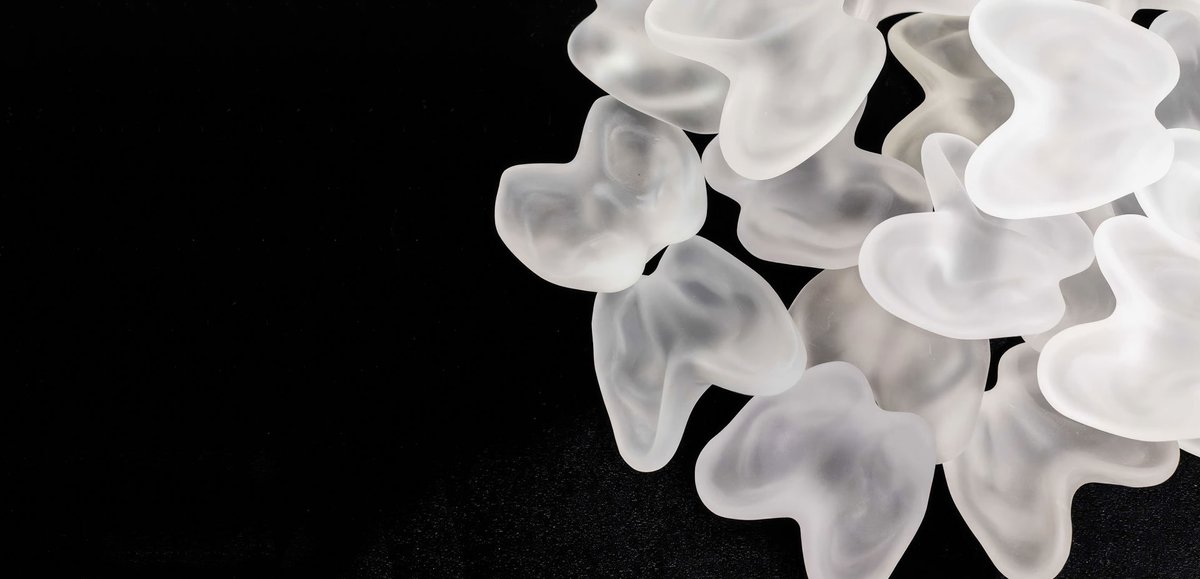
Days later, in her studio, Monika creates a mold of the negative space of her palm, recording the action, the physical language of human emotion. She casts the form in aluminum—a conductive material, cool to the touch—and engraves it with the words In times of despair, put it to your forehead. Small enough to hold, the sculptures have become go-to tools for friends. “I tell them to keep it in the fridge and just pull it out whenever they need a little relief,” the Royal Institute of Art-trained artist says with a laugh.
Across public sculptures, interactive installations, paintings and tiny objects, the multimedia artist translates emotionally charged moments into physical forms designed to slow reaction and invite reflection. She focuses on the points when communication falters, the gap between what we feel and how we act: Why do we lash out when what we want is to be held close? How do we balance trust with the urge to self-protect? “[I make] things that test how we relate to intimacy, how we live our lives,” she says. “What is invisible between us, and what do we hide?” She refers to her works collectively as visual poems.
Despite the often monumental scale of her art, much of Monika’s work happens before fabrication. As she moves through life, the artist takes note of behavior and interactions—her own, her husband’s, her friends’ and those of strangers on the street. Each moment becomes a mental note to explore, a question of ‘Why?’ that tumbles in her mind for months or years before an image emerges. The thinking takes place in a tree house studio attached to her Fort Myers home, where she develops the psychological questions that drive each of her projects. “It’s more like a mental studio,” she says.
Monika first visited Southwest Florida in 2010, at the invitation of artist Dana Roes, a former professor at Florida SouthWestern State College whom she met while the two were studying and working in Iceland. Drawn by the contrast to winter in Malmö, she purchased a home in 2011 and began dividing her time between Sweden and Fort Myers.
She designed the tree house herself, working with the builders to shape two stories of open-air living space that catch the breeze and cedar railings that frame sunrise, sunset and the surrounding canopy. Inside the screened-in terrace, six hammocks unfurl from a central post to form a lotus shape. Her studio is filled with cardboard and miniature print-outs of her artworks used to replicate exhibition spaces, allowing her to test how a visual narrative might unfold. “I like beautiful places,” she says. “I don’t even want to do a show if the place is not beautiful.”
For her recent exhibition at BIG ARTS Sanibel—Impediments and Byways to Love on the Road to Eternity, a collaboration with fellow Swedish artist Frida Oliv—Monika used the coastal light that pours into the glass-wrapped museum as part of the artworks. A globular glass form, titled Dare, appeared abstract until positioned in the light, where it casts the shadow of an anatomical heart across the wall. She also leveraged the gallery’s open plan to position seven display tables as a connected mass, creating a circular flow for viewing and requiring people to negotiate passage—unscripted exchanges that echoed the show’s focus on how we treat ourselves and others. In it, we see how her work travels from emotion to observation to object, and from object to experience.
Like any good translator, Monika relies on context to convey her message. Just as Dare’s positioning reveals its true form, its name signals dual meaning. In Swedish, ‘dare’ means to be present; in English, to be courageous. “Both are true in love,” Monika says. Elsewhere, black oak spikes carved with fragments of romantic poetry sit alongside a black epoxy snake, evoking the way vulnerability can feel like a looming threat. Her reinterpretation of Rodin’s The Kiss removes the figures entirely, carving only the space between and around them.
Born and raised in Sweden, Monika spent eight years as project manager of the Swedish Public Art Agency. “I would place a piece of art in an office building where no one talked to each other, then all of a sudden, they were connecting over this piece,” she says.
The artist still does much of her fabrication in Sweden, where her modular Malmö workshop allows her to shift among carving, photography and video as projects demand. For complex productions, she collaborates with respected glass houses such as Kosta Boda and Lindshammar.
Working primarily in stone, glass, metal and photography, she limits her palette mostly to black, white and skin tones. Color is introduced only when meaning demands it. In a text-based installation for the BIG ARTS show, Monika arranged the phrase ‘The grass is greener on the other side’ in a continuous circle of green lettering. By removing any beginning or end, the form denies the phrase its usual promise of somewhere else to go. “The grass is not greener on the other side. It’s all circular. But if you look around, it is green where you stand,” she says.
For the past 10 years, Monika has been working on what she calls her opus, Emotional Trails-Känslovägar. Expected to be completed in 2030, the installation comprises more than 70 individual pieces in 14 major artwork installations that will unfold along a half-mile stretch of the Stockholm subway system.
Every piece is designed for engagement, a way to create moments of reflection amid an otherwise chaotic environment. Large-scale sculptures will punctuate the platforms, and along the walls, windows, and floors, she’ll intersperse photography and sandblasted text, surrounding commuters in messages of love and self-acceptance. A large, rice corn-shaped black granite form titled Me references the pineal gland, long associated with the soul and imagination. Divots carved into the sides suggest receptivity to the lessons and beauty of life. Another installation, Gold Bushes, presents lyrics from love songs arranged so they appear as a shrub from afar, revealing their words only as commuters move closer.
To her, the setting—with its pathways, intersections, pauses and detours—reflects the emotional weight people carry through their days. “We can’t live with too much fear and shame and guilt and all of these things,” she says. “Anger at people [doesn’t] work; you can’t function.”
Whether held in the palm of a hand or embedded in a subway platform, her works function as prompts—reminders to notice how we move through our lives and toward one another. “It’s a constant training—every time you disagree with a friend, it becomes a little burst. ‘How could I have done that better?’” she says. “It’s a big little quest.”