
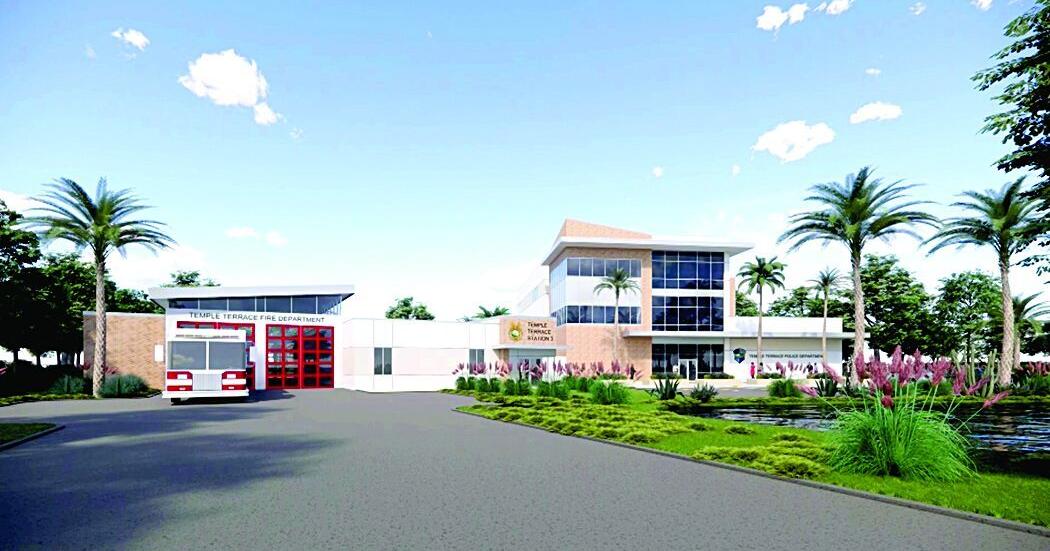
TEMPLE TERRACE — Temple Terrace voters will decide this summer whether to fund a new police headquarters and third fire station after the City Council unanimously advanced plans for a roughly $50 million public safety complex on Harney Road.
The proposed project developed by PBK Architects would include a three-story, 33,000-square-foot police station and an 11,000-square-foot Fire Station 3, which would be financed through a general obligation bond that will be on the August 18 primary election ballot.
It is a significant undertaking for the city, which has debated its police and fire facilities for years.
Councilmember Gil Schisler said he hopes to see the complex open even though he won’t still be in office.
“None of us will probably be here when you guys move in there,” Schisler said at last week’s council meeting, “but I want to be there when you cut the ribbon for this.”
The complex, planned for 7911 Harney Road, is estimated to cost about $45 million in construction alone. The plan is to fund it with a general obligation bond not to exceed $50 million.
To repay a 30-year bond of that size, at an interest rate estimated between 4% and 4.75%, the added debt-service millage is projected at roughly 0.90 to 0.98 mills. For a home assessed at $250,000, that would mean an additional $225 to $245 per year, though that number could fluctuate based on property values and future annexations expanding the tax base.
Revenue from the bond can only be spent on the police and fire station projects, not for other city operations.
“The voters would be voting exactly on what they want to financially support,” City Manager Carlos Baia said. “So it’s not buried in any budget. You’re going to very clearly see that you’d be voting to say you support building a police station and a fire station for that amount of money.”
At an hour-long workshop preceding the City Council meeting on Feb. 3, Baia outlined the need, costs and financing strategy for the project, which he said is essential to keeping up with growth to the east and maintaining the city’s ISO Class 1 fire protection rating.
The complex will be built on a five-acre parcel the city purchased in 2024 for $1.6 million specifically for a future police station.
The Temple Terrace Police Department has never had a freestanding headquarters, according to Baia, and has operated from the third floor of City Hall since the late 1970s. Its current 11,000-square-foot space has remained unchanged even as the city and the department have nearly tripled in size.
In 1982, the department had 26 sworn officers and 11 civilian employees serving around 11,000 residents. Today, it has 57 sworn officers and 20 civilian staff serving more than 28,000 residents, all from the same limited space.
Baia said reserve vehicles are parked in various lots around City Hall, while the department’s specialized units such as the SWAT van and BearCat armored vehicle are stored offsite at the Public Works property.
“Obviously having one centralized headquarters would allow them to bring all those things into a secure, unified position,” Baia said.
Plans call for secure, gated parking for the police fleet, a dedicated garage for specialized vehicles, an indoor firing range and more modern security features.
As police station planning evolved, it was determined the site was large enough to include the long-discussed Fire Station 3.
The council decided that building both structures simultaneously would result in significant savings
Fire chief Ian Kemp said the two-bay station will help with response times in the eastern part of Temple Terrace.
A fire department report found 90th percentile response times in that zone — which includes the Amazon warehouse and Veteran’s Affairs mental health clinic —average 8 minutes, 29 seconds.
“If there were not a fire station built by 2035, the department projects that could rise to 10 to 12 minutes,” Baia said.
The benchmark for Temple Terrace’s ISO Class 1-rated fire department is 6 minutes, 40 seconds for the first apparatus to arrive after a 911 call.
Council members said maintaining that rating is critical, and a downgrade could result in higher homeowner’s insurance costs.
To limit the operating expenses of a new station, Kemp proposed opening Station 3 without hiring new personnel initially.
The department currently operates three rescue ambulances — one at Station 2 on East Telecom Parkway and two at Station 1 on Bullard Parkway.
Under the proposal, the city would relocate one of Station 1’s rescue units to Station 3, along with the existing staff needed.
Down the road, a full fire suppression unit (roughly 12 firefighter paramedics) may need to be added, by a future council, adding $1.3 million to the yearly budget, though that potentially could be offset by grants.
“I think a future council needs to look at the data and decide when that decision is appropriate,” Mayor Andy Ross said. “That is not the decision we are making tonight.”
Council members also agreed that while it was considered more aggressive, the referendum should be placed on the Aug. 18 primary ballot rather than the general election in November, where it would have to compete with a crowded ballot, or a special election in 2027, which would cost an estimated $15,000.
While state law bars elected officials from advocating for a bond issue, Baia said the city plans a public education campaign, which potentially could include town halls, a presence at city’s events, collaborating with community groups, a website and plenty of social media outreach.
If approved, the city will finalize bond details later this year, issue the bonds in early 2027 and begin construction in 2028. The project could be completed by late 2029 or early 2030.