
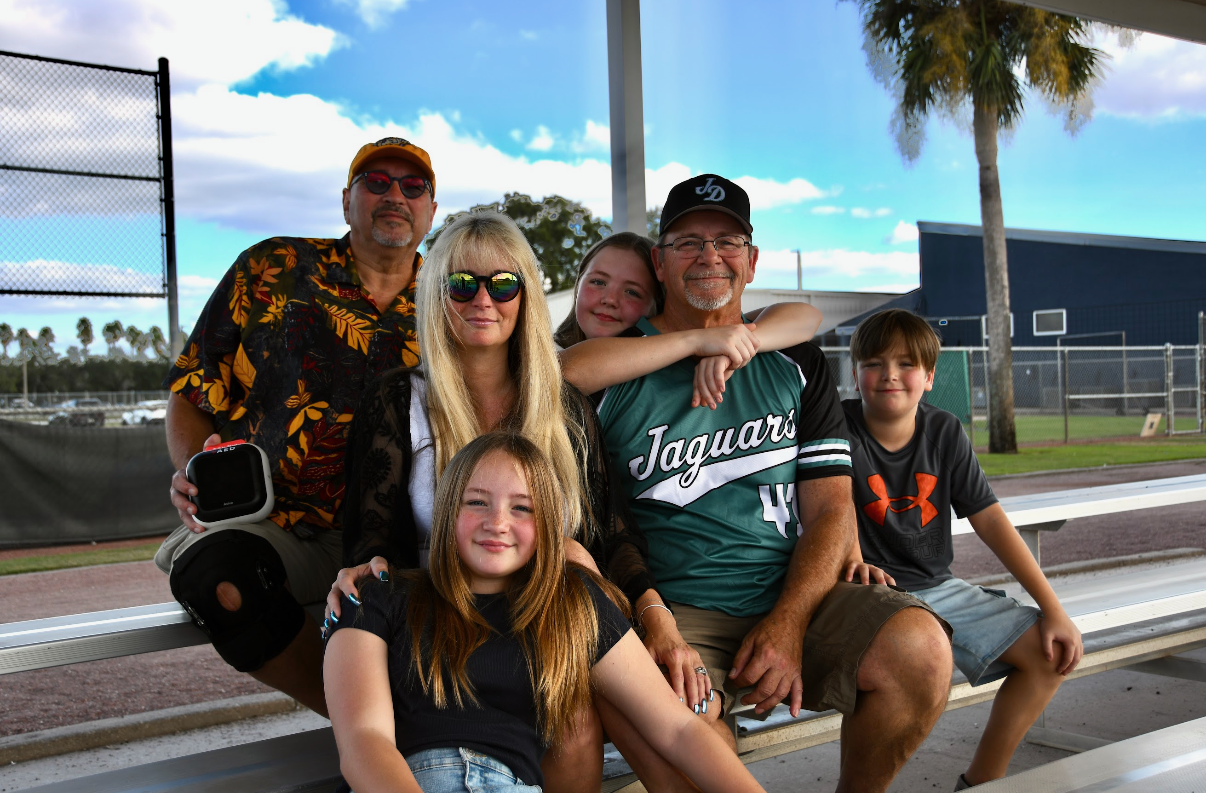
Keenan Brown and his family. -AVIVE AED / COURTESY PHOTO
The year is 2024, and it was a breezy fall day in Fort Myers, Florida. The Roy Hobbs Signature Fall Classic World Series was in full swing, and Keenan Brown was taking to the field for his pre-game warmups. After a few minutes of throwing the baseball around, his teammate threw one high over his right shoulder. He leapt for it, and bang, everything went black.
Brown is a 64-year-old retiree who likes to keep his body active throughout the year by working out at his local gym and playing sports, particularly baseball.
“I have been going to the Roy Hobbs tournament every year for the last 20 years,” said Brown. “When I was playing for a team out of Lansing, Michigan, I got myself into good shape over the summer and decided to go down there and play. I felt I was in some of the best shape to go play some baseball.”
Brown and his wife arrived the day before the first game, and he felt great. He met his teammates and was preparing to be the starting pitcher at the time of the incident. After he fell and everything went black, the teammate he was warming up with initially thought he was joking. Another person came up and looked at him saying, he was pale and knew something wasn’t right. Moments later, they began screaming for medical help.
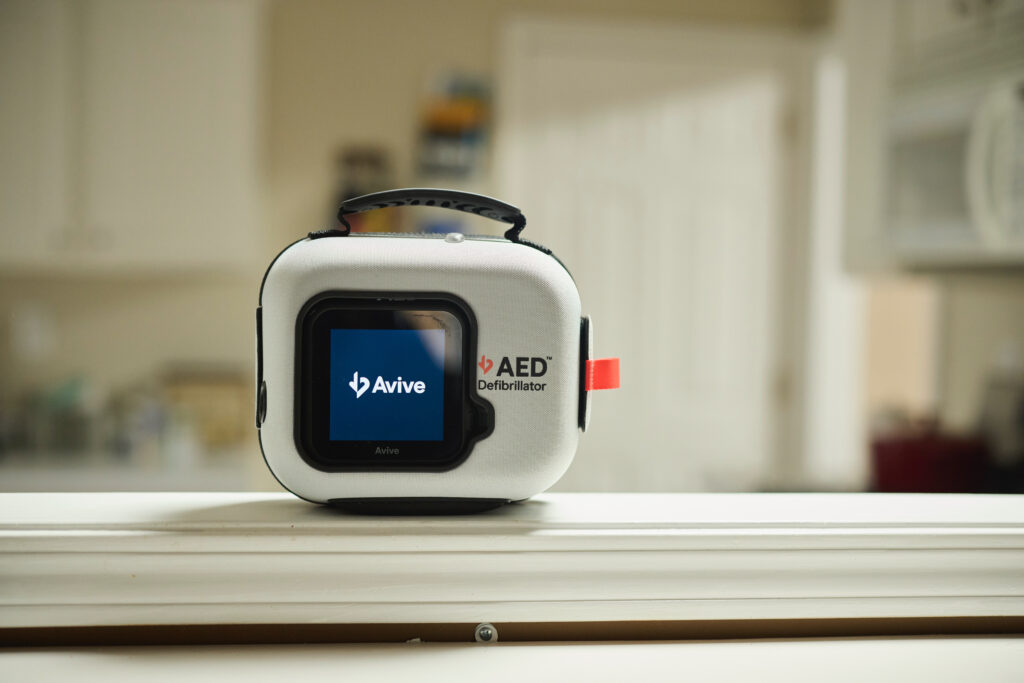
Avive’s AED is a life-saving tool that can be used to shock a person back to life. -AVIVE AED / COURTESY PHOTO
“I happened to be near the field that he was on, my back was to him, but I heard somebody yelling for help,” said Tony Nazzaro, a certified CPR instructor and EMT of 30 years. “I happened to be right next to the AED device and immediately grabbed it, got into a golf cart, and took off to him. I didn’t know exactly what happened to him, but being an EMT for 30 years, I could tell he was in distress and hooked up the machine.”
Nazzaro administered CPR and delivered two shocks using the Avive AED device before first responders made it on scene. Nazzaro was close to giving a third shock, but started to feel movement out of Brown, and that’s when he sat up and began breathing. The device was later credited by doctors for being instrumental in saving Brown’s life.
An AED, or Automated External Defibrillator, is a portable medical device that analyzes heart rhythms and delivers an electric shock to treat sudden cardiac arrest, helping to restore a person’s normal heartbeat. These devices are designed for public use, providing audio and visual prompts to untrained bystanders.
“I went to the emergency room, and the doctor told me, ‘Man, I don’t think you had a heart attack because they showed no signs of it,’” said Brown. “He did say that my heart did stop, though, and without a shock from the AED, I wouldn’t have come back; without it, I wouldn’t have survived.”
From the time Brown collapsed, it was about seven to eight minutes until first responders arrived on scene. That time was critical, and Nazzaro, being a trained medical professional, stayed calm during the incident and saved a life. Keenan’s story highlights the importance of fast response and readily available equipment in times of distress.
“As a CPR instructor, I’ve taught over the years that the faster you can get aid to someone in cardiac and respiratory distress, the more likely you’ll be successful in saving their life,” said Nazzaro. “One of the key components in aiding Keenan was that I happened to be right next to the AED; its placement was critical. If it were on another field or if I weren’t standing right next to it, precious minutes would’ve been wasted.”
Avive, the company behind the AED used on that day, also believes in delivering quick and timely care that saves lives; it’s why they exist.
“Keenan’s survival is exactly why Avive exists. What saved Keenan’s life was a prepared community, an empowered responder, and a connected AED that supported the entire chain of survival in what became an inspiring save,” said Sameer Jafri, CEO of Avive Solutions. “Lee County’s commitment to making defibrillation accessible, visible, and integrated is setting a new standard for public safety. It’s an example of how technology and readiness together can turn a potential tragedy into a story of survival and hope.”
Nazzaro said the devices are designed to be easy to use, and anyone can operate one. The AED displays pictures and instructions for its user, walking them through each step of the process. It will let the operator know when to conduct CPR and administer shocks automatically when needed, with no buttons to be pressed.
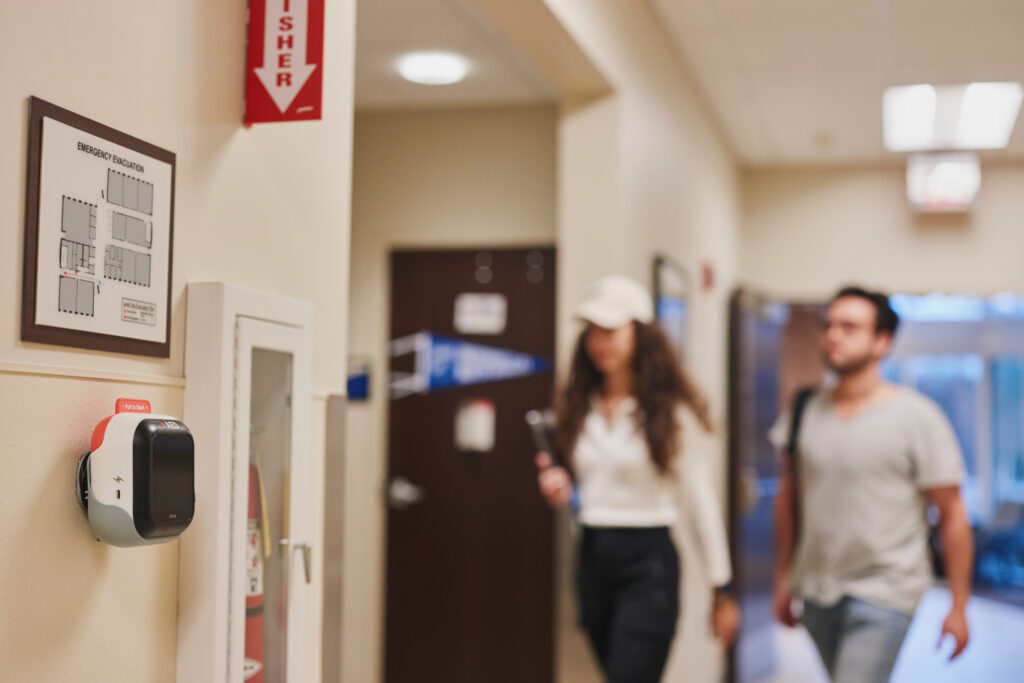
An AED can help save a life if an individual was to go into cardiac arrest. -AVIVE AED / COURTESY PHOTO
“The more information companies like Avive put into these AEDs, the more people are going to feel comfortable using them,” said Nazzaro. “I’m proud to share this story, not because of what I did but because of the technology that’s available to save lives. I want people to know that it’s not something to be afraid of doing.”
Nazzaro’s experience sheds light on the work companies like Avive have done to make the life-saving process as easy as possible. He later added that even if you have no professional training or experience, don’t be afraid to take that AED off the wall if you see someone in distress. The first step is to act, and the device will guide you through the rest.
Fast-forwarding through six months of recovery and hard work, Brown was able to resume physical activities and get himself back in game shape.
“It was a good six months before I really started again,” said Brown. “I got into a lot better shape and played with my team in Detroit. I threw one inning, and man, it felt good.”
Brown would continue to work out and play a lot of baseball in the following months. It’s now 2025, and the Roy Hobbs Signature Fall Classic is back, and so is he. Just one year removed from the incident, he was ready to go again said he was feeling really good. This time would be special; his wife and three kids would be in the stands to watch his return to action, and he wouldn’t disappoint. Keenan was positioned on first base, and the next batter was up. He ripped a deep double, and Keenan was off. He ran all the way from first to home base and scored the team’s first run of the tournament.
“There were a lot of emotional highs the first few days with my family,” said Brown. “There were the highs of our team’s victories as well and the letdown at the end, but I felt this was one of my best ever. At the end, the team picked an MVP, and they picked me.”
This story highlights the importance of being in the right place at the right time and the courage it takes to come back after a scary medical encounter. Brown’s story doesn’t have to be the only one. With companies like Avive working to make AED devices easier to use and more readily available throughout communities in America, we hope to read more stories of more lives saved.
“If you’re a young person that has no experience at all, don’t be afraid to use it and save somebody’s life,” said Nazzaro. “It’s easy, intuitive, and walks you through all the steps. I think if a company like Avive continues to drive the importance of having these devices around and sharing just how easy it is to use without any formal training, I think that’s one of the most important things.”
Brown’s story is also one of staying active and keeping your body moving. The shocks from the AED that restarted his heart and the aid from first responders were instrumental in his comeback. None of it would have been possible though if he sat on his couch day in and day out. In the end, staying active was what made his return to the field possible.
“Even just walking a couple of miles goes so far,” said Brown. “My daughter is a travel team softball player. Ever since she was seven or eight years old, we would go for a walk around the block a few times every night before bed. It’s not like you have to be in tip-top shape, but you’ve got to be active, man. The more you sit around and put on weight, you won’t have the energy to do the things you want to.”