
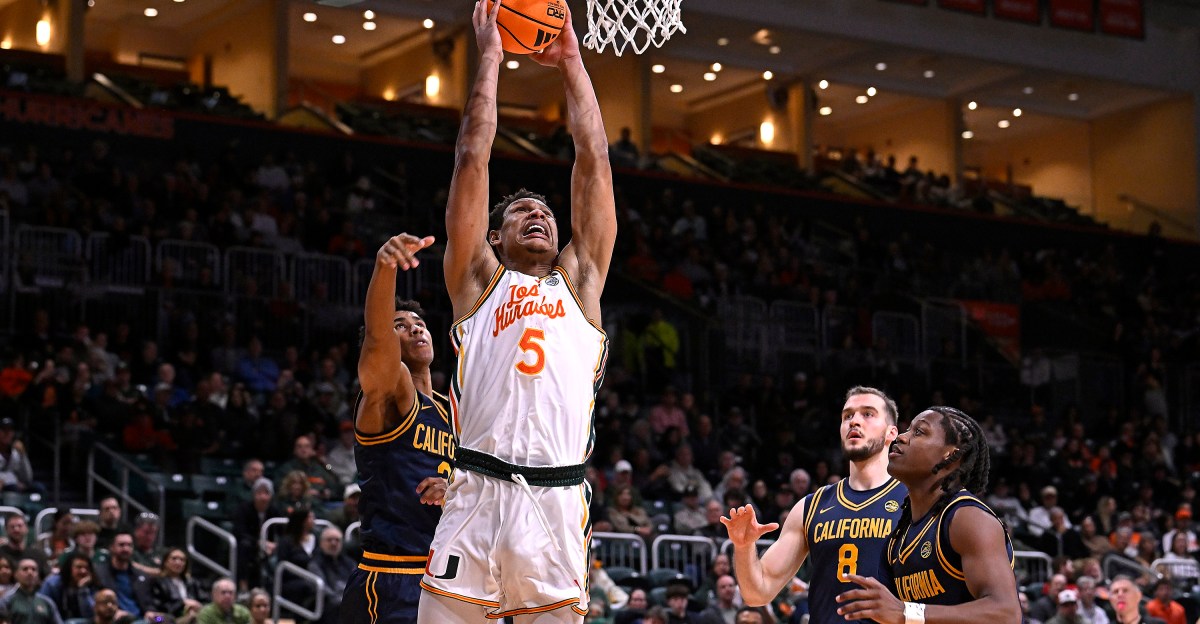
Yes, I’m sure what you want to read right now is something about UNC Basketball that isn’t basking in Saturday night’s already-legendary victory, but we have a schedule to adhere to, and Tuesday’s game at Miami isn’t getting any further away. Somewhat like UNC before Saturday night, the Canes have compiled a 7-3 record in conference play thus far thanks in part to a schedule front-loaded with the conference’s bottom half. This will be just their second game against a team that currently sports a winning ACC record, their first being a 10-point loss at Clemson. Beating teams worse than you is the sign of a pretty good team, though, and this is certainly a Miami team that could punish the Tar Heels if they come to Coral Gables without having refocused to their next game. Here are three things to watch Tuesday night. Spoilers: I’m not going to write “avoiding the hangover.” That should be a given.
This is a Hurricanes team that is built from the inside out. As a team, they rank inside the nation’s top 20 in 2-point field goal percentage and defensive rebounding percentage, and are just outside the top 20 in offensive rebounding to boot. They shoot fewer of their field goal attempts from 3 than nearly anybody else in the ACC and lead the conference in share of field goals attempted at the rim. From a player perspective, they’re lead by the frontcourt tandem of senior forward Malik Reneau and freshman wing Shelton Henderson. Reneau, a transfer from Indiana, has turned from solid player to star, averaging 20 points and 6.5 rebounds per game while making 61% of his twos. Henderson averages close to 15 points a contest on 68% shooting inside the arc. Both will step outside and shoot it occasionally, but their bread is buttered in the post, whether it’s driving to the basket or backing down smaller players: both of them are thick, powerful dudes. They’re helped by 6’11 center Ernest Udeh, who doesn’t score a lot but does pull down 11 boards per game. The Heels’ post rotation of Caleb Wilson, Henri Veesaar, and Jarin Stevenson has statistical claim to be the best in the country, but they’ve struggled at times with handling real beef in the post. This is going to be a matchup that demands them to earn that title. If they can at least match Miami on the boards and deny easy looks around the rim, they’ll give their team a much better chance to walk out with a win.
I swear this is real, though the nature of the story means there is no proof: When Caleb Foster put Duke back up 6 with under 3 minutes to play, I thought, “If we make a three in these last 3 minutes, we win. Otherwise, we lose.” I didn’t type it anywhere or say it out loud to my wife, because that would’ve jinxed it, but I definitely thought it. At that point, UNC was 5/16 from behind the arc, well below their average for the season in both attempts and percentage. The next possession, Derek Dixon made it a one-possession game again with a three, and the rest… is literally history. The Heels finished 8/19, still well below their attempts threshold, but a bit better than the mark they’ve been putting up in conference play. The article I wrote a week ago about this team needing to shoot well to be successful seems to have been pretty prescient, if I may toot my own horn a bit. That’s not going to get any less true against Miami. Teams have tended to be pretty trey-happy against them, as their perimeter defense is weaker than their post defense, and it’s yielded decent results: opponents shoot 35% against the Canes from behind the arc. While the story on defense for UNC has to start in the post, the Heels’ perimeter players have a real chance to do damage on offense.
Big games call for exceptions to rules, we know this. It’s not a bad thing, in a vacuum, that Caleb Wilson is listed as having played 40 minutes (he did sit for about 45 seconds surrounding the under-8 timeout in the first half); that Henri Veesaar didn’t come off the court in the second half and finished with 35 minutes played; that four starters played 32+ minutes and that Seth Trimble’s 32 would undoubtedly have been higher had he not found himself in some foul trouble; that out of 100 second-half minutes, 89 were played by starters. For a game of this magnitude, against an opponent of this caliber, one that means as much as it did for the history of the program and for this year’s team in particular, you do what you need to get the win.
But it cannot become a pattern. We’ve seen Hubert Davis succeed in moments by neglecting his bench in the past, and it has often led to him going back to Iron Five-ing games that he should not have to because they get a little sweaty. I know I’m not saying anything new, but this strategy isn’t good in the short term because it puts too much wear on players, and it’s not good in the long term because it hurts development and retention. And this season’s rehabilitation between the West Coast fiasco and the Duke game had come on the back of smart bench usage — in particular the rotation of Jaydon Young, Luka Bogavac, Jonathan Powell, and sometimes Jarin Stevenson on the wing allowing different guys to shine on different days and at different moments. In fact, this season is tracking to be Hubert Davis’ first where he doesn’t have a player averaging more than 34 minutes per game, which is a marked improvement for him. Going into the last stretch of ACC games, where the Heels will face mostly opponents in the top half of the standings and inside the Torvik top 65, games are not going to be easy. But if this team is to succeed against competition that isn’t a top-5 team in the country, the bench needs to continue to be a factor, and just as importantly, continue to be allowed to be a factor. The Iron Five needs to be your last resort, not your first. Davis has done an excellent job hewing to that so far even with his post depth being minimal. I hope that continues to be the case.