
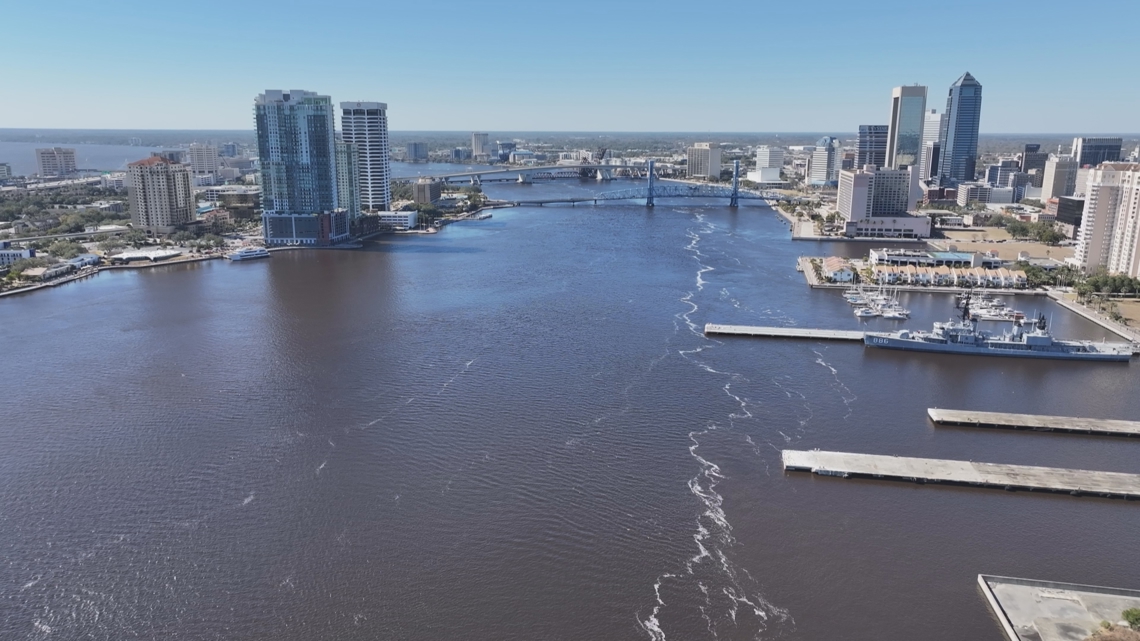
Athletes in Jacksonville’s first-ever IRONMAN triathlon will start with a 2.4-mile swim in the St. Johns River, starting at Metropolitan Park.
JACKSONVILLE, Fla. — In just three months, athletes from all over the country will be traveling to Jacksonville to compete in one of the toughest tests of endurance: the IRONMAN Triathlon. This is the first time the 140.6-mile race will be held in the city.
Athletes will start by swimming 2.4 miles in the St. Johns River, then hop on their bikes for 112 miles, before finishing with a marathon; however, IRONMAN has updated the courses.
The latest swim course now has athletes starting at Metropolitan Park, swimming under the Main Street, Acosta, and Fuller Warren bridges, and ending near Post Street Park in Riverside. This changed from the initial plan of having athletes start at the Arlington Boat Ramp and swim under the Matthews and Hart Bridges towards Downtown Jacksonville.
A spokesperson for IRONMAN told First Coast News the change was made to accommodate ‘broader city activity.’
“The primary adjustment was moving the swim exit and transition area further downriver to avoid areas impacted by stadium construction,” an IRONMAN spokesperson said in a statement. “Metropolitan Park was identified as an ideal swim start location, as it allows race operations to take place earlier in the day and for a limited duration, significantly reducing overall community impact while maintaining a safe and high‑quality experience for athletes.”
A spokesperson for IRONMAN also confirmed the course remains aligned with the tides on race day.
Lisa Rinaman, the St. Johns Riverkeeper, said this area of the river is narrower and can be challenging to navigate.
“I haven’t swam that area, but I’ve kayaked over a lot in that area, and it’s really difficult just to get from the North Bank to the South Bank in a kayak, and it’s pretty narrow, but you just have so much water rushing through there,” Rinaman explained.
Rinaman said the river’s currents are one of the most dangerous parts of swimming in the St. Johns.
“These are going to be seasoned swimmers, but a lot of times we really warn new swimmers, especially children, about jumping in the main stem of the river because those tides and currents can be so impactful,” Rinaman said.
Still, Scott Langen, Vice President of Operations for IRONMAN, said IRONMAN athletes typically prefer swimming in bodies of water, like rivers or lakes, instead of the ocean.
“It takes away some of the unknowns that choppy water and ocean water can present,” Langen said.
Along with tracking the river’s tides and currents, they are also making sure the water itself is safe for athletes. Langen said they test the water quality using USA Triathlon’s standards.
“We want to make sure that the body of water that we’re in is aligned with those guiding principles because at the end of the day, if we’re not providing an event that’s the event that the athletes are looking to accomplish, then we’re not doing our job by our athlete base,” Langen explained.
First Coast News emailed and called USA Triathlon for more information on their testing process six times over the last four months, but no one has responded.
Rinaman said the quality of the water is typically safer in the main channel of the river compared to some of its tributaries.
“Just like any body of water in nature there can be bacteria. We have many impaired tributaries that have too much fecal bacteria in it…the river’s a bigger body of water, so there’s a larger mixing zone,” Rinaman said.
There is also a chance for toxic blue green algae outbreaks, though Rinaman said this is not likely in the month of May.
“We’ve seen them as early as February, we’ve seen them in April, and so I would recommend just testing, looking out if we see anything in the water. If it’s a blue slime on the top, to have it tested. If you see a lot of cloudiness in the water column, that would be something for concern,” Rinaman said.
So, is the St. Johns River safe for IRONMAN athletes to swim in? Rinaman said yes, as long as athletes stick to the specific swim course.
“There have been several swims in this section of the river that have been very successful, but it’s just a matter of making sure, you’re out in nature, making sure you’re understanding all the different things that could pop up and preparing in advance all the swimmers and all the team members that are gonna make this a huge success we hope for Jacksonville,” Rinaman said.
The Jacksonville IRONMAN takes place May 16, 2026. The competition will be held in Jacksonville for at least the next three years.
The bike and running courses have also changed. Athletes will now start the bike portion of the race near Memorial Park, bike south along Philips Highway, east through Nocatee, and loop around Ponte Vedra. They will start the running course in Riverside and run north along the riverbank in downtown, loop back around to Riverside, and end downtown near Riverfront Plaza.
“As with any inaugural event, course planning for IRONMAN Jacksonville triathlon has been a highly collaborative process involving our partners at Visit Jacksonville, the City of Jacksonville, and multiple public safety agencies,” a spokesperson for IRONMAN said. “As we work through our planning, the decision was made to alter the courses to provide a better experience for our athletes. Several logistical and operational considerations—including community impact and large city projects—prompted us to adjust the original course design,”