
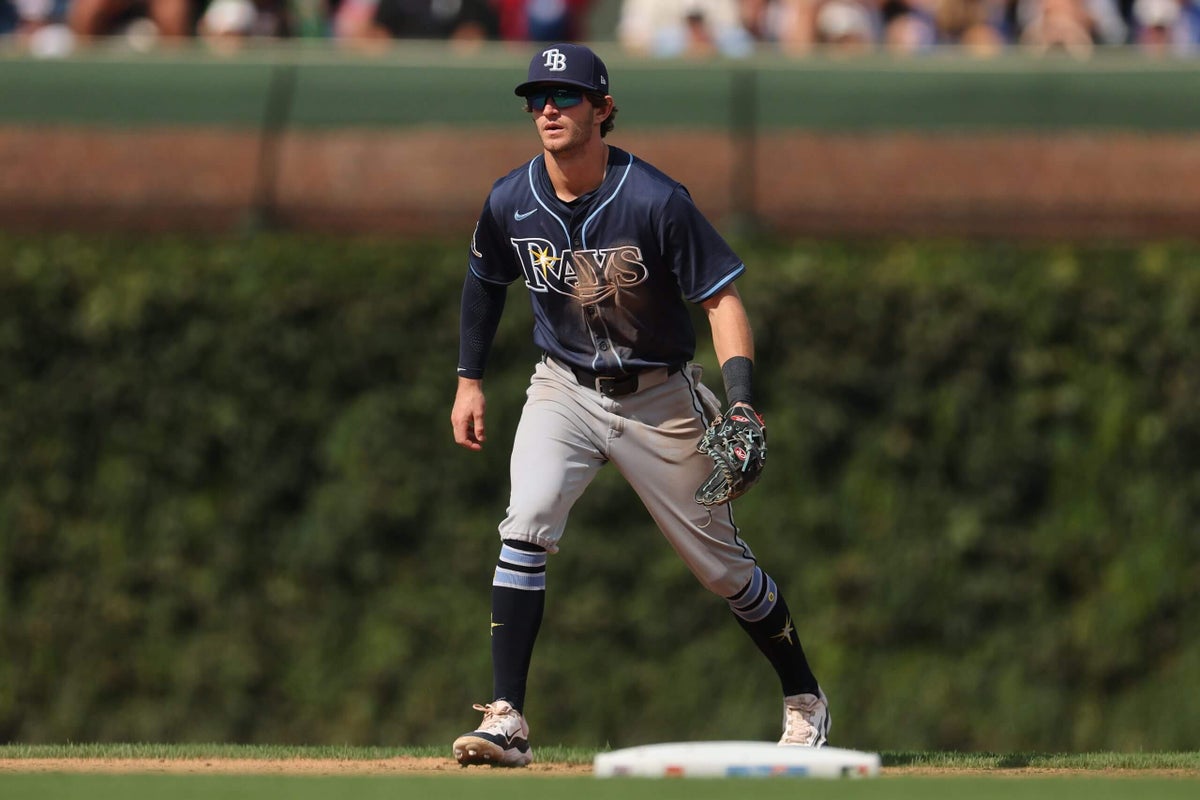
The Tampa Bay Rays don’t have much top-end talent, meaning guys who have a reasonable or realistic chance to become stars, but their system is quite deep, with players not listed on their top 20 who will probably still end up appearing in the majors, and several guys in that 11-20 range are going to be good big leaguers in less glamorous roles. They do have a lot of players who seem like they’re one adjustment away from something better, putting a heavy onus on player development to make those changes a reality.
(Note: Tools are graded on a 20-80 scouting scale; ages as of July 1, 2026. EV = exit velocity.)
Height: 6-2 | Weight: 180 | Bats: R | Throws: R | Age: 23
Williams made his MLB debut in 2025, but the season otherwise was a disaster, as his swing decisions, or lack thereof — if you choose not to decide, you still have made a choice — caught up to him in Triple A and ate him alive in the big leagues. He hit .213/.318/.447 in Triple A with a 34.2 percent strikeout rate, a higher rate than any qualifying big leaguer had in 2025 and the second worst in Triple A. He swings too often in general and often seems to decide too soon, so he’s even missing pitches in the zone — in Triple A, his contact rate when swinging at strikes was 78.2 percent, which would have ranked the fourth-worst among major-league qualifiers last year. He does have power and makes a lot of very hard contact when he does square the ball up, while he remains a 70 runner and easy plus defender at shortstop, all of which is a good foundation to at least give him a utility infielder floor.
He’s still 22 and that was his first go-round in Triple A, so he has the benefit of time and an organization that is very unlikely to rush him. He needs to make a big adjustment in how and when he decides to swing at pitches, but he retains that All-Star upside of a shortstop who hits 20-25 homers and adds value on defense and on the bases, though with lower probability than he had a year ago.
Height: 6-2 | Weight: 195 | Bats: L | Throws: R | Age: 20
Gillen came out of the gate hot to start his first full pro season and was hitting .278/.435/.407 at the All-Star break, but he wore down as the season went on and became extremely pull-happy. He hit .224/.406/.306 in a short stint after the break before a calf injury sent him to the injured list for the third time last season, ending his year. The Rays drafted him in the first round in 2024, when he was a high school shortstop who was limited in the field after shoulder labrum surgery. They moved him to center and he took to the outfield very quickly, combining his speed and overall feel for the game to show above-average defense that should end up plus.
As you might guess from his OBPs, he is very disciplined at the plate, chasing pitches out of the zone 17 percent of the time and pitches well out of the zone just 11 percent of the time, but it’s as much passivity as patience, as he doesn’t swing at enough pitches in the zone. His 60 percent swing rate at strikes would have ranked as the 15th lowest mark in the majors last year, tied with Steven Kwan, a very good player whose offense was actually worth -0.4 runs last year. Gillen is quite strong and athletic, and should show more power in games over time — maybe it’s better swing decisions, maybe it’s health, maybe it’s both — and clearly has the strike-zone judgment to keep posting high OBPs. It was a solid debut year, with clear areas for development ahead of him.
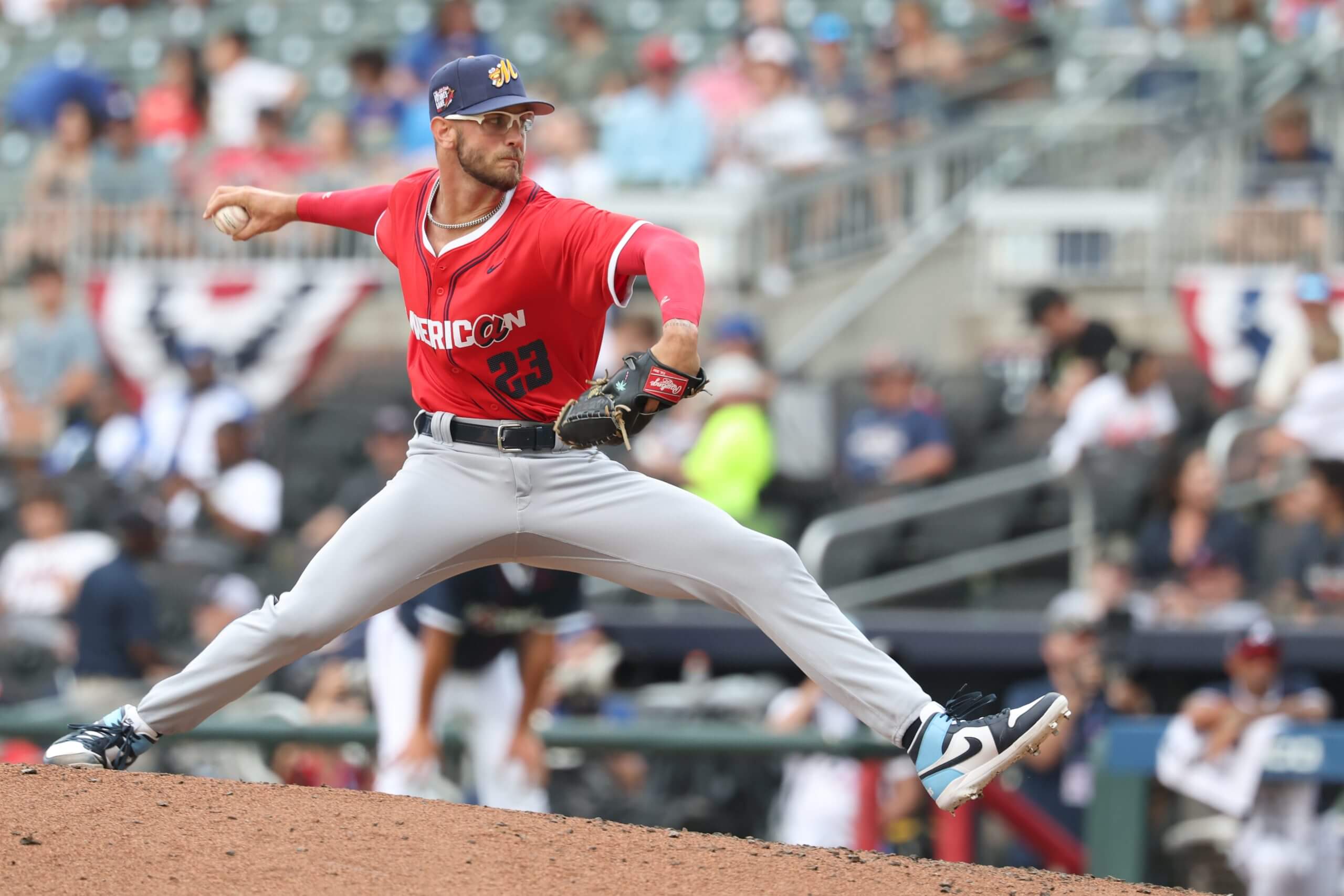
Brody Hopkins came to the Rays from the Mariners organization. (Kevin C. Cox / Getty Images)
Height: 6-4 | Weight: 200 | Bats: R | Throws: R | Age: 24
Hopkins came over to Tampa Bay in the trade that sent Randy Arozarena to Seattle, and in his first full year after the deal, he finished second in the Rays’ system in strikeouts and strikeout rate. He punched out 28.7 percent of batters he faced, using a broad mix of pitches, including a new cutter that immediately became a weapon for him, and that number will increase if he can dial it back a little to throw more strikes. Hopkins has to work more in the zone with his fastball, with just 61 percent of his fastballs going for some kind of strike last year and only about 45 percent located in the zone. The pitch misses bats, as he sits 96-97 and comes from a very low release point that gets some ride on the pitch and is generally hard for hitters to see. His slider could be plus, but he doesn’t land it in the zone enough either, which is why the Rays had him add a cutter, a similar pitch in his case, but with shorter break and that sits 90-92. He’s a superb athlete who was also a quarterback and safety in high school, but he doesn’t have that typical quarterback’s delivery. Instead, he uses a lower slot and a slinging motion that is hard to repeat — so there is a real chance he never gets to the command he needs to be a reliable starter in the heart of a rotation. He’s too athletic to give up on that potential, and with his arsenal, he has the ceiling of a No. 2 starter who can miss a ton of bats to make up for even a 10-11 percent walk rate.
Height: 6-0 | Weight: 185 | Bats: R | Throws: R | Age: 19
The Rays’ first-round pick in 2025, Pierce is a true shortstop with outstanding instincts to go with a 70 arm and 70 foot speed. He projects to hit for average, showing a swing with some loft in its finish to put the ball in the air, probably more for line drives to the gap than for over-the-fence power. His data from high school pointed to 55 or better raw power, but he didn’t show that in games and scouts projected more fringe-average power from him based on their looks and his lack of huge projection. He also showed very good pitch recognition and command of the strike zone when playing at showcases in 2024. He didn’t debut last year, thanks to the geniuses at MLB who moved the complex season up so that it’s wrapping up just as the draft happens, so we’ll see him in the complex or in Low A this spring.
5. Trevor Harrison, RHP (Just missed)Height: 6-4 | Weight: 225 | Bats: R | Throws: R | Age: 20
Harrison plateaued last year when it seemed like he was going to take a step forward, with his stuff intact from 2024 but his results a bit worse with the move up to High A, including a disappointing whiff rate of 28 percent. He works 93-96 on his four-seamer, with a little ride to it, along with an average slider and an above-average changeup he should probably use a little more, as it’s his best pitch right now and also would enhance his ability to work up top with the heater. He doesn’t induce a ton of ground balls, and he walks too many, walking over 11 percent in his stops in Low A and High A, even though at those levels, he can probably work in the zone without giving up much damage. He has an easy delivery and has a great build for a starter. He seems to compete well, which makes the walk rate even more puzzling — just go after guys! Your stuff is good! He’s still so young, turning 20 last August, that he has plenty of time to improve his control, add a pitch and so on, but I thought he was primed for a breakout last year and it didn’t happen.
6. Nathan Flewelling, C (Just missed)Height: 6-2 | Weight: 200 | Bats: L | Throws: R | Age: 19
How could a player who hit .229 with a .336 slugging percentage in 102 Low-A games be on the “just missed the top 100” list? I’m so glad you asked. Flewelling played last year at age 18 after the Rays drafted him from a high school in Alberta, Canada, in the third round in 2024. He’s a plus defensive catcher who threw out 28 percent of runners, well above the median in the Carolina League, and showed strong game-calling and framing skills in his first pro season. He has a compact swing but actually hits the ball pretty hard already, especially given his age, with very high exit velocities that haven’t shown up yet in extra-base power. And in between the average and slugging was a .393 OBP, as he was second in all of minor-league baseball with 94 walks, boasting just a 14 percent chase rate.
Flewelling came into pro ball with less baseball experience than the typical high school player, and he was young for his class on top of that. It showed in his propensity to swing and miss, but the rest of his game was surprisingly polished. Despite the underwhelming stat line, he’s a real prospect, with a high floor thanks to the defense and his extreme patience.
7. Santiago Suarez, RHPHeight: 6-2 | Weight: 175 | Bats: R | Throws: R | Age: 21
Suarez missed time last year with tightness in his shoulder, ending his season jumping from High A to Triple A because Durham was short a starter and Suarez’s year was otherwise done. Acquired from the Marlins back in November 2022 in the deal that sent Xavier Edwards to Miami, Suarez has some of the best command and control in the minors, walking 3.8 percent of batters he faced last year and never walking more than two in any outing. He’s 93-96 with a plus curveball and 55 slider, never showing a platoon split despite the lack of a changeup or splitter, and he repeats his delivery very well. He works toward the edges of the strike zone, avoiding the middle more than most pitchers his age because he knows he can get strikes on the inner or outer thirds. If he stays healthy, he’ll be a top 100 guy next year, with No. 2 starter upside.
8. Slater de Brun, OFHeight: 5-10 | Weight: 187 | Bats: L | Throws: L | Age: 19
Acquired as part of the four-player return from Baltimore for Shane Baz, de Brun is a definite center fielder who’s already demonstrated an excellent feel to hit and gets high marks for his makeup and intensity on the field. He’s short, listed at 5-foot-10 and you should take the under on that, hitting the ball somewhat hard as an amateur but not likely to get to Corbin Carroll-level power. The No. 37 pick in last year’s draft takes a solid stride before his swing to activate his hips and get power from his legs, but he has a little bit of a bat wrap and the swing can get long, even getting more slashing in shape, rather than lifting the ball for power. He has a real two-strike approach, going to the Juan Soto “how wide can my legs go” stance, to try to put the ball in play at all costs. He’s a few years off, with above-average everyday upside, and will make his pro debut this spring in Low A, most likely.
9. Cooper Flemming, SSHeight: 6-3 | Weight: 190 | Bats: L | Throws: R | Age: 19
Flemming was the Rays’ second-round pick in 2025, a high school shortstop from southern California who was one of the better pure bats in the draft class. He has little-to-no load at the plate, with a short, simple swing that led to extremely high contact rates in high school even against better stuff, but didn’t produce much power as the swing isn’t geared toward driving the ball. He still has some projection left and could become more of a well-rounded hitter with some swing help, which he’ll need to become an above-average regular at third or second, as he’s not sticking at shortstop. I know some scouts who thought his bat was good enough to make him a first-rounder last year.
10. Jacob Melton, OFHeight: 6-3 | Weight: 208 | Bats: L | Throws: L | Age: 25
Melton came over from Houston in the three-team trade that sent Brandon Lowe to the Pirates. With 70 career MLB at-bats, he just barely squeaks in under the line for rookie eligibility this year. He is a platoon outfielder with plus power and at least 70 defense in center, hitting the ball much harder last year in his second run through Triple A, although his swing decisions still weren’t great and MLB pitchers embarrassed him. He’s here in the Rays’ rankings over many players with higher ceilings because he’s ready to contribute in the majors right now, at least on defense, and because this is close to the Kevin Kiermaier skill set: play a great center field, hit some dingers, avoid southpaws. I’m not saying Melton will be Kiermaier, just that it is his ceiling, a different kind of upside than the prospects I typically talk up in any of my work. (One note: I said in the farm system rankings that Melton wasn’t in their top 10, but this list wasn’t finalized at the time, and I have since revised it to move him up one spot.)
11. Tre’ Morgan, 1B/OFHeight: 6-0 | Weight: 215 | Bats: L | Throws: L | Age: 23
Morgan hit .274/.398/.412 in Triple A last year, still favoring an all-fields contact approach over any kind of power, and if anything his swing decisions got a little worse in 2025 — perhaps because he almost skipped Double A entirely, playing just 21 games there the year before. He’s a plus defender at first, comfortably, and has played a little bit of left field, where he might be a 45 but isn’t someone you want out there every day. If he does get to some more raw and in-game power, he’s a regular at first thanks to the defense and his history of walk rates over 10 percent. Right now, he looks like a Spencer Horwitz-type, a starter on a bad team, although he doesn’t have Horwitz’s platoon issues.
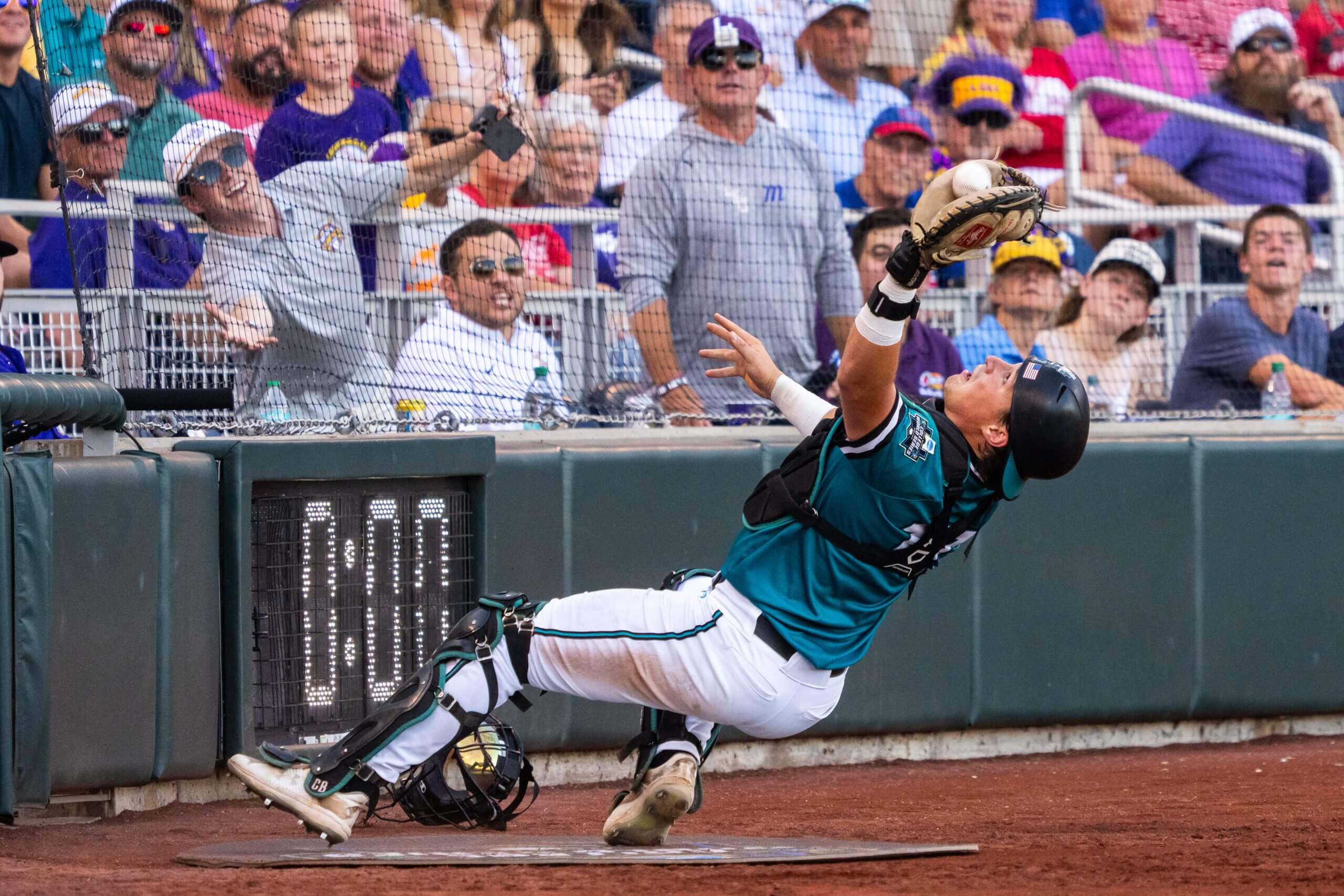
Caden Bodine is a good defender with strong on-base skills. (Dylan Widger / Imagn Images)
12. Caden Bodine, CHeight: 5-10 | Weight: 200 | Bats: B | Throws: R | Age: 22
Bodine was also part of the Shane Baz deal, coming in shortly after the Orioles took him with one of their four first-round/comp-round picks in the 2025 draft. He’s a high-contact hitter at catcher without much power. He struck out less than 10 percent of the time in each of his last two seasons at Coastal Carolina, swinging infrequently and then rarely missing when he did deign to remove the bat from his shoulder. He’s a 55 receiver with a plus arm, perhaps needing work on his transfer and release to speed up his in-game throws. He should be a solid-average catcher who adds value on defense and with above-average OBPs, while probably hitting fewer than 10 homers a year.
13. Jose Urbina, RHPHeight: 6-3 | Weight: 180 | Bats: R | Throws: R | Age: 20
Urbina took a big step forward last year, working with a little longer arm action that he was able to repeat more effectively, so he started locating his fastball better within the zone and also cut his walk rate from 12.1 percent to 8.2 percent. He sits 96-97 and was up to 100 last year with a very sharp slider that was up to 92. He barely used his changeup, but he’s got some feel for it and Low A hitters missed over a third of the time they swung at it. He just turned 20, and still has fewer than 200 innings in the minors, so he’s probably several years off. Last year took him from “it looks very reliever-ish” (my words) to “holy crap, I think he might be a starter” (also my words).
14. Xavier Isaac, 1BHeight: 6-3 | Weight: 240 | Bats: L | Throws: L | Age: 22
Isaac revealed this offseason that he had emergency surgery in July after he passed out in the dugout and a precautionary scan found a brain tumor. He is expected to make a full recovery and play this spring, which is secondary to his health and well-being, of course. Speaking strictly of his baseball career, he returned to Double A last year and hit .201/.366/.446 there, striking out 29.7 percent of the time, as he hasn’t been able to recognize pitches and has been leaving the bat on his shoulder too often to try to compensate. He does have real all-fields power, hitting four of his nine homers to left-center or to left last year. His platoon issues persist, as he was 3 for 48 against lefties last year, with two singles and a double, along with 24 strikeouts in 63 PA (38 percent). He’s also a below-average defender at first. He could be a platoon DH if he improves his ability to pick up offspeed stuff against righties. That remains the least important consideration here, however. I’ll be glad to see him on the field in any capacity.
15. T.J. Nichols, RHPHeight: 6-5 | Weight: 189 | Bats: R | Throws: R | Age: 24
In Nichols’ draft year in 2023, he posted an 8.27 ERA for the University of Arizona, walking 29 and hitting 17 in 57 2/3 innings while allowing 12 homers. I often say don’t scout the stat line, but you can scout that one: He stunk. The Rays took him in the sixth round, then played it slow with him, sending him to Low A in 2024 as a 22-year-old, where he did throw strikes (7.6 percent walk rate) and cut his ERA to 2.90, although he didn’t dominate like a college product should at that level. In 2025, his velocity crept up some more and he did dominate, first in High A and then in Double A, walking just 5.7 percent of batters while striking out 28.6 percent, both the best rates he’s ever posted.
He’s always had a short arm action, and since signing, it’s become smoother with less visible effort even with the rise in velocity. His arm can be late relative to his landing leg, but so far it hasn’t affected his stuff or timing. Nichols is now sitting 95-96 with four pitches, nothing truly plus, with a slider, curveball and split-change. He gets guys out by attacking them early in the zone and getting ahead in the count, so that he went from 0-0 to 0-1 more than two-thirds of the time last year. He did give up 20 homers in 96 innings in High A, most of them on the fastball, as it’s firm without much life, and that may be the factor that keeps him at the very back of a rotation rather than getting him toward a mid-rotation role. If he adds or modifies a pitch to become truly plus, as in a real swing-and-miss weapon, I’ll revise the ceiling upward.
16. Brendan Summerhill, OFHeight: 6-3 | Weight: 200 | Bats: L | Throws: R | Age: 22
Summerhill was the Rays’ pick in competitive balance round A in 2025 after a spring when he missed a month due to a fractured hand and several more games due to a leg injury. He didn’t hit nearly as well after his return, unsurprisingly, and in his 10-game pro debut, hit for average without power. He has excellent command of the strike zone, with a potentially elite hit tool, and showed hard contact in the past before the hand injury. He may need some swing help to get the ball in the seats more often to take advantage of his strength and profile better as a regular in a corner, as he hasn’t been good in center when he’s played there before.
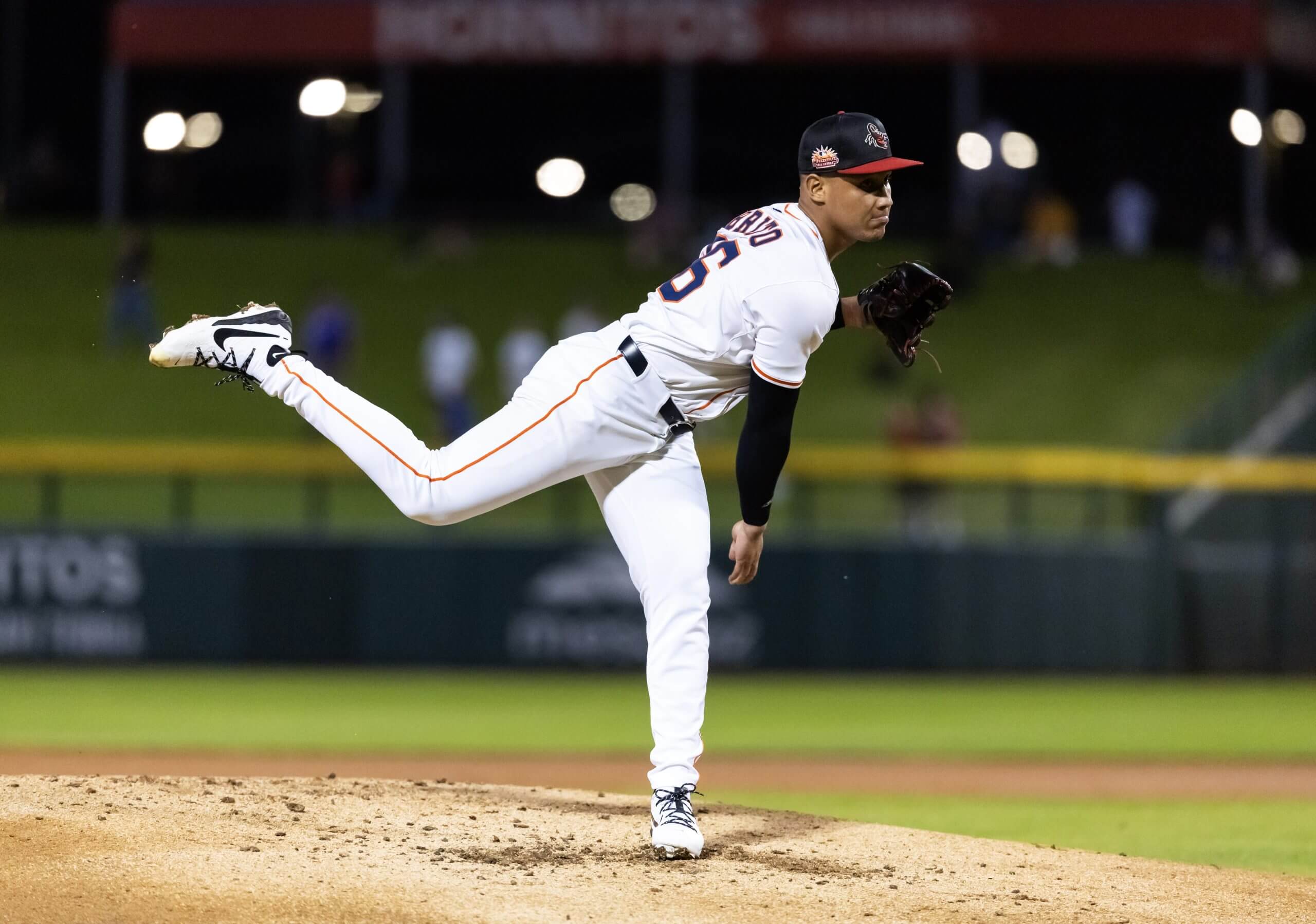
Anderson Brito pitched well in the Arizona Fall League before being traded to Tampa. (Mark J. Rebilas / Imagn Images)
17. Anderson Brito, RHPHeight: 5-10 | Weight: 155 | Bats: R | Throws: R | Age: 21
Brito came over with Melton from Houston in the Brandon Lowe trade, shortly after an impressive showing in the Arizona Fall League, where he was 95-98 with a plus slider/sweeper. He missed last summer with a stress reaction in his throwing shoulder, and he’s 5-10 with a lot of effort in his delivery, so there are real reliever concerns, exacerbated by his high walk rate last year in High A (13.4 percent). He’s 21 and only just reached full-season ball last year, as he signed with the Astros when he was 19 for $10,000, so there could be more growth for him in command and perhaps adding new pitches. I do not expect any more vertical growth, however. Sorry, Anderson.
18. Michael Forret, RHPHeight: 6-3 | Weight: 190 | Bats: L | Throws: R | Age: 22
Player No. 3 in the Shane Baz return, Forret was the lone pitcher. Forret had a breakout season in 2025 by shortening up his arm action and adding about 2 mph to his heater to get to 94-96. It’s a rough delivery where he cuts himself off with some cross-body action, although he compensates a little for the longer look he gives lefties with a 55 changeup. His best breaking pitch is a sweepy slider in the mid-80s, but the changeup actually missed more bats last season. He has had a lot of injury issues, not always to his arm, and between that and the delivery, I’m betting heavily that he’s a reliever, but one who can pitch in high-leverage spots or handle more than a one-inning workload.
19. Aidan Smith, OFHeight: 6-2 | Weight: 190 | Bats: R | Throws: R | Age: 21
Smith came over with Hopkins in the Randy Arozarena trade with Seattle and followed up a strong 2024 season with a disappointing 2025, as he moved up to High A and hit .237/.331/.388 with a 31.1 percent strikeout rate. He started to sell out too much for power last year, swinging more uphill and popping up or fouling off a lot of pitches he should have lined to the left-center field warning track. He’s made himself a good defender in center, maybe a plus one, so if he gets back to the high-OBP doubles guy he was a year ago, he can still end up an above-average regular.
20. Ty Johnson, RHPHeight: 6-6 | Weight: 205 | Bats: R | Throws: R | Age: 24
Johnson was part of the return from the Cubs for Isaac Paredes at the 2024 trade deadline, and he was outstanding in his first full year with the Rays, finishing two off the Double-A Southern League lead in strikeouts because he started the year in a multi-inning relief role. That is his future, as he’s a two-pitch pitcher with a very short arm action and a slider good enough to get righties out in the majors. Given how well he held up over 110 1/3 innings last year, with solid control in that role, he should at least get a chance to be a multi-inning reliever, and the lack of anything for lefties might mean he’s suboptimal for high-leverage spots anyway.
Others of note
Right-hander Gary Gill Hill is a sinkerballer with an excellent feel to pitch, generating a 50 percent ground-ball rate last year, but he doesn’t have any pitch that grades better than a 55, if that, and became homer-prone last year in High A. Tampa’s fourth-round pick out of a high school in upstate* New York, he doesn’t need more velocity but could use something extra or new in the arsenal. (*Defined as “north of the Bronx.”) … Dominic Keegan should get some time as a backup catcher, but the bat speed concerns have turned out to be well-founded, as four-seamers ate him up in Triple A last year … Outfielder Homer Bush Jr., is a 70 runner and a 60 defender in center with a 45 arm. He hit .301/.375/.360 as a 23-year-old in Double A last year, with zero homers in 121 games, which is why I think he is a fourth outfielder … Catcher Taitn Gray is a bat-first guy who flashed huge exit velocities last spring and carried that over to the bridge league after the draft. He’s almost certainly moving out from behind the plate, with right field the best-case scenario … OF Brailer Guerrero has crazy bat speed and can flash high-end power, but he was totally out of shape in the AFL and played like he didn’t want to be there, resulting in 16 strikeouts in 29 PA … Shortstop Adrian Santana is a plus defender who can run and puts the ball in play, but even after adding about 10 pounds, he still doesn’t make hard enough contact to be more than an up-and-down guy. He slugged .326 last year, with his first two professional homers, but his ISOs the last two seasons have been .065 and .063 … Outfielder Austin Overn was the fourth player in the Baz deal, maybe an up-and-down guy who has a poor approach and maybe 45 power, struggling to hit fastballs up. He can handle center enough that he would have value as a fourth outfielder if the bat produced more.
2026 impact
Melton might have the best chance to make the Opening Day roster and have positive value for the team this year. Williams and Morgan have played in Triple A, but Williams needs to produce there first and Morgan is blocked at his best position.
The fallen
Man, I thought Brayden Taylor would hit, but the Rays’ first-round pick in the loaded 2023 draft has looked worse the longer he’s been in pro ball, hitting .173/.289/.286 in Double A last year with a 27.6 percent strikeout rate. Even his defense at third hasn’t been up to pre-draft reports.
Sleeper
I said above that Suarez should be a top 100 guy in a year if he just has a full, healthy season.