
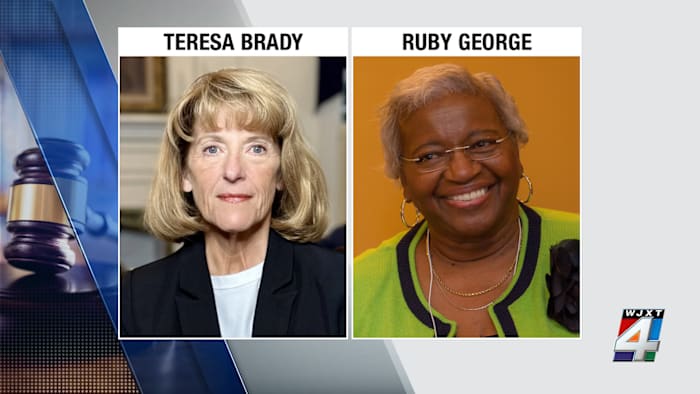
JACKSONVILLE, Fla. – Two former leaders of the Duval County teachers union were sentenced Monday in federal court—after admitting to a fraud scheme prosecutors say drained millions of dollars from teachers over nearly a decade.
Former Duval Teachers United president Teresa “Terrie” Brady, 70, and former DTU vice president Ruby George, 82, pleaded guilty to taking money from the union and then covering it up.
Brady was sentenced to 27 months and three years of supervised release. George will spend 12 months and one month behind bars, followed by three years of supervised release that will include home confinement.
A judge, before sentencing, condemned Brady and George for repeatedly stealing over a decade from the organization they were meant to serve, betraying people who trusted them.
The judge called the crime “just a decision to steal on a regular basis … for 10 years.”
While acknowledging the many letters praising Brady and George’s dedication and good deeds, the judge emphasized that the sentencing had to remain focused on justice and accountability.
Calling her a “corrupt union boss” in court documents, federal prosecutors are asking a judge to sentence Brady to 36 months in prison for the fraud scheme that enabled her to pocket more than $1 million from the union over nearly a decade.
Brady and her attorney declined to comment to News4JAX on Monday afternoon as they arrived for the 1:30 p.m. sentencing hearing in federal court.
Brady and George both presented messages to the judge during the hearing.
Brady said in an emotional plea to the courtroom that this was something she never imagined. She took accountability for her actions and acknowledged the hurt and shame she brought to DTU.
“I failed,“ Brady said through tears. “Because of my actions, I have lost their trust. They do deserve better. I hurt the employees of the union who counted on me to lead the organization. […] I hurt my friends and my family, bringing them into my circle of shame.
George also spoke, giving a strong and emotional delivery.
“I would like to say to this court, I was taught from my earliest memory, that every road has an end somewhere, and I always believed this, I don’t know how I got off track, I don’t know. It boggles my mind, after all of my 80-something years, did I get to this point? How did I get here? I’m in no way trying to justify my actions,” George said.
She asked the court for mercy and compassion.
“I regret my involvement, again, ask for a second chance. Regret I didn’t speak up. I ask that the court take my physical health into consideration,” she pleaded.
In January 2025, prosecutors announced a variety of fraud charges against Brady and George. Investigators believe the scheme succeeded for so long because of how carefully it was hidden.
According to the indictment, Brady and George sold un-earned leave time back to the union, enabling each to pocket more than $1 million. The indictment said the two withheld the activity from the DTU’s auditors by signing each other’s checks, hid the payments from the DTU’s Secretary/Treasurer, and withheld the funds from Florida’s Public Employee Relations Committee (PERC) in required yearly financial statements. Brady was also charged with two counts of money laundering.
DTU represents about 6,500 Duval County school employees, most of whom pay dues straight out of their paychecks. The union brings in about $5 million a year, largely from those dues paid by teachers and school staff across Duval County.
In October, Brady pleaded guilty to four of the charges she faced, including wire fraud, mail fraud, and money laundering.
“I accept full responsibility for my actions and their consequences,” Brady wrote in a statement at the time to News4JAX. “I am truly sorry for my wrongdoing and the harm I caused to Duval Teachers United (DTU) and its members. Understanding the seriousness of my offenses, I accept the outcome with humility and sincere remorse while deeply regretting breaching the trust placed in me by DTU, my community and my family.”
George pleaded guilty in August to three counts: conspiracy to commit wire fraud, aiding and abetting wire fraud, and aiding and abetting mail fraud.
RELATED: Longtime Duval teachers union president retires in wake of FBI, IRS investigation | FBI agents left Duval teachers union office with credit card statements, computers, photos show
In court filings last week, prosecutors and defense attorneys submitted sentencing memorandums ahead of Monday’s scheduled sentencing. The filings are in part based on a calculation based on sentencing guidelines, which suggest a sentence of 33 to 41 months.
In asking for the 36-month sentence for Brady, prosecutors note that it is in the middle of the guidelines range. They wrote that Brady and George broke the trust of the teachers who were a part of the union.
Prosecutors said that through a “decade of deceit and deception,” Brady stole at least $1,328,695 from DTU, through leave time that was sold back, but had not yet been earned. They also noted that Brady is an “individual – not just with influence – but also of means,” adding that she drives a Mercedes, lives in Avondale, and earned more than $150,000 a year as DTU president.
The document notes that after she pleaded guilty, Brady was able to write a check to the government for more than $1.3 million to fulfill her forfeiture obligation.
Brady’s attorney, prominent Jacksonville defense attorney Hank Coxe, also submitted a sentencing memorandum, in which they ask for a sentence of 33 months’ probation, with 18 months of home confinement as a condition of the probation, and a monthly restitution obligation of $1,000.
The memo notes Brady’s upbringing in Jacksonville and her time as a classroom teacher before joining the DTU as a staff consultant in 1989, a role she held until 1999, when she was elected president of the union. It describes her as a classic “workaholic,” and that by 2003, she had accumulated more than 5,000 hours of leave.
In 2010, the union’s auditor noted the financial liability that Brady and George’s large amounts of unused leave time represented for the union, and urged them to either take the vacation days or sell the time back to the union when the union had the funds available, which she began doing.
But the memo notes that, according to an analysis by the government, around 2013, she had used up all of the leave that she had accrued. While she was still legitimately accruing leave at that point – she was still cashing in leave like she used to do, but at this point, some of the leave she was cashing in had not actually been earned.
The defense filing also references letters submitted directly to the court on Brady’s behalf that “show a woman whose life has been marked by care and compassion, and concern for those in pain and distress.”
While the prosecution’s filing called for a specific sentence for Brady, it did not make a similar recommendation for George. Prosecutors wrote that she has substantially assisted the government in the prosecution of the case. In the memo, they write that whether she continues to cooperate and the extent of the cooperation – including the on the day of her sentencing hearing – will be something for prosecutors to consider in sentencing.
Prosecutors submitted a separate motion for that “downward departure” based on her assistance – saying that when interviewed, she provided prosecutors with information that incriminated Brady. A report of the interview was provided to Brady, and prosecutors write that George’s availability as a witness at trial may have contributed to her decision to plead guilty. They write that the reduction in sentence due to the cooperation would reduce the guideline range from 33-41 months, down to 24-30 months, though again, a specific sentencing recommendation was not made in the court filings.
For their part, George’s attorneys ask that the assistance to the government, as well as George’s significant health issues, as outlined in court documents, be reasons for a downward departure from the guidelines. They also point to numerous letters submitted to the court by George’s family and friends, including a former school board member. The defense filing doesn’t ask for a specific sentence but asks for a “reasonable” sentence that balances the need for George to be present with her family so they can help care for her.
Copyright 2026 by WJXT News4JAX – All rights reserved.