
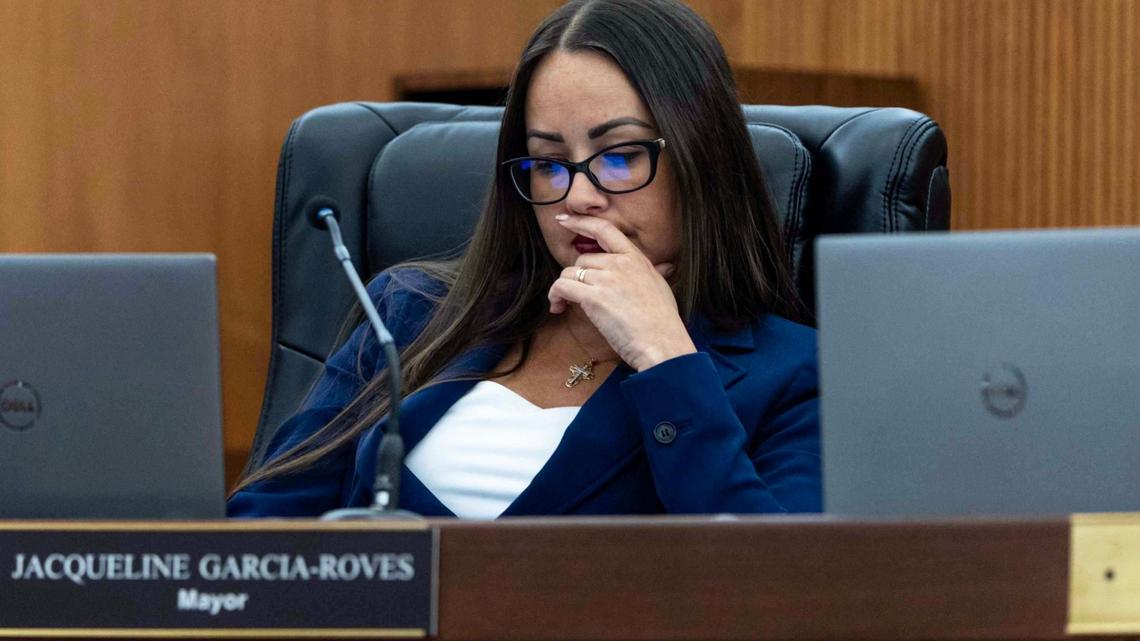
Mayor Jacqueline Garcia-Roves looks on during a city council meeting on Tuesday, May 13, 2025, at city hall in Hialeah, Fla.
D.A. Varela
dvarela@miamiherald.com
Even as interim Hialeah Mayor Jacqueline Garcia-Roves campaigns on a promise to lower residents’ soaring water and sewer bills, Miami-Dade County has filed a lawsuit against the city, claiming it owes nearly $18 million in unpaid utility debt.
“I’m confronting the county right now,” Garcia-Roves said at a press conference on Tuesday. “I am disputing the $18 million they say we owe — which we don’t. It’s a faulty meter that’s been reading our wastewater incorrectly. It’s reading air instead of water, and they’ve been trying to charge us for that. I refuse to pay those $18 million with our taxpayers’ money.”
In a complaint filed July 24 in Miami-Dade circuit court, the county claims Hialeah violated its wholesale wastewater services agreement beginning in fiscal year 2020–21 under then-Mayor Carlos Hernández and continuing through 2022–23 under then-Mayor Esteban “Steve” Bovo.
The county complaint says Hialeah “began a practice of short-paying each bill it received from the county and, instead of catching up at the close of each fiscal year, continued to let the balance accumulate.”
By June 2023, Hialeah’s unpaid balance for wholesale sewer services had reached over $27 million, according to the lawsuit. The city made two back payments of $2.5 million each in July and August 2023, applied to overdue bills from September and October 2020. By July 2024, the unpaid balance had only dropped to $18.1 million. An additional $300,000 payment was made in early 2025, but the county says a significant balance remains for services rendered during what it calls the “disputed period.”
The legal battle underscores long-standing tensions between Hialeah and Miami-Dade over utility infrastructure and cost-sharing. Garcia-Roves, who was appointed interim mayor in April, is now seeking a full term in the November election. Her standoff with the county over water bills—one of the top concerns for Hialeah residents—has quickly become a central issue in her campaign.
‘A disservice to all residents’
Miami-Dade Mayor Daniella Levine Cava told the Miami Herald that Hialeah’s refusal to pay its past-due bills is affecting not just the city’s residents but customers across the county.
“The City of Hialeah has chosen to walk away from its obligations—both in the operation of the jointly owned Reverse Osmosis Water Treatment Plant and in the payment of nearly $18 million owed for wholesale sewer services,” Levine Cava said.
She also rejected a proposal from Hialeah to relinquish its stake in the two governments’ jointly operated water-treatment plant as a substitute for payment. “Doing so would set a dangerous precedent and further burden our residents,” she said.
Levine Cava said the county believes Hialeah’s financial challenges are largely self-inflicted.
“It is our belief that the City faces significant financial constraints of its own making,” she said, urging Hialeah to conduct a full review of its financial practices. “If water and sewer revenues are being diverted to subsidize unrelated municipal operations, that is a disservice to both their residents and ours.”
In March 2022, Bovo told the Herald that Hialeah’s Public Works Department — which operates the city’s water and sewer services — had been used “as a piggy bank,” with funds diverted elsewhere, leading to a lack of maintenance and frequent system leaks that contributed to higher water bills. Last year, the city council unanimously approved setting aside $14.8 million for improvements in the system, including the construction of new pump stations, water main replacements, manhole cover cleaning and restoration, and sewer system repairs.
Esteban “Steve” Bovo, mayor of Hialeah at the time, speaks wich Jacqueline Garcia-Roves, the council president, on Feb. 11, 2025. Pedro Portal pportal@miamiherald.com Garcia-Roves unveils new plan
At last week’s press conference, Garcia-Roves revealed a five-point proposal to reduce Hialeah’s water and sewer costs:
Use taxpayer dollars to cover the 20% rate hike imposed by Miami-Dade — about $16 million annually, a proposal whose fate is uncertain, as the City Council is currently split 3–3 and lacks a seventh member to fill the seat vacated by Garcia-Roves.Refuse to pay the $18 million in debt being pursued by the county.Eliminate the $100 million reverse osmosis plant jointly operated with Miami-Dade, arguing the city “does not need” a water treatment facility. Launch a program to allow residents to install a second water meter on their properties—though it’s unclear who would cover the cost. Hialeah has 58,000 water accounts.Request an independent audit of Miami-Dade’s recent water and sewer rate increases.
The plan, particularly the refusal to pay the $18 million and eliminate the reverse osmosis plant, has drawn sharp criticism from county officials.
“Miami-Dade Water and Sewer Department is an enterprise operation, funded solely by customer payments—not by tax dollars,” Levine Cava said. “When one customer refuses to pay, every other customer across the county unfairly shoulders the cost. The city’s refusal to pay its past due sewer bills is currently hurting other hard-working residents that are keeping up with their bills.”
Hialeah bills among highest in county
The Miami-Dade Water and Sewer Department charges wholesale rates that cover only regional system costs. Each municipality, including Hialeah, sets its own local rates to cover capital needs, operations and maintenance.
Among the 34 municipalities in Miami-Dade County, Hialeah has the fourth highest water and sewer rates—behind only North Miami Beach, Bay Harbor Islands and Medley.
As of October 2024, the average monthly water and sewer bill for a Miami-Dade customer was $63, based on typical household usage of 5,236 gallons. In Hialeah, customers paid an average of $78 for the same usage.
Its residents were also subject to a franchise fee, which critics have labeled a “double tax.” That fee generated approximately $3.7 million for the city’s budget but was suspended in August 2024 under Bovo’s administration, and Garcia-Roves is now proposing its permanent elimination.
“While Miami-Dade has maintained significantly lower customer bills, Hialeah residents are already paying considerably more,” the county said. “If Hialeah’s customers are facing higher bills, the cause lies in the city’s own rate-setting practices.”
During the press conference, Garcia-Roves called for a state audit of the Miami-Dade Water and Sewer Department, citing “rising water costs and the fiscal impact on Hialeah residents.” In response, the department said the city has the explicit contractual right to audit all County records related to the calculation of wholesale rates.

el Nuevo Herald
Verónica Egui Brito ha profundizado en temas sociales apremiantes y de derechos humanos. Cubre noticias dentro de la vibrante ciudad de Hialeah y sus alrededores para el Nuevo Herald y el Miami Herald. Se unió al Herald en 2022. Verónica Egui Brito has delved into pressing social, and human rights issues. She covers news within the vibrant city of Hialeah, and its surrounding areas for el Nuevo Herald, and the Miami Herald. Joined the Herald in 2022.