
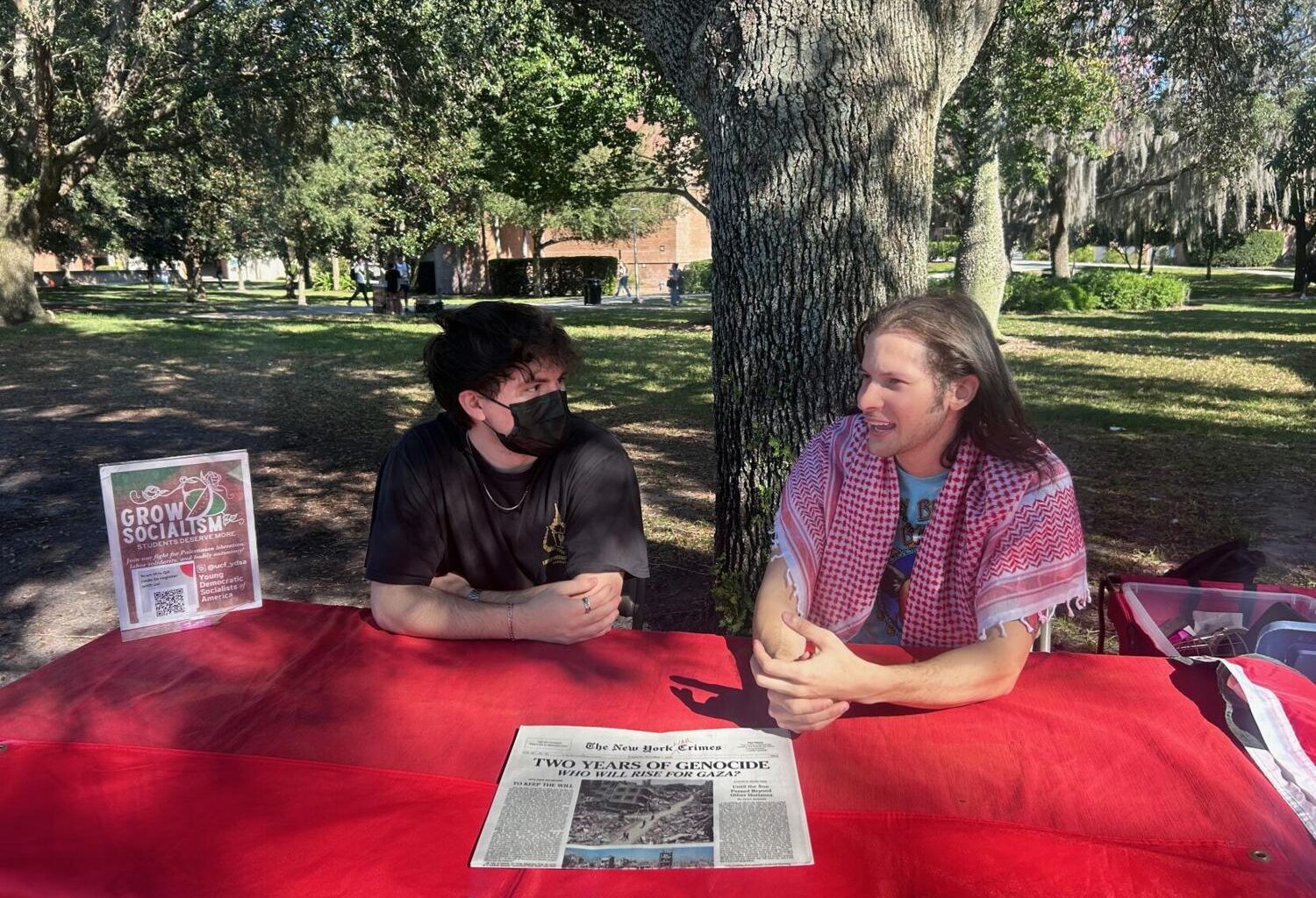

President of Young Democratic Socialists of America at UCF, senior political science major, Eli Lambert, speaks with a YDSA member (right) on the growth of socialism and advocacy for Palestinian liberation on Nov. 20 at the Reflection Pond.
Emmy Bailey
On a campus of more than 69,000 students, conversations about socialism are no longer confined to political science classrooms.
This shift comes months after New York mayoral candidate Zohran Mamdani’s Nov. 4 election win, and just over a month after he was sworn into office.
Mamdani’s campaign, rooted in pillars of democratic socialism, including tenant protections, affordability and aggressive economic reform, was framed by supporters as a turning point for young voters disillusioned with the political and economic systems around them.
At UCF, student-led organizations promoting socialism have grown this academic year, hosting new educational events, organizing rallies and drawing more students into discussions about housing, affordability and economic power.
Dr. Aubrey Jewett, political science professor at UCF, said the reaction to Mamdani’s victory has often been framed as ideological, but the underlying motivations are more practical.
“He was talking about the bread-and-butter economic issues that people care about, and he had a way of connecting with voters,” Jewett said. “For most voters, the ideology or the label is not quite as important as feeling like you have a personal connection with somebody who understands your problems.”
Meanwhile, the numbers show that there is a shift among younger voters in favor of socialism.
A Cato Institute and YouGov survey conducted in 2025 found that 62% of Americans under the age of 30 hold a “favorable view” of socialism, and 34% said the same of communism. However, the poll did not define “socialism.”
Whether young Floridians lean left, right or somewhere in between, the rising engagement signals a generation actively questioning the systems around them.
“We’re in an affordability crisis. People can’t look forward to homeownership like they used to,” Vanessa Christaldi, senior psychology major who serves as vice president of Students for a Democratic Society, said. “They’re struggling to pay rent, they’re struggling to afford food. There’s a real need for something that will address that.”
According to the Heartland–Rasmussen survey, nearly a third of young adults who support democratic socialist policies cite housing costs as their top issue.
At UCF, that urgency is visible everywhere, from rising rent in the surrounding neighborhoods to arguments over campus parking; a smaller fight symbolizing bigger feelings about affordability and fairness.
“UCF could help with parking; there is simply not enough parking available for students. I hear so many stories of students having to miss classes because they can’t find parking,” Marcus Polzer, senior sociology major and representative of the Freedom Road Socialist Organization, said.
“But, also at the very minimum, what UCF can do is to lower the cost of parking for students. We have a lot of things at UCF that could be improved, while our president just got a bump in his salary, so he can clear almost $2 million a year from our school,” he added.
As interest in socialism grows, students say the definition itself has become a point of debate.
“Socialism is when you have a government that is made up of and working for the working class and the masses of people instead of the rich,” Polzer said.
The difference reflects how language changes across generations through media and cultural moments.
“When young people talk about socialism, they’re not thinking about the old Soviet Union,” Jewett said. “They’re thinking about democratic socialism, the northern European model.”
Jewett said this “northern European model” references democracies in countries like Denmark and Finland, where governments fund universal healthcare, affordable education, and worker benefits through higher taxes, while maintaining a capitalist economy.
He also contrasted those systems with authoritarian socialist systems, where the state controls most industries and political freedoms are restricted. Northern European democracies rely on elections, competitive markets, and social programs aimed at reducing inequality.
However, not everyone agrees with the rise of socialism on campus.
Jake Suggs, senior political science major and chair of Young Americans for Freedom, worries the shift in interest in socialism reflects a deeper cultural frustration rather than a workable policy direction.
“I think it stems from the increased difficulty for young people to afford things,” Suggs said. “People on the left and right have this sort of bizarre victim mentality, believing it’s the billionaire corporations that are oppressing them or it’s some sort of deep state.”
Suggs argues the economic evidence speaks for itself.
“The shortest way to lift people out of poverty, evidenced by all of human history, is capitalism,” Suggs said. “What conservatives propose is lower taxes, less government regulation and less government intervention in your pocketbook. I think that has been shown over and over again to be the best way for economic growth and prosperity.”
Suggs agrees that housing is the biggest issue facing young people, but he chalks it up to supply and demand. While he acknowledges the struggles students face, he believes personal responsibility also plays a role.
“I talk to students who say, ‘I’m working three jobs and still can’t afford anything,’ but they’re dressed like a bum and don’t present themselves well,” Suggs said. “Sometimes taking responsibility for how you carry yourself opens more opportunities than you think.”
The state’s response to young voters’ shifting politics and views of socialism is also emerging, particularly in politics and education.
The Heritage Foundation, a prominent conservative nonprofit research foundation, released a new anti-communism curriculum in Florida public schools. Anti-communism rhetoric is used to discredit socialist ideas, equating them with the authoritarian aspects of 20th-century communist regimes
While students at UCF debate what socialism means, many question whether Mamdani’s win represents a broader political shift, which experts say is complicated and deeply rooted in economic reality.
Jewett said that national conservatives have been quick to frame the New York election as an ideological issue and are trying to suggest it is “a sign that the entire Democratic Party across the country is now socialist.”
However, Jewett cautioned against reading the election too narrowly. For young people, those worries are piling up fast, and student debt only intensifies those frustrations.
“If you’re a college graduate, your debt is a huge problem,” Jewett said. “Young people ask, why don’t we have a system where if you have the brainpower and talent to go to college, you shouldn’t be saddled with $40,000 or more in debt just to get your degree.
For UCF students, the debate over socialism isn’t abstract. It’s shaped by rent increases, tuition bills and uncertainty about what comes after graduation.
In response to increased interest in socialism, the Young Democratic Socialists of America at UCF produced a program called “Socialist Night School,” a series of educational meetings aimed at breaking down political theory and modern socialist policy in accessible terms.
The next session, scheduled for Feb. 10, will focus on power and organizing, examining how political movements build influence and the role student organizing plays in the broader political landscape.
Whether students ultimately embrace socialism, reject it or redefine it altogether, the growing engagement on campus suggests increased political attention to the system.